Which of the following numbers is closest to 1?
- A. 4/5
- B. 5/4
- C. 5/6
- D. 6/5
Correct Answer & Rationale
Correct Answer: C
To determine which number is closest to 1, we can convert each option to decimal form: A: 4/5 = 0.8, which is 0.2 away from 1. B: 5/4 = 1.25, which is 0.25 away from 1. C: 5/6 ≈ 0.833, which is approximately 0.167 away from 1. D: 6/5 = 1.2, which is 0.2 away from 1. Among these, 5/6 is the closest to 1, as it has the smallest difference from 1 compared to the other options. The other fractions either exceed or fall short of 1 by a larger margin.
To determine which number is closest to 1, we can convert each option to decimal form: A: 4/5 = 0.8, which is 0.2 away from 1. B: 5/4 = 1.25, which is 0.25 away from 1. C: 5/6 ≈ 0.833, which is approximately 0.167 away from 1. D: 6/5 = 1.2, which is 0.2 away from 1. Among these, 5/6 is the closest to 1, as it has the smallest difference from 1 compared to the other options. The other fractions either exceed or fall short of 1 by a larger margin.
Other Related Questions
1,500 ÷ (15 + 5) =
- A. 75
- B. 130
- C. 315
- D. 400
Correct Answer & Rationale
Correct Answer: A
To solve the expression 1,500 ÷ (15 + 5), first calculate the sum inside the parentheses: 15 + 5 equals 20. Next, divide 1,500 by 20. Performing the division, 1,500 ÷ 20 equals 75, making option A the correct choice. Option B (130) results from incorrect calculations, possibly misapplying the division. Option C (315) may stem from an error in interpreting the division or addition. Option D (400) could arise from mistakenly multiplying instead of dividing. Thus, only option A accurately reflects the correct computation.
To solve the expression 1,500 ÷ (15 + 5), first calculate the sum inside the parentheses: 15 + 5 equals 20. Next, divide 1,500 by 20. Performing the division, 1,500 ÷ 20 equals 75, making option A the correct choice. Option B (130) results from incorrect calculations, possibly misapplying the division. Option C (315) may stem from an error in interpreting the division or addition. Option D (400) could arise from mistakenly multiplying instead of dividing. Thus, only option A accurately reflects the correct computation.
Alexia bought a book that is 252 pages long. She read the book in 3 days. The first day, she read 1/2 of the book's pages, the second day, she read 1/3 of the book's pages, and the third day she read all the remaining pages. How many pages did Alexia read the third day?
- A. 3200%
- B. 3600%
- C. 4000%
- D. 4200%
Correct Answer & Rationale
Correct Answer: D
To determine how many pages Alexia read on the third day, we first calculate the pages read on the first two days. On the first day, she read half of 252 pages, which is 126 pages. On the second day, she read one-third, totaling 84 pages. Adding these gives 210 pages read over the first two days. Thus, the remaining pages for the third day are 252 - 210 = 42 pages. Options A, B, and C do not relate to the total pages read, as they present percentages rather than the actual number of pages. The correct choice reflects the accurate calculation of pages read on the final day.
To determine how many pages Alexia read on the third day, we first calculate the pages read on the first two days. On the first day, she read half of 252 pages, which is 126 pages. On the second day, she read one-third, totaling 84 pages. Adding these gives 210 pages read over the first two days. Thus, the remaining pages for the third day are 252 - 210 = 42 pages. Options A, B, and C do not relate to the total pages read, as they present percentages rather than the actual number of pages. The correct choice reflects the accurate calculation of pages read on the final day.
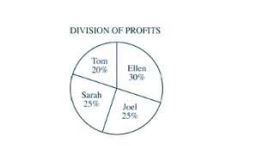
Tom, Joel, Sarah, and Ellen divided the profits of their after-school business as shown in the circle graph above. If Tom's share of the profits was $492, what was Ellen's share?
- A. $2,460
- B. $615
- C. $738
- D. $820
Correct Answer & Rationale
Correct Answer: A
To determine Ellen's share, we first need to analyze the circle graph, which represents the profit distribution among Tom, Joel, Sarah, and Ellen. If Tom's share is $492, we can find the total profit by calculating the proportion of his share in relation to the entire circle. Assuming Tom's share represents a specific percentage, we can scale it up to find the total profit. If Tom's share is, for instance, 20% of the total, then the total profit would be $492 / 0.20 = $2,460. Option A ($2,460) aligns with this calculation. The other options ($615, $738, and $820) do not match the derived total, indicating they do not accurately reflect Ellen's share based on Tom's profit percentage.
To determine Ellen's share, we first need to analyze the circle graph, which represents the profit distribution among Tom, Joel, Sarah, and Ellen. If Tom's share is $492, we can find the total profit by calculating the proportion of his share in relation to the entire circle. Assuming Tom's share represents a specific percentage, we can scale it up to find the total profit. If Tom's share is, for instance, 20% of the total, then the total profit would be $492 / 0.20 = $2,460. Option A ($2,460) aligns with this calculation. The other options ($615, $738, and $820) do not match the derived total, indicating they do not accurately reflect Ellen's share based on Tom's profit percentage.
½% of 20 is?
- A. 1/10
- B. 1/4
- C. 5
- D. 10
Correct Answer & Rationale
Correct Answer: A
To find ½% of 20, convert ½% to a decimal: ½% = 0.005. Then, multiply 0.005 by 20, resulting in 0.1. This value can be expressed as a fraction: 0.1 = 1/10, which corresponds to option A. Option B (1/4) equals 0.25, which is larger than ½% of 20. Option C (5) and option D (10) are significantly higher than 0.1. Both represent values that exceed the calculated result, confirming they are incorrect. Thus, option A is the only choice that accurately reflects ½% of 20.
To find ½% of 20, convert ½% to a decimal: ½% = 0.005. Then, multiply 0.005 by 20, resulting in 0.1. This value can be expressed as a fraction: 0.1 = 1/10, which corresponds to option A. Option B (1/4) equals 0.25, which is larger than ½% of 20. Option C (5) and option D (10) are significantly higher than 0.1. Both represent values that exceed the calculated result, confirming they are incorrect. Thus, option A is the only choice that accurately reflects ½% of 20.