Which of the following teacher strategies will best help students to master word analysis skills?
- A. Asking students to complete isolated, worksheet-based vocabulary drills
- B. Focusing instruction on phonics and comprehension skills independently of one another
- C. Having students use flash cards to memorize large amounts of sight words
- D. Providing opportunities to work with word parts, such as syllables and rimes, in context
Correct Answer & Rationale
Correct Answer: D
Option D effectively supports word analysis skills by allowing students to engage with word parts, such as syllables and rimes, in meaningful contexts. This approach fosters deeper understanding and application of language structures. Option A, while it may reinforce vocabulary, relies on isolated drills that do not promote contextual learning or critical thinking. Option B separates phonics from comprehension, hindering students' ability to connect decoding skills with understanding text. Option C focuses on memorization of sight words, which can limit students' ability to analyze and deconstruct unfamiliar words effectively.
Option D effectively supports word analysis skills by allowing students to engage with word parts, such as syllables and rimes, in meaningful contexts. This approach fosters deeper understanding and application of language structures. Option A, while it may reinforce vocabulary, relies on isolated drills that do not promote contextual learning or critical thinking. Option B separates phonics from comprehension, hindering students' ability to connect decoding skills with understanding text. Option C focuses on memorization of sight words, which can limit students' ability to analyze and deconstruct unfamiliar words effectively.
Other Related Questions
For each row, select ONE column.
- A. In/sect
- B. Pen/cil
- C. Be/gin
- D. Sub/ject
- E. Stu/dent
Correct Answer & Rationale
Correct Answer: Open Syllable: E; Closed Syllable: A,B,C,D
Open syllables end with a vowel that typically has a long sound, while closed syllables end with a consonant, leading to a short vowel sound. Option E (Stu/dent) is an open syllable because "stu" ends in a vowel and has a long sound. Options A (In/sect), B (Pen/cil), C (Be/gin), and D (Sub/ject) are closed syllables. Each ends in a consonant, causing the vowel sound to be short: "in," "pen," "be," and "sub," respectively. Thus, they do not fit the criteria for open syllables.
Open syllables end with a vowel that typically has a long sound, while closed syllables end with a consonant, leading to a short vowel sound. Option E (Stu/dent) is an open syllable because "stu" ends in a vowel and has a long sound. Options A (In/sect), B (Pen/cil), C (Be/gin), and D (Sub/ject) are closed syllables. Each ends in a consonant, causing the vowel sound to be short: "in," "pen," "be," and "sub," respectively. Thus, they do not fit the criteria for open syllables.
Which of the following sentences contains an example of personification?
- A. It is raining cats and dogs.
- B. I can hear the wind whispering to me.
- C. I felt as brave as a lion prowling the jungle.
- D. My friend spent ten years on one math problem.
Correct Answer & Rationale
Correct Answer: B
Personification involves attributing human qualities to non-human entities. Option B, "I can hear the wind whispering to me," exemplifies this by giving the wind the human ability to "whisper," creating a vivid image of its gentle sound. Option A, "It is raining cats and dogs," is an idiomatic expression describing heavy rain, but it does not give human traits to animals or rain. Option C, "I felt as brave as a lion prowling the jungle," uses a simile to compare bravery to a lion, but does not personify the lion itself. Option D, "My friend spent ten years on one math problem," is a straightforward statement about perseverance and does not involve personification.
Personification involves attributing human qualities to non-human entities. Option B, "I can hear the wind whispering to me," exemplifies this by giving the wind the human ability to "whisper," creating a vivid image of its gentle sound. Option A, "It is raining cats and dogs," is an idiomatic expression describing heavy rain, but it does not give human traits to animals or rain. Option C, "I felt as brave as a lion prowling the jungle," uses a simile to compare bravery to a lion, but does not personify the lion itself. Option D, "My friend spent ten years on one math problem," is a straightforward statement about perseverance and does not involve personification.
Which of the following speaker strategies best promotes audience engagement during an oral presentation?
- A. Acknowledging the sources cited at the end of the presentation
- B. Presenting the information using a logical flow of ideas with a clear message
- C. Giving as much information on every part of the topic as possible
- D. Using as many visual items in the presentation as possible
Correct Answer & Rationale
Correct Answer: B
Option B effectively promotes audience engagement by ensuring that the presentation has a logical flow and a clear message, making it easier for the audience to follow and understand the content. This structure helps maintain interest and encourages interaction. Option A, while important for credibility, does not directly engage the audience during the presentation. Option C may overwhelm listeners with excessive information, leading to disengagement rather than fostering interaction. Lastly, option D could distract the audience if visuals are not relevant or well-integrated, detracting from the main message instead of enhancing engagement.
Option B effectively promotes audience engagement by ensuring that the presentation has a logical flow and a clear message, making it easier for the audience to follow and understand the content. This structure helps maintain interest and encourages interaction. Option A, while important for credibility, does not directly engage the audience during the presentation. Option C may overwhelm listeners with excessive information, leading to disengagement rather than fostering interaction. Lastly, option D could distract the audience if visuals are not relevant or well-integrated, detracting from the main message instead of enhancing engagement.
Which of the following concepts is best illustrated by the activity?
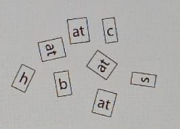
- A. Mastering sight words
- B. Working with syllabication
- C. Creating word families-
- D. Identifying prefixes and suffixes
Correct Answer & Rationale
Correct Answer: C
Creating word families demonstrates how words share a common base or root, allowing students to see relationships between words and enhance their vocabulary. This activity encourages learners to group words with similar structures, fostering an understanding of language patterns. Mastering sight words focuses on recognizing high-frequency words, which does not directly illustrate the concept of word families. Working with syllabication emphasizes breaking words into syllables rather than exploring their relationships. Identifying prefixes and suffixes involves understanding word parts but does not encompass the broader connections found in word families.
Creating word families demonstrates how words share a common base or root, allowing students to see relationships between words and enhance their vocabulary. This activity encourages learners to group words with similar structures, fostering an understanding of language patterns. Mastering sight words focuses on recognizing high-frequency words, which does not directly illustrate the concept of word families. Working with syllabication emphasizes breaking words into syllables rather than exploring their relationships. Identifying prefixes and suffixes involves understanding word parts but does not encompass the broader connections found in word families.