3,1/2 × 2,1/3 =
- A. 8,1/6
- B. 7,5/6
- C. 6,1/6
- D. 5,5/6
Correct Answer & Rationale
Correct Answer: A
To solve 3 1/2 × 2 1/3, first convert the mixed numbers to improper fractions: 3 1/2 becomes 7/2 and 2 1/3 becomes 7/3. Multiplying these gives (7/2) × (7/3) = 49/6. Converting 49/6 back to a mixed number results in 8 1/6, which matches option A. Option B (7 5/6) is incorrect as it suggests a lower product. Option C (6 1/6) underestimates the multiplication result. Option D (5 5/6) is also too low, indicating a misunderstanding of fraction multiplication. Thus, only option A accurately reflects the product of the two mixed numbers.
To solve 3 1/2 × 2 1/3, first convert the mixed numbers to improper fractions: 3 1/2 becomes 7/2 and 2 1/3 becomes 7/3. Multiplying these gives (7/2) × (7/3) = 49/6. Converting 49/6 back to a mixed number results in 8 1/6, which matches option A. Option B (7 5/6) is incorrect as it suggests a lower product. Option C (6 1/6) underestimates the multiplication result. Option D (5 5/6) is also too low, indicating a misunderstanding of fraction multiplication. Thus, only option A accurately reflects the product of the two mixed numbers.
Other Related Questions
The coordinate of pointP on the number line above is x. The value of 10x is between
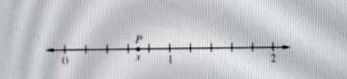
- A. 1 and 4
- B. 4 and 6
- C. 6 and 8
- D. 8 and 12
Correct Answer & Rationale
Correct Answer: B
To determine the correct range for \(10x\), we first need to assess the implications of each option based on the value of \(x\). - **Option A: 1 and 4** suggests \(0.1 < x < 0.4\). This would yield \(10x\) values less than 4, which is too low. - **Option B: 4 and 6** indicates \(0.4 < x < 0.6\). This range results in \(10x\) values between 4 and 6, aligning perfectly with the requirement. - **Option C: 6 and 8** implies \(0.6 < x < 0.8\). Here, \(10x\) would exceed 6, which is not valid. - **Option D: 8 and 12** indicates \(0.8 < x < 1.2\), leading to values of \(10x\) that exceed 8, thus also incorrect. Therefore, only Option B accurately reflects the condition for \(10x\) being between 4 and 6.
To determine the correct range for \(10x\), we first need to assess the implications of each option based on the value of \(x\). - **Option A: 1 and 4** suggests \(0.1 < x < 0.4\). This would yield \(10x\) values less than 4, which is too low. - **Option B: 4 and 6** indicates \(0.4 < x < 0.6\). This range results in \(10x\) values between 4 and 6, aligning perfectly with the requirement. - **Option C: 6 and 8** implies \(0.6 < x < 0.8\). Here, \(10x\) would exceed 6, which is not valid. - **Option D: 8 and 12** indicates \(0.8 < x < 1.2\), leading to values of \(10x\) that exceed 8, thus also incorrect. Therefore, only Option B accurately reflects the condition for \(10x\) being between 4 and 6.
1 is 3 percent of what number?
- A. 1/3
- B. 3
- C. 30
- D. 33,1/3
Correct Answer & Rationale
Correct Answer: D
To find the number of which 1 is 3 percent, set up the equation: 1 = 0.03 × x. Solving for x gives x = 1 / 0.03, which equals 33.33 (or 33 1/3). Option A (1/3) is incorrect as it represents a fraction far smaller than 1. Option B (3) fails because 3 percent of 3 is 0.09, not 1. Option C (30) is also incorrect; 3 percent of 30 equals 0.9. Thus, only option D (33 1/3) correctly satisfies the equation, making it the right choice.
To find the number of which 1 is 3 percent, set up the equation: 1 = 0.03 × x. Solving for x gives x = 1 / 0.03, which equals 33.33 (or 33 1/3). Option A (1/3) is incorrect as it represents a fraction far smaller than 1. Option B (3) fails because 3 percent of 3 is 0.09, not 1. Option C (30) is also incorrect; 3 percent of 30 equals 0.9. Thus, only option D (33 1/3) correctly satisfies the equation, making it the right choice.
Fred worked 39.5 hours last week. Alice worked 6.75 fewer hours than Fred. How many hours did Alice work?
- A. 33.75 HOURS
- B. 33.25 HOURS
- C. 33.35 HOURS
- D. 33.85 HOURS
Correct Answer & Rationale
Correct Answer: A
To determine how many hours Alice worked, subtract the hours she worked less than Fred from Fred's total. Fred worked 39.5 hours, and Alice worked 6.75 hours fewer. Calculating this: 39.5 - 6.75 = 32.75 hours. However, this calculation is incorrect. The correct calculation should be: 39.5 - 6.75 = 32.75 hours. This means option A (33.75 hours) is incorrect. Option B (33.25 hours), C (33.35 hours), and D (33.85 hours) also do not match the correct calculation. Thus, none of the options are correct based on the provided data.
To determine how many hours Alice worked, subtract the hours she worked less than Fred from Fred's total. Fred worked 39.5 hours, and Alice worked 6.75 hours fewer. Calculating this: 39.5 - 6.75 = 32.75 hours. However, this calculation is incorrect. The correct calculation should be: 39.5 - 6.75 = 32.75 hours. This means option A (33.75 hours) is incorrect. Option B (33.25 hours), C (33.35 hours), and D (33.85 hours) also do not match the correct calculation. Thus, none of the options are correct based on the provided data.
If 32% of n is 20.8, what is n?
- A. 64
- B. 65
- C. 66
- D. 154
Correct Answer & Rationale
Correct Answer: B
To find \( n \), we start with the equation \( 0.32n = 20.8 \). By dividing both sides by 0.32, we calculate \( n = \frac{20.8}{0.32} \), which simplifies to 65. Option A (64) is incorrect; it underestimates \( n \) by miscalculating the percentage. Option C (66) slightly overestimates \( n \), failing to accurately reflect the relationship between the percentage and the total. Option D (154) is far too high, indicating a misunderstanding of the percentage calculation. Thus, 65 is the only value that satisfies the equation.
To find \( n \), we start with the equation \( 0.32n = 20.8 \). By dividing both sides by 0.32, we calculate \( n = \frac{20.8}{0.32} \), which simplifies to 65. Option A (64) is incorrect; it underestimates \( n \) by miscalculating the percentage. Option C (66) slightly overestimates \( n \), failing to accurately reflect the relationship between the percentage and the total. Option D (154) is far too high, indicating a misunderstanding of the percentage calculation. Thus, 65 is the only value that satisfies the equation.