At the Crest Coffee Shop, the cost of a plain bagel was $0.75 last year. This year the cost of a plain bagel is $0.90. By what percent did the cost of a plain bagel increase from last year to this year?
- A. 10%
- B. 15%
- C. 17%
- D. 20%
Correct Answer & Rationale
Correct Answer: D
To determine the percent increase in the cost of a plain bagel, the formula used is: \[ \text{Percent Increase} = \left( \frac{\text{New Price} - \text{Old Price}}{\text{Old Price}} \right) \times 100 \] Substituting the given values: \[ \text{Percent Increase} = \left( \frac{0.90 - 0.75}{0.75} \right) \times 100 = \left( \frac{0.15}{0.75} \right) \times 100 = 20\% \] Option A (10%) underestimates the increase, while B (15%) and C (17%) also fail to reflect the correct calculation. Therefore, the accurate calculation confirms a 20% increase in cost.
To determine the percent increase in the cost of a plain bagel, the formula used is: \[ \text{Percent Increase} = \left( \frac{\text{New Price} - \text{Old Price}}{\text{Old Price}} \right) \times 100 \] Substituting the given values: \[ \text{Percent Increase} = \left( \frac{0.90 - 0.75}{0.75} \right) \times 100 = \left( \frac{0.15}{0.75} \right) \times 100 = 20\% \] Option A (10%) underestimates the increase, while B (15%) and C (17%) also fail to reflect the correct calculation. Therefore, the accurate calculation confirms a 20% increase in cost.
Other Related Questions
Which of the following inequalities is correct?
- A. 2/3 < 3/5 < 5/7
- B. 2/3 < 5/7 < 3/5
- C. 3/5 < 2/3 < 5/7
- D. 3/5 < 5/7 < 2/3
Correct Answer & Rationale
Correct Answer: C
To determine the order of the fractions, we can convert them to decimals or find a common denominator. - **Option A (2/3 < 3/5 < 5/7)** is incorrect because 2/3 (approximately 0.67) is greater than 3/5 (0.6), violating the first inequality. - **Option B (2/3 < 5/7 < 3/5)** is also incorrect, as 5/7 (approximately 0.71) is greater than 2/3, making the first inequality false. - **Option D (3/5 < 5/7 < 2/3)** is incorrect because, while 3/5 is less than 5/7, 5/7 is greater than 2/3, contradicting the second inequality. - **Option C (3/5 < 2/3 < 5/7)** is accurate; 3/5 is indeed less than 2/3, and 2/3 is less than 5/7, maintaining the correct order.
To determine the order of the fractions, we can convert them to decimals or find a common denominator. - **Option A (2/3 < 3/5 < 5/7)** is incorrect because 2/3 (approximately 0.67) is greater than 3/5 (0.6), violating the first inequality. - **Option B (2/3 < 5/7 < 3/5)** is also incorrect, as 5/7 (approximately 0.71) is greater than 2/3, making the first inequality false. - **Option D (3/5 < 5/7 < 2/3)** is incorrect because, while 3/5 is less than 5/7, 5/7 is greater than 2/3, contradicting the second inequality. - **Option C (3/5 < 2/3 < 5/7)** is accurate; 3/5 is indeed less than 2/3, and 2/3 is less than 5/7, maintaining the correct order.
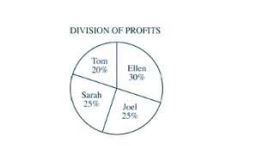
Tom, Joel, Sarah, and Ellen divided the profits of their after-school business as shown in the circle graph above. If Tom's share of the profits was $492, what was Ellen's share?
- A. $2,460
- B. $615
- C. $738
- D. $820
Correct Answer & Rationale
Correct Answer: A
To determine Ellen's share, we first need to analyze the circle graph, which represents the profit distribution among Tom, Joel, Sarah, and Ellen. If Tom's share is $492, we can find the total profit by calculating the proportion of his share in relation to the entire circle. Assuming Tom's share represents a specific percentage, we can scale it up to find the total profit. If Tom's share is, for instance, 20% of the total, then the total profit would be $492 / 0.20 = $2,460. Option A ($2,460) aligns with this calculation. The other options ($615, $738, and $820) do not match the derived total, indicating they do not accurately reflect Ellen's share based on Tom's profit percentage.
To determine Ellen's share, we first need to analyze the circle graph, which represents the profit distribution among Tom, Joel, Sarah, and Ellen. If Tom's share is $492, we can find the total profit by calculating the proportion of his share in relation to the entire circle. Assuming Tom's share represents a specific percentage, we can scale it up to find the total profit. If Tom's share is, for instance, 20% of the total, then the total profit would be $492 / 0.20 = $2,460. Option A ($2,460) aligns with this calculation. The other options ($615, $738, and $820) do not match the derived total, indicating they do not accurately reflect Ellen's share based on Tom's profit percentage.
2/3 (6 + 1/2) =
- A. 4,1/3
- B. 4,1/2
- C. 5,1/2
- D. 6,1/3
Correct Answer & Rationale
Correct Answer: A
To solve \( \frac{2}{3}(6 + \frac{1}{2}) \), start by simplifying the expression inside the parentheses. \( 6 + \frac{1}{2} \) equals \( 6.5 \) or \( \frac{13}{2} \). Next, multiply \( \frac{2}{3} \) by \( \frac{13}{2} \): \[ \frac{2}{3} \times \frac{13}{2} = \frac{2 \times 13}{3 \times 2} = \frac{13}{3} = 4 \frac{1}{3} \] Option A is accurate. Option B (4,1/2) incorrectly adds an extra half. Option C (5,1/2) miscalculates the multiplication and addition. Option D (6,1/3) mistakenly assumes a higher total before multiplication.
To solve \( \frac{2}{3}(6 + \frac{1}{2}) \), start by simplifying the expression inside the parentheses. \( 6 + \frac{1}{2} \) equals \( 6.5 \) or \( \frac{13}{2} \). Next, multiply \( \frac{2}{3} \) by \( \frac{13}{2} \): \[ \frac{2}{3} \times \frac{13}{2} = \frac{2 \times 13}{3 \times 2} = \frac{13}{3} = 4 \frac{1}{3} \] Option A is accurate. Option B (4,1/2) incorrectly adds an extra half. Option C (5,1/2) miscalculates the multiplication and addition. Option D (6,1/3) mistakenly assumes a higher total before multiplication.
Harriet took 48 minutes to ride her bike the distance from her house to the town library. If she rode at a constant rate, what fraction of the total distance did she ride in the first 12 minutes?
- A. 1/4
- B. 1/3
- C. 1/2
- D. 3/4
Correct Answer & Rationale
Correct Answer: A
To determine the fraction of the total distance Harriet rode in the first 12 minutes, we start by recognizing that she took 48 minutes for the entire trip. Riding at a constant rate means that her distance covered is proportional to the time spent riding. In 12 minutes, which is one-fourth of the total 48 minutes, she would have covered one-fourth of the total distance. Thus, the fraction of the total distance she rode in the first 12 minutes is 1/4. Options B (1/3), C (1/2), and D (3/4) misrepresent the proportion of time to total time. Each suggests a greater fraction than what corresponds to 12 minutes relative to 48 minutes, leading to incorrect conclusions about the distance covered.
To determine the fraction of the total distance Harriet rode in the first 12 minutes, we start by recognizing that she took 48 minutes for the entire trip. Riding at a constant rate means that her distance covered is proportional to the time spent riding. In 12 minutes, which is one-fourth of the total 48 minutes, she would have covered one-fourth of the total distance. Thus, the fraction of the total distance she rode in the first 12 minutes is 1/4. Options B (1/3), C (1/2), and D (3/4) misrepresent the proportion of time to total time. Each suggests a greater fraction than what corresponds to 12 minutes relative to 48 minutes, leading to incorrect conclusions about the distance covered.