Decide whether each of the following words is a sight word, a decodable word, both, or neither.
For each row, select ALL that apply. Some rows may be empty.
- A. And
- B. Said
- C. Win
Correct Answer & Rationale
Correct Answer: A: Sight Word/ Decodable Word, B: Sight Word, C: Decodable Word
Option A, "And," is categorized as a sight word and decodable word because it is frequently used in texts and can be phonetically sounded out. Option B, "Said," is a sight word, as it does not follow standard phonetic rules and is commonly recognized in reading, but it is not decodable. Option C, "Win," is a decodable word since it follows phonetic rules, allowing students to sound it out easily. Each option serves a different purpose in literacy development, highlighting the distinction between sight words and decodable words in reading instruction.
Option A, "And," is categorized as a sight word and decodable word because it is frequently used in texts and can be phonetically sounded out. Option B, "Said," is a sight word, as it does not follow standard phonetic rules and is commonly recognized in reading, but it is not decodable. Option C, "Win," is a decodable word since it follows phonetic rules, allowing students to sound it out easily. Each option serves a different purpose in literacy development, highlighting the distinction between sight words and decodable words in reading instruction.
Other Related Questions
Which of the following parts of speech expresses emotion?
- A. A verb
- B. An interjection
- C. An adverb
- D. A pronoun
Correct Answer & Rationale
Correct Answer: B
Interjections are unique parts of speech specifically designed to express emotion or exclamation, such as "wow!" or "ouch!" They stand apart from other categories. Verbs (A) denote actions or states of being, but do not inherently convey emotion. Adverbs (C) modify verbs, adjectives, or other adverbs, providing context like manner or degree, rather than emotional expression. Pronouns (D) replace nouns in sentences and serve a grammatical function without expressing feelings. Thus, interjections are the only option that directly conveys emotion.
Interjections are unique parts of speech specifically designed to express emotion or exclamation, such as "wow!" or "ouch!" They stand apart from other categories. Verbs (A) denote actions or states of being, but do not inherently convey emotion. Adverbs (C) modify verbs, adjectives, or other adverbs, providing context like manner or degree, rather than emotional expression. Pronouns (D) replace nouns in sentences and serve a grammatical function without expressing feelings. Thus, interjections are the only option that directly conveys emotion.
Tier 2 vocabulary words are
- A. basic words that commonly appear in spoken language
- B. high frequency words used across several content areas
- C. common words that generally do not require explicit instruction
- D. low frequency words central to building knowledge within academic topics
Correct Answer & Rationale
Correct Answer: B
Tier 2 vocabulary words are high-frequency terms that are applicable across various content areas, enhancing students' comprehension and expression in multiple subjects. Option A describes Tier 1 words, which are basic and often used in everyday speech. Option C refers to words that are usually familiar to students and don't need direct teaching, aligning more with Tier 1 vocabulary. Option D inaccurately characterizes Tier 3 vocabulary, which consists of low-frequency, specialized terms specific to particular subjects. Thus, only option B accurately captures the essence of Tier 2 vocabulary.
Tier 2 vocabulary words are high-frequency terms that are applicable across various content areas, enhancing students' comprehension and expression in multiple subjects. Option A describes Tier 1 words, which are basic and often used in everyday speech. Option C refers to words that are usually familiar to students and don't need direct teaching, aligning more with Tier 1 vocabulary. Option D inaccurately characterizes Tier 3 vocabulary, which consists of low-frequency, specialized terms specific to particular subjects. Thus, only option B accurately captures the essence of Tier 2 vocabulary.
Which of the following concepts is best illustrated by the activity?
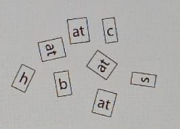
- A. Mastering sight words
- B. Working with syllabication
- C. Creating word families-
- D. Identifying prefixes and suffixes
Correct Answer & Rationale
Correct Answer: C
Creating word families demonstrates how words share a common base or root, allowing students to see relationships between words and enhance their vocabulary. This activity encourages learners to group words with similar structures, fostering an understanding of language patterns. Mastering sight words focuses on recognizing high-frequency words, which does not directly illustrate the concept of word families. Working with syllabication emphasizes breaking words into syllables rather than exploring their relationships. Identifying prefixes and suffixes involves understanding word parts but does not encompass the broader connections found in word families.
Creating word families demonstrates how words share a common base or root, allowing students to see relationships between words and enhance their vocabulary. This activity encourages learners to group words with similar structures, fostering an understanding of language patterns. Mastering sight words focuses on recognizing high-frequency words, which does not directly illustrate the concept of word families. Working with syllabication emphasizes breaking words into syllables rather than exploring their relationships. Identifying prefixes and suffixes involves understanding word parts but does not encompass the broader connections found in word families.
Which of the following best describes the phonological skill the student is practicing?
- A. Blending
- B. Segmenting
- C. Substituting
- D. Deleting
Correct Answer & Rationale
Correct Answer: D
The student is practicing deleting, which involves removing specific sounds from words to create new words. For example, removing the initial sound from "smile" to form "mile." Blending (Option A) refers to combining individual sounds to form a word, such as merging /s/, /m/, /i/, and /l/ into "smile." Segmenting (Option B) is the opposite, where a word is broken down into its individual sounds, like separating "cat" into /k/, /æ/, and /t/. Substituting (Option C) involves replacing one sound with another, such as changing the /s/ in "sat" to /h/ to make "hat." Each of these skills plays a distinct role in phonological awareness, but only deleting accurately describes the student's activity.
The student is practicing deleting, which involves removing specific sounds from words to create new words. For example, removing the initial sound from "smile" to form "mile." Blending (Option A) refers to combining individual sounds to form a word, such as merging /s/, /m/, /i/, and /l/ into "smile." Segmenting (Option B) is the opposite, where a word is broken down into its individual sounds, like separating "cat" into /k/, /æ/, and /t/. Substituting (Option C) involves replacing one sound with another, such as changing the /s/ in "sat" to /h/ to make "hat." Each of these skills plays a distinct role in phonological awareness, but only deleting accurately describes the student's activity.