Liz spent 1/2, 1/3, 1/4, $15 left. Birthday money?
- A. $360
- B. $180
- C. $120
- D. $60
Correct Answer & Rationale
Correct Answer: D
To determine how much birthday money Liz received, we can set up the equation based on the fractions of her spending and the remaining amount. Let \( x \) represent the total birthday money. She spent \( \frac{1}{2}x + \frac{1}{3}x + \frac{1}{4}x + 15 = x \). Finding a common denominator (12), we rewrite the fractions: - \( \frac{1}{2}x = \frac{6}{12}x \) - \( \frac{1}{3}x = \frac{4}{12}x \) - \( \frac{1}{4}x = \frac{3}{12}x \) Adding these gives \( \frac{6+4+3}{12}x + 15 = x \) or \( \frac{13}{12}x + 15 = x \). Rearranging yields \( 15 = x - \frac{13}{12}x \), simplifying to \( 15 = \frac{1}{12}x \). Therefore, \( x = 180 \). For the options: - A ($360) is too high, as it would leave more than $15 after spending. - B ($180) results in no remaining amount after spending. - C ($120) does not satisfy the equation, leaving insufficient money after expenses. - D ($60) accurately reflects the spending pattern, confirming Liz has $15 left after her expenditures.
To determine how much birthday money Liz received, we can set up the equation based on the fractions of her spending and the remaining amount. Let \( x \) represent the total birthday money. She spent \( \frac{1}{2}x + \frac{1}{3}x + \frac{1}{4}x + 15 = x \). Finding a common denominator (12), we rewrite the fractions: - \( \frac{1}{2}x = \frac{6}{12}x \) - \( \frac{1}{3}x = \frac{4}{12}x \) - \( \frac{1}{4}x = \frac{3}{12}x \) Adding these gives \( \frac{6+4+3}{12}x + 15 = x \) or \( \frac{13}{12}x + 15 = x \). Rearranging yields \( 15 = x - \frac{13}{12}x \), simplifying to \( 15 = \frac{1}{12}x \). Therefore, \( x = 180 \). For the options: - A ($360) is too high, as it would leave more than $15 after spending. - B ($180) results in no remaining amount after spending. - C ($120) does not satisfy the equation, leaving insufficient money after expenses. - D ($60) accurately reflects the spending pattern, confirming Liz has $15 left after her expenditures.
Other Related Questions
Shaded region shows?
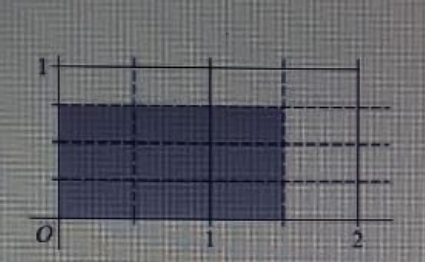
- A. 3/4 x 1/2
- B. 3/4 x 3/4
- C. 3/4 x 3/2
- D. 3/4 x 3
Correct Answer & Rationale
Correct Answer: A
The shaded region represents the area of a rectangle formed by multiplying two fractions. Option A, \( \frac{3}{4} \times \frac{1}{2} \), correctly calculates the area of a rectangle with a length of \( \frac{3}{4} \) and a width of \( \frac{1}{2} \), resulting in \( \frac{3}{8} \). Option B, \( \frac{3}{4} \times \frac{3}{4} \), represents a larger area, \( \frac{9}{16} \), which does not match the shaded region. Option C, \( \frac{3}{4} \times \frac{3}{2} \), yields \( \frac{9}{8} \), exceeding the shaded area. Finally, option D, \( \frac{3}{4} \times 3 \), results in \( \frac{9}{4} \), also too large. Thus, only option A accurately reflects the area of the shaded region.
The shaded region represents the area of a rectangle formed by multiplying two fractions. Option A, \( \frac{3}{4} \times \frac{1}{2} \), correctly calculates the area of a rectangle with a length of \( \frac{3}{4} \) and a width of \( \frac{1}{2} \), resulting in \( \frac{3}{8} \). Option B, \( \frac{3}{4} \times \frac{3}{4} \), represents a larger area, \( \frac{9}{16} \), which does not match the shaded region. Option C, \( \frac{3}{4} \times \frac{3}{2} \), yields \( \frac{9}{8} \), exceeding the shaded area. Finally, option D, \( \frac{3}{4} \times 3 \), results in \( \frac{9}{4} \), also too large. Thus, only option A accurately reflects the area of the shaded region.
Algebraic expressions? Select ALL.
- A. 2*(x+3)+4
- B. 4=x^2
- C. x=3y+7
- D. 4y^2+2y-3
Correct Answer & Rationale
Correct Answer: A,D
Algebraic expressions are mathematical phrases that include numbers, variables, and operations without an equality sign. Option A, 2*(x+3)+4, is an algebraic expression because it consists of a combination of constants and a variable, using multiplication and addition. Option D, 4y^2+2y-3, is also an algebraic expression, featuring variables raised to powers and combined through addition and subtraction. Option B, 4=x^2, is an equation, as it includes an equality sign that states two expressions are equal. Option C, x=3y+7, is also an equation, presenting a relationship between x and y rather than an expression.
Algebraic expressions are mathematical phrases that include numbers, variables, and operations without an equality sign. Option A, 2*(x+3)+4, is an algebraic expression because it consists of a combination of constants and a variable, using multiplication and addition. Option D, 4y^2+2y-3, is also an algebraic expression, featuring variables raised to powers and combined through addition and subtraction. Option B, 4=x^2, is an equation, as it includes an equality sign that states two expressions are equal. Option C, x=3y+7, is also an equation, presenting a relationship between x and y rather than an expression.
Point (-3,-6) quadrant?
- A. I
- B. II
- C. III
- D. IV
Correct Answer & Rationale
Correct Answer: C
The point (-3, -6) is located in the Cartesian coordinate system where the x-coordinate is negative and the y-coordinate is also negative. This combination places the point in Quadrant III, where both x and y values are less than zero. Option A (I) is incorrect as Quadrant I contains positive x and y values. Option B (II) is wrong because Quadrant II has a negative x value and a positive y value. Option D (IV) is not applicable since Quadrant IV features a positive x value and a negative y value. Thus, the only quadrant that matches the coordinates (-3, -6) is Quadrant III.
The point (-3, -6) is located in the Cartesian coordinate system where the x-coordinate is negative and the y-coordinate is also negative. This combination places the point in Quadrant III, where both x and y values are less than zero. Option A (I) is incorrect as Quadrant I contains positive x and y values. Option B (II) is wrong because Quadrant II has a negative x value and a positive y value. Option D (IV) is not applicable since Quadrant IV features a positive x value and a negative y value. Thus, the only quadrant that matches the coordinates (-3, -6) is Quadrant III.
3(2x+5)+4x+7?
- A. 6x+12
- B. 10x+22
- C. 10x+12
- D. 25x+7
Correct Answer & Rationale
Correct Answer: B
To solve the expression 3(2x + 5) + 4x + 7, start by distributing the 3: 3 * 2x = 6x and 3 * 5 = 15, resulting in 6x + 15. Next, combine this with the other terms: 6x + 15 + 4x + 7. Combining like terms gives: (6x + 4x) + (15 + 7) = 10x + 22. Option A (6x + 12) incorrectly simplifies the expression. Option C (10x + 12) miscalculates the constant term, while Option D (25x + 7) adds the x terms incorrectly. Thus, option B accurately represents the simplified expression.
To solve the expression 3(2x + 5) + 4x + 7, start by distributing the 3: 3 * 2x = 6x and 3 * 5 = 15, resulting in 6x + 15. Next, combine this with the other terms: 6x + 15 + 4x + 7. Combining like terms gives: (6x + 4x) + (15 + 7) = 10x + 22. Option A (6x + 12) incorrectly simplifies the expression. Option C (10x + 12) miscalculates the constant term, while Option D (25x + 7) adds the x terms incorrectly. Thus, option B accurately represents the simplified expression.