Marisol has 5 times as many books as Jerry. Jerry has 15 books. How many books does Marisol have?
- A. 10
- B. 20
- C. 75
- D. 225
Correct Answer & Rationale
Correct Answer: C
To determine how many books Marisol has, start by recognizing that she has 5 times the number of books Jerry has. Since Jerry has 15 books, you multiply 15 by 5: 15 × 5 = 75. Thus, Marisol has 75 books. Option A (10) is incorrect as it suggests Marisol has fewer books than Jerry. Option B (20) also underestimates her total, as it does not account for the multiplication factor of 5. Option D (225) overestimates the total by incorrectly multiplying the number of Jerry's books. Only option C accurately reflects the calculation based on the relationship between Marisol's and Jerry's books.
To determine how many books Marisol has, start by recognizing that she has 5 times the number of books Jerry has. Since Jerry has 15 books, you multiply 15 by 5: 15 × 5 = 75. Thus, Marisol has 75 books. Option A (10) is incorrect as it suggests Marisol has fewer books than Jerry. Option B (20) also underestimates her total, as it does not account for the multiplication factor of 5. Option D (225) overestimates the total by incorrectly multiplying the number of Jerry's books. Only option C accurately reflects the calculation based on the relationship between Marisol's and Jerry's books.
Other Related Questions
76 ÷ 0.01 =
- A. 0.76
- B. 7.6
- C. 760
- D. 7,600
Correct Answer & Rationale
Correct Answer: D
To solve 76 ÷ 0.01, it is helpful to recognize that dividing by a decimal is equivalent to multiplying by its reciprocal. The reciprocal of 0.01 is 100, so this operation can be rewritten as 76 × 100, which equals 7,600. Option A (0.76) incorrectly suggests a much smaller result, as it misinterprets the division. Option B (7.6) also underestimates the value, failing to account for the decimal's effect. Option C (760) is closer but still incorrect, as it does not fully account for the multiplication by 100. Therefore, D (7,600) accurately reflects the operation's outcome.
To solve 76 ÷ 0.01, it is helpful to recognize that dividing by a decimal is equivalent to multiplying by its reciprocal. The reciprocal of 0.01 is 100, so this operation can be rewritten as 76 × 100, which equals 7,600. Option A (0.76) incorrectly suggests a much smaller result, as it misinterprets the division. Option B (7.6) also underestimates the value, failing to account for the decimal's effect. Option C (760) is closer but still incorrect, as it does not fully account for the multiplication by 100. Therefore, D (7,600) accurately reflects the operation's outcome.
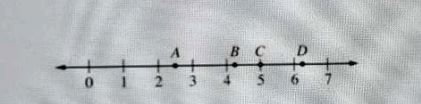
Which of the labeled points on the number line above has coordinate closest to
- A. A
- B. B
- C. C
- D. D
Correct Answer & Rationale
Correct Answer: D
Point D is closest to zero on the number line, making its coordinate the nearest to the origin. Points A, B, and C are further away from zero, with A being negative and C being a larger positive number. Point B, while positive, is also farther from zero than D. Thus, D represents the coordinate that is numerically closest to zero, confirming its position as the nearest point on the number line. Understanding the proximity of these points to zero is essential for accurately determining their coordinates.
Point D is closest to zero on the number line, making its coordinate the nearest to the origin. Points A, B, and C are further away from zero, with A being negative and C being a larger positive number. Point B, while positive, is also farther from zero than D. Thus, D represents the coordinate that is numerically closest to zero, confirming its position as the nearest point on the number line. Understanding the proximity of these points to zero is essential for accurately determining their coordinates.
A book is on sale for 25% off. If the original price of the book was D dollars, what is the sale price, in dollars, in terms of D?
- A. D - 25
- B. 7.5D
- C. 0.75D
- D. 0.25D
Correct Answer & Rationale
Correct Answer: C
To find the sale price of a book that is 25% off, we first calculate the discount amount, which is 25% of the original price D. This can be expressed as 0.25D. The sale price is then the original price minus the discount, or D - 0.25D, which simplifies to 0.75D. Option A (D - 25) incorrectly subtracts a fixed dollar amount rather than a percentage, making it irrelevant to the problem. Option B (7.5D) mistakenly applies the percentage in a way that inflates the price instead of reducing it. Option D (0.25D) represents only the discount amount, not the sale price. Thus, 0.75D accurately reflects the sale price after applying the discount.
To find the sale price of a book that is 25% off, we first calculate the discount amount, which is 25% of the original price D. This can be expressed as 0.25D. The sale price is then the original price minus the discount, or D - 0.25D, which simplifies to 0.75D. Option A (D - 25) incorrectly subtracts a fixed dollar amount rather than a percentage, making it irrelevant to the problem. Option B (7.5D) mistakenly applies the percentage in a way that inflates the price instead of reducing it. Option D (0.25D) represents only the discount amount, not the sale price. Thus, 0.75D accurately reflects the sale price after applying the discount.
Which of the following is equivalent to 1.04?
- A. 52/51
- B. 51/50
- C. 27/25
- D. 26/25
Correct Answer & Rationale
Correct Answer: D
To determine the equivalence to 1.04, we can convert each fraction to a decimal. Option A, 52/51, equals approximately 1.0196, which is less than 1.04. Option B, 51/50, equals 1.02, also less than 1.04. Option C, 27/25, equals 1.08, exceeding 1.04. Option D, 26/25, simplifies to 1.04, matching the target value exactly. Thus, only option D accurately represents 1.04, while the others deviate from this value.
To determine the equivalence to 1.04, we can convert each fraction to a decimal. Option A, 52/51, equals approximately 1.0196, which is less than 1.04. Option B, 51/50, equals 1.02, also less than 1.04. Option C, 27/25, equals 1.08, exceeding 1.04. Option D, 26/25, simplifies to 1.04, matching the target value exactly. Thus, only option D accurately represents 1.04, while the others deviate from this value.