Of the following, which is closest to (2,12/15 - 1/10) ÷ 16/6 ?
- B. 1
- C. 2
- D. 3
Correct Answer & Rationale
Correct Answer: B
To solve (2, 12/15 - 1/10) ÷ (16/6), first, convert the mixed number 2, 12/15 to an improper fraction: 2 = 30/15, so 2, 12/15 = 30/15 + 12/15 = 42/15. Next, simplify 12/15 - 1/10. Finding a common denominator (30), we have 24/30 - 3/30 = 21/30, which simplifies to 7/10. Thus, we compute (42/15 - 7/10) = (28/10 - 21/30) = (84/30 - 21/30) = 63/30 = 21/10. Dividing by (16/6) equals (21/10) ÷ (8/3) = (21/10) × (3/8) = 63/80, which is closest to 1. Options C and D (2 and 3) are incorrect as they overshoot the calculated value, while option B (1) accurately reflects the result of the division.
To solve (2, 12/15 - 1/10) ÷ (16/6), first, convert the mixed number 2, 12/15 to an improper fraction: 2 = 30/15, so 2, 12/15 = 30/15 + 12/15 = 42/15. Next, simplify 12/15 - 1/10. Finding a common denominator (30), we have 24/30 - 3/30 = 21/30, which simplifies to 7/10. Thus, we compute (42/15 - 7/10) = (28/10 - 21/30) = (84/30 - 21/30) = 63/30 = 21/10. Dividing by (16/6) equals (21/10) ÷ (8/3) = (21/10) × (3/8) = 63/80, which is closest to 1. Options C and D (2 and 3) are incorrect as they overshoot the calculated value, while option B (1) accurately reflects the result of the division.
Other Related Questions
1,500 ÷ (15 + 5) =
- A. 75
- B. 130
- C. 315
- D. 400
Correct Answer & Rationale
Correct Answer: A
To solve the expression 1,500 ÷ (15 + 5), first calculate the sum inside the parentheses: 15 + 5 equals 20. Next, divide 1,500 by 20. Performing the division, 1,500 ÷ 20 equals 75, making option A the correct choice. Option B (130) results from incorrect calculations, possibly misapplying the division. Option C (315) may stem from an error in interpreting the division or addition. Option D (400) could arise from mistakenly multiplying instead of dividing. Thus, only option A accurately reflects the correct computation.
To solve the expression 1,500 ÷ (15 + 5), first calculate the sum inside the parentheses: 15 + 5 equals 20. Next, divide 1,500 by 20. Performing the division, 1,500 ÷ 20 equals 75, making option A the correct choice. Option B (130) results from incorrect calculations, possibly misapplying the division. Option C (315) may stem from an error in interpreting the division or addition. Option D (400) could arise from mistakenly multiplying instead of dividing. Thus, only option A accurately reflects the correct computation.
50.50 ÷ 0.25
- A. 202
- B. 2.2
- C. 2.02
- D. 0.22
Correct Answer & Rationale
Correct Answer: A
To solve 50.50 ÷ 0.25, converting the division into a simpler form is helpful. Dividing both numbers by 0.25 effectively transforms the problem into 50.50 ÷ 0.25 = 50.50 × 4, which equals 202. Option B (2.2) is incorrect as it misrepresents the scale of the division, resulting from a misunderstanding of decimal placement. Option C (2.02) also miscalculates the division, likely stemming from incorrect multiplication or division steps. Option D (0.22) is far too low, indicating a significant error in understanding the relationship between the dividend and divisor.
To solve 50.50 ÷ 0.25, converting the division into a simpler form is helpful. Dividing both numbers by 0.25 effectively transforms the problem into 50.50 ÷ 0.25 = 50.50 × 4, which equals 202. Option B (2.2) is incorrect as it misrepresents the scale of the division, resulting from a misunderstanding of decimal placement. Option C (2.02) also miscalculates the division, likely stemming from incorrect multiplication or division steps. Option D (0.22) is far too low, indicating a significant error in understanding the relationship between the dividend and divisor.
Multiplying a certain nonzero number by 0.01 gives the same result as dividing the number by
- A. 100
- B. 10
- C. 1/10
- D. 1/100
Correct Answer & Rationale
Correct Answer: A
When a nonzero number is multiplied by 0.01, it is equivalent to dividing that number by 100. This is because multiplying by 0.01 (or 1/100) reduces the value of the number to one-hundredth of its original amount. Option B (10) is incorrect as dividing by 10 would yield a larger result than multiplying by 0.01. Option C (1/10) is also wrong because dividing by 1/10 actually increases the number, contrary to the operation of multiplying by 0.01. Option D (1/100) might seem close, but it represents the multiplication factor rather than the division needed. Thus, dividing by 100 accurately reflects the operation of multiplying by 0.01.
When a nonzero number is multiplied by 0.01, it is equivalent to dividing that number by 100. This is because multiplying by 0.01 (or 1/100) reduces the value of the number to one-hundredth of its original amount. Option B (10) is incorrect as dividing by 10 would yield a larger result than multiplying by 0.01. Option C (1/10) is also wrong because dividing by 1/10 actually increases the number, contrary to the operation of multiplying by 0.01. Option D (1/100) might seem close, but it represents the multiplication factor rather than the division needed. Thus, dividing by 100 accurately reflects the operation of multiplying by 0.01.
Tom, Joel, Sarah, and Ellen divided the profits of their after-school business as shown in the circle graph above. If Tom's share of the profits was $492, what was Ellen's share?
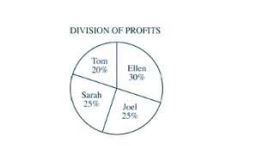
- A. $2,460
- B. $615
- C. $738
- D. $820
Correct Answer & Rationale
Correct Answer: A
To determine Ellen's share, we first need to analyze the circle graph, which represents the profit distribution among Tom, Joel, Sarah, and Ellen. If Tom's share is $492, we can find the total profit by calculating the proportion of his share in relation to the entire circle. Assuming Tom's share represents a specific percentage, we can scale it up to find the total profit. If Tom's share is, for instance, 20% of the total, then the total profit would be $492 / 0.20 = $2,460. Option A ($2,460) aligns with this calculation. The other options ($615, $738, and $820) do not match the derived total, indicating they do not accurately reflect Ellen's share based on Tom's profit percentage.
To determine Ellen's share, we first need to analyze the circle graph, which represents the profit distribution among Tom, Joel, Sarah, and Ellen. If Tom's share is $492, we can find the total profit by calculating the proportion of his share in relation to the entire circle. Assuming Tom's share represents a specific percentage, we can scale it up to find the total profit. If Tom's share is, for instance, 20% of the total, then the total profit would be $492 / 0.20 = $2,460. Option A ($2,460) aligns with this calculation. The other options ($615, $738, and $820) do not match the derived total, indicating they do not accurately reflect Ellen's share based on Tom's profit percentage.