Quickly multiply 24x16?
- A. 20x20-4x4
- B. 20x20
- C. 20x10+4x6
- D. 25x10+4x15
Correct Answer & Rationale
Correct Answer: A
Option A, 20x20 - 4x4, effectively utilizes the difference of squares method. It simplifies the multiplication by recognizing that 24 can be expressed as 20 + 4 and 16 as 20 - 4, leading to a calculation of (20+4)(20-4). Option B, 20x20, underestimates the value of 24 and 16, yielding only 400 instead of the correct 384. Option C, 20x10 + 4x6, inaccurately breaks down the multiplication, leading to 200 + 24, which totals 224. Option D, 25x10 + 4x15, misrepresents the factors, resulting in 250 + 60, totaling 310. Thus, option A is the most accurate approach for this multiplication.
Option A, 20x20 - 4x4, effectively utilizes the difference of squares method. It simplifies the multiplication by recognizing that 24 can be expressed as 20 + 4 and 16 as 20 - 4, leading to a calculation of (20+4)(20-4). Option B, 20x20, underestimates the value of 24 and 16, yielding only 400 instead of the correct 384. Option C, 20x10 + 4x6, inaccurately breaks down the multiplication, leading to 200 + 24, which totals 224. Option D, 25x10 + 4x15, misrepresents the factors, resulting in 250 + 60, totaling 310. Thus, option A is the most accurate approach for this multiplication.
Other Related Questions
1.085/12 value?
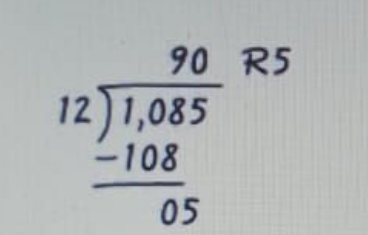
- A. 90
- B. 90 * 5/1.085
- C. 90 * 5/12
- D. 90.5
Correct Answer & Rationale
Correct Answer: C
To find the value of 1.085/12, we need to simplify the expression. Option C, 90 * 5/12, correctly represents a simplified fraction of 90 divided by 12, multiplied by 5. This yields a value consistent with the original division. Option A (90) is incorrect as it does not involve the division by 12. Option B (90 * 5/1.085) incorrectly uses 1.085 as a divisor instead of 12, leading to an inaccurate calculation. Option D (90.5) is also incorrect as it does not relate to the division of 1.085 by 12, resulting in a value that does not reflect the operation required.
To find the value of 1.085/12, we need to simplify the expression. Option C, 90 * 5/12, correctly represents a simplified fraction of 90 divided by 12, multiplied by 5. This yields a value consistent with the original division. Option A (90) is incorrect as it does not involve the division by 12. Option B (90 * 5/1.085) incorrectly uses 1.085 as a divisor instead of 12, leading to an inaccurate calculation. Option D (90.5) is also incorrect as it does not relate to the division of 1.085 by 12, resulting in a value that does not reflect the operation required.
P=2(L+W), P=48, W=L-4. Width?
- A. 10
- B. 12
- C. 20
- D. 24
Correct Answer & Rationale
Correct Answer: A
To find the width (W), start with the given perimeter formula \( P = 2(L + W) \). Substituting \( P = 48 \) gives \( 48 = 2(L + W) \), which simplifies to \( L + W = 24 \). Given \( W = L - 4 \), substitute this into the equation: \( L + (L - 4) = 24 \). This simplifies to \( 2L - 4 = 24 \), leading to \( 2L = 28 \) and \( L = 14 \). Thus, \( W = 14 - 4 = 10 \). Option B (12) does not satisfy the perimeter equation. Option C (20) and Option D (24) also do not fit the derived equations, confirming that W must be 10.
To find the width (W), start with the given perimeter formula \( P = 2(L + W) \). Substituting \( P = 48 \) gives \( 48 = 2(L + W) \), which simplifies to \( L + W = 24 \). Given \( W = L - 4 \), substitute this into the equation: \( L + (L - 4) = 24 \). This simplifies to \( 2L - 4 = 24 \), leading to \( 2L = 28 \) and \( L = 14 \). Thus, \( W = 14 - 4 = 10 \). Option B (12) does not satisfy the perimeter equation. Option C (20) and Option D (24) also do not fit the derived equations, confirming that W must be 10.
Equivalent to 2(4f+2g)? Select ALL.
- A. 4*(2f+g)
- B. 4(2f+2g)
- C. 2f(4+2g)
- D. 16f+4g
- E. 8f+2g
Correct Answer & Rationale
Correct Answer: A,F
To determine which expressions are equivalent to \( 2(4f + 2g) \), we first simplify it: \[ 2(4f + 2g) = 8f + 4g \] Now, let's analyze each option: **A: \( 4(2f + g) \)** This expands to \( 8f + 4g \), matching our simplified expression. **B: \( 4(2f + 2g) \)** This simplifies to \( 8f + 8g \), which does not match \( 8f + 4g \). **C: \( 2f(4 + 2g) \)** This expands to \( 8f + 4fg \), introducing an extra term \( 4fg \) that makes it unequal. **D: \( 16f + 4g \)** This expression has \( 16f \), which is double the \( 8f \) we expect, thus it is not equivalent. **E: \( 8f + 2g \)** Here, while \( 8f \) matches, \( 2g \) does not equal \( 4g \), making it non-equivalent. **F: \( 8f + 4g \)** This matches our simplified expression exactly, confirming its equivalence. In summary, options A and F correctly represent the original expression, while B, C, D, and E do not.
To determine which expressions are equivalent to \( 2(4f + 2g) \), we first simplify it: \[ 2(4f + 2g) = 8f + 4g \] Now, let's analyze each option: **A: \( 4(2f + g) \)** This expands to \( 8f + 4g \), matching our simplified expression. **B: \( 4(2f + 2g) \)** This simplifies to \( 8f + 8g \), which does not match \( 8f + 4g \). **C: \( 2f(4 + 2g) \)** This expands to \( 8f + 4fg \), introducing an extra term \( 4fg \) that makes it unequal. **D: \( 16f + 4g \)** This expression has \( 16f \), which is double the \( 8f \) we expect, thus it is not equivalent. **E: \( 8f + 2g \)** Here, while \( 8f \) matches, \( 2g \) does not equal \( 4g \), making it non-equivalent. **F: \( 8f + 4g \)** This matches our simplified expression exactly, confirming its equivalence. In summary, options A and F correctly represent the original expression, while B, C, D, and E do not.
Cost of 3 cans of peaches is $2.67. Cost of 8 cans?
- A. $5.34
- B. $7.12
- C. $8.01
- D. $21.36
Correct Answer & Rationale
Correct Answer: B
To determine the cost of 8 cans of peaches, first calculate the cost per can. The cost of 3 cans is $2.67, so the cost per can is $2.67 ÷ 3 = $0.89. To find the cost of 8 cans, multiply the cost per can by 8: $0.89 × 8 = $7.12. Option A ($5.34) incorrectly assumes a lower total based on miscalculated per can pricing. Option C ($8.01) slightly overestimates the total, likely from rounding errors. Option D ($21.36) suggests a misunderstanding of basic multiplication, as it implies a much higher price than calculated. Thus, $7.12 accurately reflects the cost for 8 cans.
To determine the cost of 8 cans of peaches, first calculate the cost per can. The cost of 3 cans is $2.67, so the cost per can is $2.67 ÷ 3 = $0.89. To find the cost of 8 cans, multiply the cost per can by 8: $0.89 × 8 = $7.12. Option A ($5.34) incorrectly assumes a lower total based on miscalculated per can pricing. Option C ($8.01) slightly overestimates the total, likely from rounding errors. Option D ($21.36) suggests a misunderstanding of basic multiplication, as it implies a much higher price than calculated. Thus, $7.12 accurately reflects the cost for 8 cans.