Which conclusion can be drawn from the diagrams?
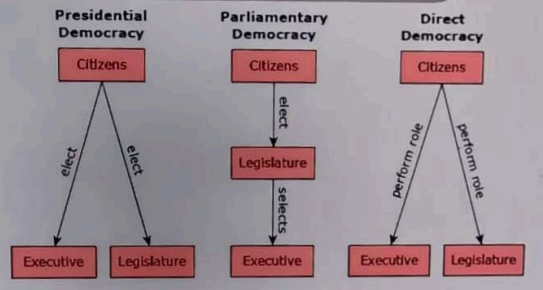
- A. The legislature is more representative of the people in a presidential democracy than in a parliamentary democracy.
- B. The branches of government are more independent of each other in a presidential democracy than in a parliamentary democracy.
- C. The executive branch is more accountable to the people in a parliamentary democracy than in a direct democracy.
- D. The people are more involved in governing in a presidential democracy than in a direct democracy.
Correct Answer & Rationale
Correct Answer: B
In a presidential democracy, the separation of powers is a key feature, allowing the executive, legislative, and judicial branches to operate independently. This independence enhances checks and balances, ensuring that no single branch can dominate. Option A is incorrect as both systems aim for representation, but the degree can vary based on specific contexts rather than the type of democracy. Option C misrepresents accountability; in parliamentary systems, the executive is directly accountable to the legislature, which is elected by the people. Option D is misleading; in a direct democracy, citizens have direct involvement in governance, often more so than in a presidential system.
In a presidential democracy, the separation of powers is a key feature, allowing the executive, legislative, and judicial branches to operate independently. This independence enhances checks and balances, ensuring that no single branch can dominate. Option A is incorrect as both systems aim for representation, but the degree can vary based on specific contexts rather than the type of democracy. Option C misrepresents accountability; in parliamentary systems, the executive is directly accountable to the legislature, which is elected by the people. Option D is misleading; in a direct democracy, citizens have direct involvement in governance, often more so than in a presidential system.
Other Related Questions
Which statement best explains the situation described in the paragraphs?
- A. Crude oil prices in 2014 encouraged U.S. families to buy less gasoline in 2015.
- B. Crude oil production levels have caused U.S. gasoline prices to fall.
- C. Greater crude oil reserves have caused the U.S. government to reduce gasoline prices.
- D. Lower crude oil production will cause U.S. gasoline prices to return to 2014 levels by 2016.
Correct Answer & Rationale
Correct Answer: B
Option B accurately reflects the relationship between crude oil production levels and gasoline prices. Increased production typically leads to lower prices, as supply outstrips demand. Option A incorrectly suggests a direct correlation between crude oil prices in 2014 and gasoline purchases in 2015, neglecting the influence of production levels. Option C misrepresents the role of reserves; while greater reserves can impact prices, it is production levels that directly affect market prices. Option D speculates on future price increases due to lower production, which is uncertain and not directly supported by the information provided.
Option B accurately reflects the relationship between crude oil production levels and gasoline prices. Increased production typically leads to lower prices, as supply outstrips demand. Option A incorrectly suggests a direct correlation between crude oil prices in 2014 and gasoline purchases in 2015, neglecting the influence of production levels. Option C misrepresents the role of reserves; while greater reserves can impact prices, it is production levels that directly affect market prices. Option D speculates on future price increases due to lower production, which is uncertain and not directly supported by the information provided.
Which statement identifies the purpose of President Nixon's message?
- A. to convince Congress that technological advancement and population growth must be slowed to protect the environment
- B. to convince Congress that industrial polluters of the air and water should not pay for cleaning the environment
- C. to convince Congress that it must take part in action to address human damage to the environment
- D. to convince Congress that there should be no benefits for businesses that pollute the environment
Correct Answer & Rationale
Correct Answer: C
President Nixon's message aimed to mobilize Congress to actively engage in addressing environmental degradation caused by human activities. This focus on collective action underscores the urgency of legislative involvement in environmental protection. Option A misinterprets the goal, as Nixon did not advocate for slowing technological advancement but rather for responsible management. Option B inaccurately suggests that he supported industrial polluters avoiding responsibility, which contradicts his environmental stance. Option D implies a complete lack of support for businesses, neglecting the balanced approach Nixon promoted towards regulatory measures and economic growth.
President Nixon's message aimed to mobilize Congress to actively engage in addressing environmental degradation caused by human activities. This focus on collective action underscores the urgency of legislative involvement in environmental protection. Option A misinterprets the goal, as Nixon did not advocate for slowing technological advancement but rather for responsible management. Option B inaccurately suggests that he supported industrial polluters avoiding responsibility, which contradicts his environmental stance. Option D implies a complete lack of support for businesses, neglecting the balanced approach Nixon promoted towards regulatory measures and economic growth.
Which statement from the passage is an opinion?
- A. "Even so, the success of Levittown depended not only on the efficiency of the Levitt brothers' process but also on the Federal Housing Administration" (paragraph 4)
- B. "Shortly after World War II, many changes led to the development of suburbs." (paragraph 1)
- C. "This, much of the baby-boom generation had well-constructed homes in which to grow up." (paragraph 4)
- D. "With this financing in place, more homes could be built and more veterans could afford to buy them." (paragraph 4)
Correct Answer & Rationale
Correct Answer: C
Option C expresses a subjective view about the quality of homes available to the baby-boom generation, indicating an opinion that these homes were "well-constructed." This characterization is not a factual statement and reflects a personal judgment. In contrast, Option A presents a factual statement about the factors contributing to Levittown's success, grounded in historical context. Option B provides a straightforward observation regarding the timeline of suburban development, without personal interpretation. Option D outlines a factual cause-and-effect relationship regarding financing and home construction, remaining objective. Thus, only Option C conveys a personal opinion.
Option C expresses a subjective view about the quality of homes available to the baby-boom generation, indicating an opinion that these homes were "well-constructed." This characterization is not a factual statement and reflects a personal judgment. In contrast, Option A presents a factual statement about the factors contributing to Levittown's success, grounded in historical context. Option B provides a straightforward observation regarding the timeline of suburban development, without personal interpretation. Option D outlines a factual cause-and-effect relationship regarding financing and home construction, remaining objective. Thus, only Option C conveys a personal opinion.
Which statement best describes the action of the people in the photograph?
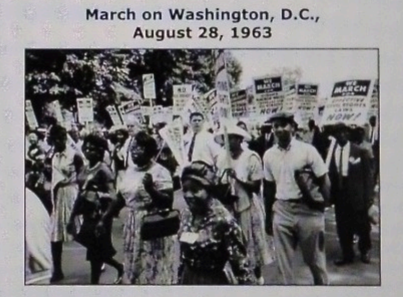
- A. They are utilizing an 8th Amendment right to secure the release of a colleague who was jailed unfairly.
- B. They are utilizing a 6th Amendment right to secure a fair trial for a jailed associate.
- C. They are utilizing a 1st Amendment right to secure equality under the law.
- D. They are utilizing a 14th Amendment right to secure the opportunity to vote in federal elections.
Correct Answer & Rationale
Correct Answer: C
The action depicted in the photograph aligns with the 1st Amendment, which guarantees freedoms concerning speech, assembly, and the right to petition the government. The individuals are likely advocating for equality under the law, a fundamental principle of democratic society. Option A incorrectly references the 8th Amendment, which focuses on protection against excessive bail and cruel punishment, not the right to protest for a colleague's release. Option B misapplies the 6th Amendment, which ensures the right to a fair trial, rather than addressing broader issues of equality. Option D inaccurately connects the situation to the 14th Amendment, which deals with citizenship rights and equal protection, not specifically voting rights.
The action depicted in the photograph aligns with the 1st Amendment, which guarantees freedoms concerning speech, assembly, and the right to petition the government. The individuals are likely advocating for equality under the law, a fundamental principle of democratic society. Option A incorrectly references the 8th Amendment, which focuses on protection against excessive bail and cruel punishment, not the right to protest for a colleague's release. Option B misapplies the 6th Amendment, which ensures the right to a fair trial, rather than addressing broader issues of equality. Option D inaccurately connects the situation to the 14th Amendment, which deals with citizenship rights and equal protection, not specifically voting rights.