Which statement is supported by the diagrams?
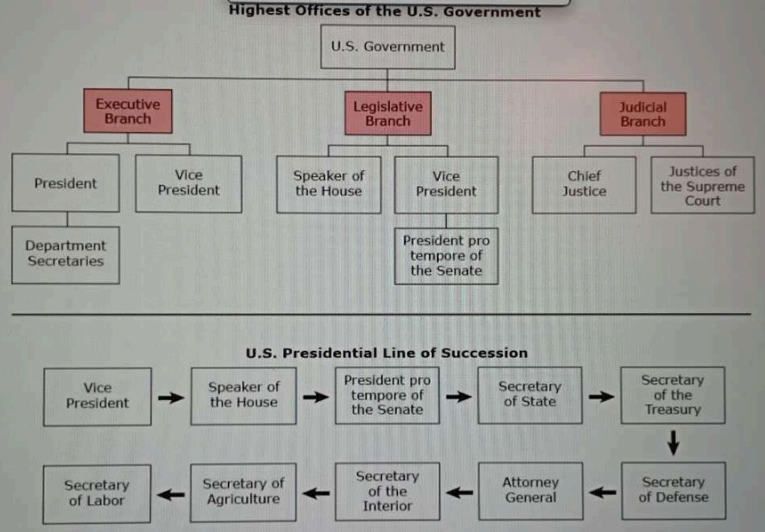
- A. Only the vice president and the president pro tempore of the Senate serve in two branches.
- B. Only officials from the executive and legislative branches are in the line of presidential succession.
- C. The order of presidential succession is determined by the members of the executive branch.
- D. The leaders of Congress are accountable to the members of the executive branch.
Correct Answer & Rationale
Correct Answer: B
Option B accurately reflects the structure of presidential succession, which includes officials from both the executive and legislative branches, specifically the vice president and the leaders of Congress. Option A is misleading; while the vice president and president pro tempore serve in both branches, other officials in the line of succession also include members from the cabinet, which is part of the executive branch. Option C is incorrect as the order of succession is established by law, not determined solely by the executive branch members. Option D misrepresents accountability; Congress leaders are accountable to their constituents, not the executive branch.
Option B accurately reflects the structure of presidential succession, which includes officials from both the executive and legislative branches, specifically the vice president and the leaders of Congress. Option A is misleading; while the vice president and president pro tempore serve in both branches, other officials in the line of succession also include members from the cabinet, which is part of the executive branch. Option C is incorrect as the order of succession is established by law, not determined solely by the executive branch members. Option D misrepresents accountability; Congress leaders are accountable to their constituents, not the executive branch.
Other Related Questions
Which conclusion is best supported by information in the table and article?
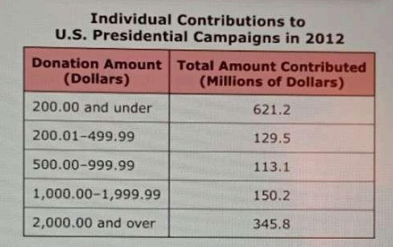
- A. Individuals contributed a total amount of money equal to the total of all other sources of donations.
- B. Individuals contributing the smallest quantity of money insignificantly impact presidential campaigns.
- C. Individuals donated the greatest total amount although many contributions were relatively small.
- D. Individuals have more influence on the proposed policies of presidential candidates than groups do.
Correct Answer & Rationale
Correct Answer: C
Option C is supported by the data, indicating that while many individual contributions were small, they collectively formed the largest portion of total donations to presidential campaigns. This highlights the significant role individuals play despite the size of their contributions. Option A is incorrect as it suggests individuals’ contributions equaled all other sources, which is not supported by the data. Option B misrepresents the impact of smaller donations; even small contributions can collectively influence campaign funding significantly. Option D overstates individuals' influence on policy compared to groups, which often have more resources and organized lobbying power.
Option C is supported by the data, indicating that while many individual contributions were small, they collectively formed the largest portion of total donations to presidential campaigns. This highlights the significant role individuals play despite the size of their contributions. Option A is incorrect as it suggests individuals’ contributions equaled all other sources, which is not supported by the data. Option B misrepresents the impact of smaller donations; even small contributions can collectively influence campaign funding significantly. Option D overstates individuals' influence on policy compared to groups, which often have more resources and organized lobbying power.
Which sentence from the passage provides evidence that the Veterans Administration was involved in the development of suburban communities?
- A. "Men returned home from military service, got married, and started families." (paragraph 1)
- B. "Moreover, a separate government program made low-interest mortgage loans available to returning military personnel." (paragraph 4)
- C. "Even so, the success of Levittown depended not only on the efficiency of the Levitt brothers' process but also on the Federal Housing Administration, which guaranteed bank loans to builders." (paragraph 4)
- D. "William and his brother Alfred first gained experience in assembly-line techniques while building government housing for defense workers during World War II." (paragraph 2)
Correct Answer & Rationale
Correct Answer: B
Option B clearly highlights the involvement of the Veterans Administration by mentioning a specific government program that provided low-interest mortgage loans to returning military personnel. This directly links the agency's actions to the development of suburban communities, as affordable housing financing is crucial for homeownership. Option A discusses the general trend of returning veterans starting families but does not specifically reference the Veterans Administration's role. Option C mentions the Federal Housing Administration, not the Veterans Administration, which makes it irrelevant to the question. Option D focuses on the Levitt brothers’ prior experience and does not address the Veterans Administration's involvement in suburban development.
Option B clearly highlights the involvement of the Veterans Administration by mentioning a specific government program that provided low-interest mortgage loans to returning military personnel. This directly links the agency's actions to the development of suburban communities, as affordable housing financing is crucial for homeownership. Option A discusses the general trend of returning veterans starting families but does not specifically reference the Veterans Administration's role. Option C mentions the Federal Housing Administration, not the Veterans Administration, which makes it irrelevant to the question. Option D focuses on the Levitt brothers’ prior experience and does not address the Veterans Administration's involvement in suburban development.
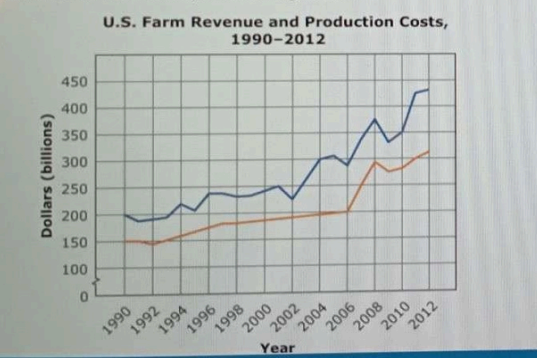
What impact do the varying insurance rates of the Revenue Protection Plan have on farming?
- A. They maintain stable prices for certain crops.
- B. They give farmers an incentive to promote crop diversity.
- C. They ensure the steady increase of crop production levels.
- D. They give farmers an incentive to grow crops that have higher subsidies.
Correct Answer & Rationale
Correct Answer: D
The varying insurance rates of the Revenue Protection Plan incentivize farmers to cultivate crops that receive higher subsidies, as these crops can mitigate financial risks associated with farming. This option aligns with economic behavior, where farmers are likely to prioritize profitability. Option A is incorrect because insurance rates do not directly stabilize prices; they primarily provide financial protection. Option B misrepresents the incentive structure; while crop diversity is beneficial, the plan does not specifically encourage it through varying rates. Option C is misleading, as the plan does not guarantee increased production levels; it merely provides a safety net against revenue loss.
The varying insurance rates of the Revenue Protection Plan incentivize farmers to cultivate crops that receive higher subsidies, as these crops can mitigate financial risks associated with farming. This option aligns with economic behavior, where farmers are likely to prioritize profitability. Option A is incorrect because insurance rates do not directly stabilize prices; they primarily provide financial protection. Option B misrepresents the incentive structure; while crop diversity is beneficial, the plan does not specifically encourage it through varying rates. Option C is misleading, as the plan does not guarantee increased production levels; it merely provides a safety net against revenue loss.
Which statement from Common Sense provides evidence that the author Thomas Paine supported American independence?
- A. "Absolute governments have this advantage with them, that they are simple..."
- B. "I challenge the warmest advocate for reconciliation, to [show], a single advantage that this continent can reap, by being connected with Great Britain."
- C. "The prejudice of Englishmen, in [favor] of their own government arises as much or more from national pride than reason."
- D. "Society in every state is a blessing, but government even in its best state is but a necessary evil."
Correct Answer & Rationale
Correct Answer: B
Option B provides clear evidence of Thomas Paine's support for American independence by challenging the benefits of remaining connected to Great Britain. By asking advocates for reconciliation to demonstrate any advantages, Paine emphasizes the futility of such ties and advocates for autonomy. Option A discusses the simplicity of absolute governments, which does not directly address the question of American independence. Option C critiques English national pride but lacks a direct link to the argument for independence. Option D presents a philosophical view on government but does not specifically advocate for breaking away from British rule.
Option B provides clear evidence of Thomas Paine's support for American independence by challenging the benefits of remaining connected to Great Britain. By asking advocates for reconciliation to demonstrate any advantages, Paine emphasizes the futility of such ties and advocates for autonomy. Option A discusses the simplicity of absolute governments, which does not directly address the question of American independence. Option C critiques English national pride but lacks a direct link to the argument for independence. Option D presents a philosophical view on government but does not specifically advocate for breaking away from British rule.