This excerpt is from a speech delivered by Theodore Roosevelt in 1910.
I recognize the right and duty of this generation to develop and use the natural resources of our land; but I do not recognize the right to waste them, or to rob, by wasteful use, the generations that come after us....
Moreover, I believe that the natural resources must be used for the benefit of all our people, and not monopolized for the benefit of the few.... Of all the questions which can come before this nation, short of the actual preservation of its existence in a great war, there is none which compares in importance with the great central task of leaving this land even a better land for our descendants than it is for us, and training them into a better race to inhabit the land and pass it on. Conservation is a great moral issue, for it involves the patriotic duty of insuring the safety and continuance of the nation.....
Which statement identifies a purpose of Roosevelt's speech?
- A. to convince his audience that preserving the environment is as important as national security
- B. to convince his audience that preserving the environment is the responsibility of ordinary citizens
- C. to gain support for using public lands to obtain vital productive resources
- D. to gain support for a candidate who wants to preserve the environment
Correct Answer & Rationale
Correct Answer: A
Option A effectively captures Roosevelt's emphasis on the interconnectedness of environmental preservation and national security. He aimed to highlight that a healthy environment is crucial for the nation's well-being and stability. Option B is incorrect as Roosevelt’s speech focuses more on broader national priorities rather than individual responsibilities. Option C misinterprets the message; while resource management is important, the speech primarily advocates for environmental preservation rather than exploitation. Option D is misleading; Roosevelt's speech is not about promoting a candidate but rather advocating for a national commitment to environmental stewardship.
Option A effectively captures Roosevelt's emphasis on the interconnectedness of environmental preservation and national security. He aimed to highlight that a healthy environment is crucial for the nation's well-being and stability. Option B is incorrect as Roosevelt’s speech focuses more on broader national priorities rather than individual responsibilities. Option C misinterprets the message; while resource management is important, the speech primarily advocates for environmental preservation rather than exploitation. Option D is misleading; Roosevelt's speech is not about promoting a candidate but rather advocating for a national commitment to environmental stewardship.
Other Related Questions
This flow chart traces development of democratic government in England. Which event completes this sequence?

- A. The English Bill of Rights gave the king power to appoint most members of Parliament.
- B. The Magna Carta forced the nobles to give up their feudal lands.
- C. The English Bill of Rights guaranteed suffrage to most male citizens.
- D. The Magna Carta forced the king to share his political power.
Correct Answer & Rationale
Correct Answer: D
The correct choice, D, highlights the Magna Carta's pivotal role in limiting the king's absolute power and initiating the concept of shared governance. This foundational document established that the monarch must consult nobles before making decisions, laying the groundwork for parliamentary democracy. Option A is incorrect as the English Bill of Rights actually limited the king's power over Parliament, not enhanced it. Option B misrepresents the Magna Carta's purpose; it did not force nobles to relinquish their lands, but rather addressed their grievances against the king. Option C is also inaccurate, as the English Bill of Rights did not guarantee suffrage but focused on limiting royal authority and protecting certain rights.
The correct choice, D, highlights the Magna Carta's pivotal role in limiting the king's absolute power and initiating the concept of shared governance. This foundational document established that the monarch must consult nobles before making decisions, laying the groundwork for parliamentary democracy. Option A is incorrect as the English Bill of Rights actually limited the king's power over Parliament, not enhanced it. Option B misrepresents the Magna Carta's purpose; it did not force nobles to relinquish their lands, but rather addressed their grievances against the king. Option C is also inaccurate, as the English Bill of Rights did not guarantee suffrage but focused on limiting royal authority and protecting certain rights.
Which statement from the passage is an opinion?
- A. "Even so, the success of Levittown depended not only on the efficiency of the Levitt brothers' process but also on the Federal Housing Administration" (paragraph 4)
- B. "Shortly after World War II, many changes led to the development of suburbs." (paragraph 1)
- C. "This, much of the baby-boom generation had well-constructed homes in which to grow up." (paragraph 4)
- D. "With this financing in place, more homes could be built and more veterans could afford to buy them." (paragraph 4)
Correct Answer & Rationale
Correct Answer: C
Option C expresses a subjective view about the quality of homes available to the baby-boom generation, indicating an opinion that these homes were "well-constructed." This characterization is not a factual statement and reflects a personal judgment. In contrast, Option A presents a factual statement about the factors contributing to Levittown's success, grounded in historical context. Option B provides a straightforward observation regarding the timeline of suburban development, without personal interpretation. Option D outlines a factual cause-and-effect relationship regarding financing and home construction, remaining objective. Thus, only Option C conveys a personal opinion.
Option C expresses a subjective view about the quality of homes available to the baby-boom generation, indicating an opinion that these homes were "well-constructed." This characterization is not a factual statement and reflects a personal judgment. In contrast, Option A presents a factual statement about the factors contributing to Levittown's success, grounded in historical context. Option B provides a straightforward observation regarding the timeline of suburban development, without personal interpretation. Option D outlines a factual cause-and-effect relationship regarding financing and home construction, remaining objective. Thus, only Option C conveys a personal opinion.
How does the U.S. Supreme Court's ruling differ from Justice Murphy's dissent?
- A. Only Justice Murphy's dissent acknowledged the dangers to the United States of having citizens from foreign lands.
- B. Only the Court's ruling acknowledged that the actions of fearful U.S. authorities can endanger the civil rights of citizens.
- C. Only the Court's ruling contended that Korematsu was ordered held in an internment camp because he was disloyal to the United States during time of war.
- D. Only Justice Murphy's dissent contended that U.S. internment camps were a clear-cut example of racial prejudice.
Correct Answer & Rationale
Correct Answer: D
Justice Murphy's dissent emphasized that the internment camps represented blatant racial prejudice, highlighting the unjust targeting of Japanese Americans based solely on their ethnicity. This perspective contrasts sharply with the majority opinion, which focused on national security concerns without addressing the racial implications. Option A is incorrect as both perspectives recognize the potential dangers of foreign nationals, albeit in different contexts. Option B misrepresents the majority's stance, which did not explicitly acknowledge civil rights violations. Option C inaccurately simplifies the Court's ruling, which did not solely attribute internment to disloyalty.
Justice Murphy's dissent emphasized that the internment camps represented blatant racial prejudice, highlighting the unjust targeting of Japanese Americans based solely on their ethnicity. This perspective contrasts sharply with the majority opinion, which focused on national security concerns without addressing the racial implications. Option A is incorrect as both perspectives recognize the potential dangers of foreign nationals, albeit in different contexts. Option B misrepresents the majority's stance, which did not explicitly acknowledge civil rights violations. Option C inaccurately simplifies the Court's ruling, which did not solely attribute internment to disloyalty.
According to the information in the first graph, which statement correctly describes the period from 2006 to 2008?
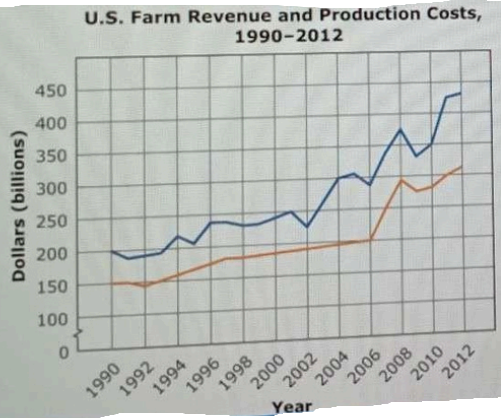
- A. Gross farm income continued the decline that had characterized previous years.
- B. Gross farm income increased despite increases in production costs.
- C. Increases in production costs caused gross farm income to decline.
- D. Decreases in production costs continued throughout this period.
Correct Answer & Rationale
Correct Answer: B
During the period from 2006 to 2008, gross farm income saw an increase, even as production costs rose. This indicates that farmers managed to offset higher expenses with increased revenue. Option A is incorrect as it suggests a continuation of decline, which contradicts the data showing growth in income. Option C misinterprets the relationship between rising costs and income, as income actually increased despite those costs. Option D is inaccurate because it implies a consistent decrease in production costs, which is not supported by the graph indicating rising expenses during this timeframe.
During the period from 2006 to 2008, gross farm income saw an increase, even as production costs rose. This indicates that farmers managed to offset higher expenses with increased revenue. Option A is incorrect as it suggests a continuation of decline, which contradicts the data showing growth in income. Option C misinterprets the relationship between rising costs and income, as income actually increased despite those costs. Option D is inaccurate because it implies a consistent decrease in production costs, which is not supported by the graph indicating rising expenses during this timeframe.