This passage discusses the first national government in the United States.
In 1781, the 13 former British American colonies established a common government when they ratified the Articles of Confederation. The document established a "firm league of friendship" between the states and reserved the greatest share of political authority to the individual states. The new confederation had only one branch, which was made up of a one-house legislature in which the states were equally represented. Among other powers, the new government had the power to conduct foreign affairs for the 13 independent states. It had the power to make war and peace and to negotiate treaties with foreign countries. It could also settle disputes between the states, Including disputes over western territories. Each of the states retained their "sovereignty, freedom and independence." Under the Articles, Congress could not collect taxes, regulate trade between states, or enforce laws. The confederation was replaced in 1787 by the government created by the U.S. Constitution.
What is the meaning of confederation in this passage?
- A. a government in which the whole population of a country votes to make laws for the people
- B. a political union in which power is divided between a strong central authority and the various other political units
- C. a political union in which the component units retain significant independence from the central government
- D. a government in which people vote to elect representatives who make laws for the people
Correct Answer & Rationale
Correct Answer: C
Confederation refers to a political union where individual components maintain considerable autonomy while cooperating for mutual benefit. Option C accurately captures this definition, emphasizing the independence of component units from the central authority. Option A describes a direct democracy, which is not aligned with the concept of confederation. Option B suggests a balance of power that leans towards a strong central authority, contradicting the essence of a confederation. Option D outlines a representative democracy, which does not inherently involve the independence of component units, thus misrepresenting the nature of a confederation.
Confederation refers to a political union where individual components maintain considerable autonomy while cooperating for mutual benefit. Option C accurately captures this definition, emphasizing the independence of component units from the central authority. Option A describes a direct democracy, which is not aligned with the concept of confederation. Option B suggests a balance of power that leans towards a strong central authority, contradicting the essence of a confederation. Option D outlines a representative democracy, which does not inherently involve the independence of component units, thus misrepresenting the nature of a confederation.
Other Related Questions
Based on the excerpts, which speaker would agree with each statement below? Drag each statement into the box labeled with that speaker's name. If neither would agree with a statement, drag it to the box labeled "Neither."
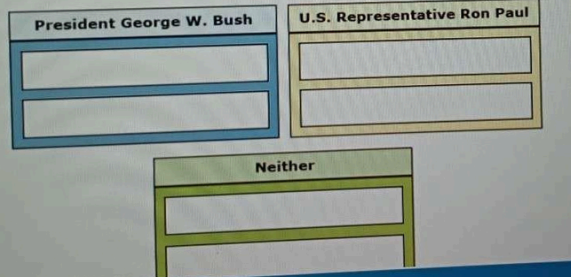
- A. Congress should spend money public education.
- B. Schools should meet federal education guidelines.
- C. Parents should hold public schools accountable.
- D. Local districts should set school guidelines.
Correct Answer & Rationale
Correct Answer:
Speaker A likely supports the idea that Congress should spend money on public education, as this aligns with a belief in federal investment in education for equitable access. Speaker B would agree that schools should meet federal education guidelines, as this emphasizes the importance of uniform standards for educational quality and accountability. Speaker C advocates for parental accountability in public schools, reflecting the belief that parents play a vital role in monitoring and improving educational outcomes. Speaker D likely supports the idea that local districts should set school guidelines, as this allows for tailored approaches that reflect community needs and values. If neither speaker aligns with a statement, it belongs in the "Neither" category.
Speaker A likely supports the idea that Congress should spend money on public education, as this aligns with a belief in federal investment in education for equitable access. Speaker B would agree that schools should meet federal education guidelines, as this emphasizes the importance of uniform standards for educational quality and accountability. Speaker C advocates for parental accountability in public schools, reflecting the belief that parents play a vital role in monitoring and improving educational outcomes. Speaker D likely supports the idea that local districts should set school guidelines, as this allows for tailored approaches that reflect community needs and values. If neither speaker aligns with a statement, it belongs in the "Neither" category.
How did Chief Justice Marshall contribute to the U.S. government system of checks and balances?
- A. by establishing the Supreme Court's power to check Congress
- B. by creating the power to remove the president from office
- C. by expanding the president's power to check Congress
- D. by giving the Supreme Court the power to control itself
Correct Answer & Rationale
Correct Answer: A
Chief Justice Marshall played a pivotal role in defining the Supreme Court's authority, notably through the landmark case Marbury v. Madison, which established the principle of judicial review. This empowered the Court to invalidate laws passed by Congress that it deemed unconstitutional, effectively allowing it to check legislative power. Option B is incorrect as the power to remove a president lies with Congress through impeachment, not the Supreme Court. Option C misrepresents Marshall's contributions, as he did not expand presidential power but rather clarified judicial authority. Option D is also inaccurate; the Supreme Court does not have self-regulating powers but operates within the framework of checks and balances.
Chief Justice Marshall played a pivotal role in defining the Supreme Court's authority, notably through the landmark case Marbury v. Madison, which established the principle of judicial review. This empowered the Court to invalidate laws passed by Congress that it deemed unconstitutional, effectively allowing it to check legislative power. Option B is incorrect as the power to remove a president lies with Congress through impeachment, not the Supreme Court. Option C misrepresents Marshall's contributions, as he did not expand presidential power but rather clarified judicial authority. Option D is also inaccurate; the Supreme Court does not have self-regulating powers but operates within the framework of checks and balances.
Assuming that the majority of senators and representatives voted along party lines, which conclusion about the U.S. government in 2011 does the table support?
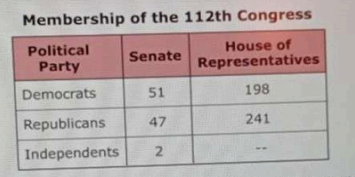
- A. The party that passed more legislation could be anticipated.
- B. The party that would win the next presidential election could be predicted.
- C. Party divisions were a challenge to the legislative process.
- D. Party affiliations are a requirement for congressional membership.
Correct Answer & Rationale
Correct Answer: C
The data suggests that party divisions significantly impacted the legislative process in 2011, indicating that partisan alignment often hindered bipartisan cooperation. Option A incorrectly implies that the quantity of legislation passed directly correlates with party strength, which is not supported by the information. Option B assumes a direct link between legislative success and electoral outcomes, which cannot be inferred from party voting patterns alone. Option D misrepresents the nature of congressional membership, as party affiliation is not a formal requirement but rather a common practice among members.
The data suggests that party divisions significantly impacted the legislative process in 2011, indicating that partisan alignment often hindered bipartisan cooperation. Option A incorrectly implies that the quantity of legislation passed directly correlates with party strength, which is not supported by the information. Option B assumes a direct link between legislative success and electoral outcomes, which cannot be inferred from party voting patterns alone. Option D misrepresents the nature of congressional membership, as party affiliation is not a formal requirement but rather a common practice among members.
This flow chart traces development of democratic government in England. Which event completes this sequence?

- A. The English Bill of Rights gave the king power to appoint most members of Parliament.
- B. The Magna Carta forced the nobles to give up their feudal lands.
- C. The English Bill of Rights guaranteed suffrage to most male citizens.
- D. The Magna Carta forced the king to share his political power.
Correct Answer & Rationale
Correct Answer: D
The correct choice, D, highlights the Magna Carta's pivotal role in limiting the king's absolute power and initiating the concept of shared governance. This foundational document established that the monarch must consult nobles before making decisions, laying the groundwork for parliamentary democracy. Option A is incorrect as the English Bill of Rights actually limited the king's power over Parliament, not enhanced it. Option B misrepresents the Magna Carta's purpose; it did not force nobles to relinquish their lands, but rather addressed their grievances against the king. Option C is also inaccurate, as the English Bill of Rights did not guarantee suffrage but focused on limiting royal authority and protecting certain rights.
The correct choice, D, highlights the Magna Carta's pivotal role in limiting the king's absolute power and initiating the concept of shared governance. This foundational document established that the monarch must consult nobles before making decisions, laying the groundwork for parliamentary democracy. Option A is incorrect as the English Bill of Rights actually limited the king's power over Parliament, not enhanced it. Option B misrepresents the Magna Carta's purpose; it did not force nobles to relinquish their lands, but rather addressed their grievances against the king. Option C is also inaccurate, as the English Bill of Rights did not guarantee suffrage but focused on limiting royal authority and protecting certain rights.