This excerpt is from a 2002 document published by the U.S. Department of Homeland Security.
The realigning President proposes to create a new Department of Homeland Security... by largely transforming and Is to protect the current confusing patchwork of government activities into a single department whose primary mission our homeland....
History... teaches us that new challenges require new organizational structures.
For example, prior to 1945, America's armed forces were inefficiently structured with separate War and Navy Departments and disconnected intelligence units. There were no formal mechanisms for.cooperation..
In December 1945, only months after America's decisive victory in World War II,... President Truman declared, "It Is now time... to provide for the future the soundest, most effective and most economical kind of structure for our armed forces...."
President Truman's goals were achieved with the National Security Act of 1947 and subsequent amendments... The legislation consolidated the separate military Departments Into the Department of Defense..., established a Central Intelligence Agency to coordinate all foreign intelligence collection and analysis, and created the National Security Council in the White House to coordinate all foreign and defense policy efforts.
Based on the excerpt, which change was a result of the National Security Act of 1947?
- A. The Central Intelligence Agency replaced the War Department.
- B. The National Security Council gained control over the Department of Defense.
- C. The Department of Homeland Security replaced the War Department.
- D. The Department of the Navy became part of the Department of Defense.
Correct Answer & Rationale
Correct Answer: D
The National Security Act of 1947 reorganized the U.S. military and intelligence community. Option D accurately reflects that the Department of the Navy became part of the newly established Department of Defense, streamlining military operations. Option A is incorrect; the CIA was created but did not replace the War Department directly. Option B is misleading; while the National Security Council was established, it does not control the Department of Defense. Option C is factually incorrect, as the Department of Homeland Security was created later, in 2003, not as a result of the 1947 Act.
The National Security Act of 1947 reorganized the U.S. military and intelligence community. Option D accurately reflects that the Department of the Navy became part of the newly established Department of Defense, streamlining military operations. Option A is incorrect; the CIA was created but did not replace the War Department directly. Option B is misleading; while the National Security Council was established, it does not control the Department of Defense. Option C is factually incorrect, as the Department of Homeland Security was created later, in 2003, not as a result of the 1947 Act.
Other Related Questions
According to the information in the first graph, which statement correctly describes the period from 2006 to 2008?
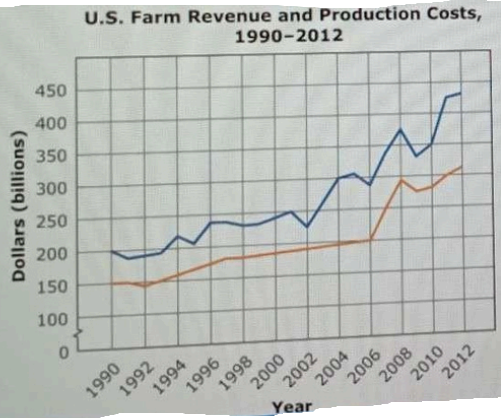
- A. Gross farm income continued the decline that had characterized previous years.
- B. Gross farm income increased despite increases in production costs.
- C. Increases in production costs caused gross farm income to decline.
- D. Decreases in production costs continued throughout this period.
Correct Answer & Rationale
Correct Answer: B
During the period from 2006 to 2008, gross farm income saw an increase, even as production costs rose. This indicates that farmers managed to offset higher expenses with increased revenue. Option A is incorrect as it suggests a continuation of decline, which contradicts the data showing growth in income. Option C misinterprets the relationship between rising costs and income, as income actually increased despite those costs. Option D is inaccurate because it implies a consistent decrease in production costs, which is not supported by the graph indicating rising expenses during this timeframe.
During the period from 2006 to 2008, gross farm income saw an increase, even as production costs rose. This indicates that farmers managed to offset higher expenses with increased revenue. Option A is incorrect as it suggests a continuation of decline, which contradicts the data showing growth in income. Option C misinterprets the relationship between rising costs and income, as income actually increased despite those costs. Option D is inaccurate because it implies a consistent decrease in production costs, which is not supported by the graph indicating rising expenses during this timeframe.
What is the meaning of confederation in this passage?
- A. a government in which the whole population of a country votes to make laws for the people
- B. a political union in which power is divided between a strong central authority and the various other political units
- C. a political union in which the component units retain significant independence from the central government
- D. a government in which people vote to elect representatives who make laws for the people
Correct Answer & Rationale
Correct Answer: C
Confederation refers to a political union where individual components maintain considerable autonomy while cooperating for mutual benefit. Option C accurately captures this definition, emphasizing the independence of component units from the central authority. Option A describes a direct democracy, which is not aligned with the concept of confederation. Option B suggests a balance of power that leans towards a strong central authority, contradicting the essence of a confederation. Option D outlines a representative democracy, which does not inherently involve the independence of component units, thus misrepresenting the nature of a confederation.
Confederation refers to a political union where individual components maintain considerable autonomy while cooperating for mutual benefit. Option C accurately captures this definition, emphasizing the independence of component units from the central authority. Option A describes a direct democracy, which is not aligned with the concept of confederation. Option B suggests a balance of power that leans towards a strong central authority, contradicting the essence of a confederation. Option D outlines a representative democracy, which does not inherently involve the independence of component units, thus misrepresenting the nature of a confederation.
Which statement best describes the action of the people in the photograph?
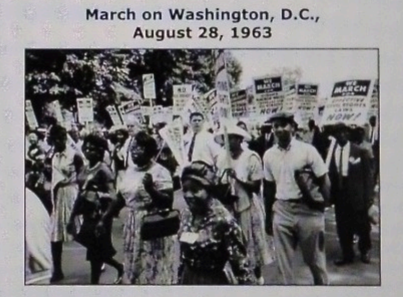
- A. They are utilizing an 8th Amendment right to secure the release of a colleague who was jailed unfairly.
- B. They are utilizing a 6th Amendment right to secure a fair trial for a jailed associate.
- C. They are utilizing a 1st Amendment right to secure equality under the law.
- D. They are utilizing a 14th Amendment right to secure the opportunity to vote in federal elections.
Correct Answer & Rationale
Correct Answer: C
The action depicted in the photograph aligns with the 1st Amendment, which guarantees freedoms concerning speech, assembly, and the right to petition the government. The individuals are likely advocating for equality under the law, a fundamental principle of democratic society. Option A incorrectly references the 8th Amendment, which focuses on protection against excessive bail and cruel punishment, not the right to protest for a colleague's release. Option B misapplies the 6th Amendment, which ensures the right to a fair trial, rather than addressing broader issues of equality. Option D inaccurately connects the situation to the 14th Amendment, which deals with citizenship rights and equal protection, not specifically voting rights.
The action depicted in the photograph aligns with the 1st Amendment, which guarantees freedoms concerning speech, assembly, and the right to petition the government. The individuals are likely advocating for equality under the law, a fundamental principle of democratic society. Option A incorrectly references the 8th Amendment, which focuses on protection against excessive bail and cruel punishment, not the right to protest for a colleague's release. Option B misapplies the 6th Amendment, which ensures the right to a fair trial, rather than addressing broader issues of equality. Option D inaccurately connects the situation to the 14th Amendment, which deals with citizenship rights and equal protection, not specifically voting rights.
Which statement from the passage is an opinion?
- A. "Even so, the success of Levittown depended not only on the efficiency of the Levitt brothers' process but also on the Federal Housing Administration" (paragraph 4)
- B. "Shortly after World War II, many changes led to the development of suburbs." (paragraph 1)
- C. "This, much of the baby-boom generation had well-constructed homes in which to grow up." (paragraph 4)
- D. "With this financing in place, more homes could be built and more veterans could afford to buy them." (paragraph 4)
Correct Answer & Rationale
Correct Answer: C
Option C expresses a subjective view about the quality of homes available to the baby-boom generation, indicating an opinion that these homes were "well-constructed." This characterization is not a factual statement and reflects a personal judgment. In contrast, Option A presents a factual statement about the factors contributing to Levittown's success, grounded in historical context. Option B provides a straightforward observation regarding the timeline of suburban development, without personal interpretation. Option D outlines a factual cause-and-effect relationship regarding financing and home construction, remaining objective. Thus, only Option C conveys a personal opinion.
Option C expresses a subjective view about the quality of homes available to the baby-boom generation, indicating an opinion that these homes were "well-constructed." This characterization is not a factual statement and reflects a personal judgment. In contrast, Option A presents a factual statement about the factors contributing to Levittown's success, grounded in historical context. Option B provides a straightforward observation regarding the timeline of suburban development, without personal interpretation. Option D outlines a factual cause-and-effect relationship regarding financing and home construction, remaining objective. Thus, only Option C conveys a personal opinion.