This excerpt is from an article published by the Library of Congress.
In order to avoid factions, the Constitution grants political parties no role in [government]. Ironically, political factions sprang up right away to support the Constitution and to oppose it. By the presidential election of 1796, political parties were in place in America...
Today the party system seems firmly entrenched. Some Americans might argue that there is no real difference between the ideals and political stance of today's parties. Other Americans routinely vote a "party ticket" in their belief that a particular political party will best represent their wishes for governing the nation.
What is the meaning of the word entrenched as used in this excerpt?
- A. in control
- B. strongly defended
- C. established and unlikely to change
- D. surrounded and unable to move
Correct Answer & Rationale
Correct Answer: C
The term "entrenched" conveys the idea of something that is firmly established and resistant to change, aligning with option C. This suggests a deep-rooted nature, often implying that it has become a significant part of a system or belief. Option A, "in control," does not capture the essence of being deeply embedded or resistant to alteration. Option B, "strongly defended," implies a protective stance rather than a state of being firmly established. Option D, "surrounded and unable to move," suggests physical confinement rather than the figurative sense of being firmly set in place.
The term "entrenched" conveys the idea of something that is firmly established and resistant to change, aligning with option C. This suggests a deep-rooted nature, often implying that it has become a significant part of a system or belief. Option A, "in control," does not capture the essence of being deeply embedded or resistant to alteration. Option B, "strongly defended," implies a protective stance rather than a state of being firmly established. Option D, "surrounded and unable to move," suggests physical confinement rather than the figurative sense of being firmly set in place.
Other Related Questions
Which statement identifies a purpose of Roosevelt's speech?
- A. to convince his audience that preserving the environment is as important as national security
- B. to convince his audience that preserving the environment is the responsibility of ordinary citizens
- C. to gain support for using public lands to obtain vital productive resources
- D. to gain support for a candidate who wants to preserve the environment
Correct Answer & Rationale
Correct Answer: A
Option A effectively captures Roosevelt's emphasis on the interconnectedness of environmental preservation and national security. He aimed to highlight that a healthy environment is crucial for the nation's well-being and stability. Option B is incorrect as Roosevelt’s speech focuses more on broader national priorities rather than individual responsibilities. Option C misinterprets the message; while resource management is important, the speech primarily advocates for environmental preservation rather than exploitation. Option D is misleading; Roosevelt's speech is not about promoting a candidate but rather advocating for a national commitment to environmental stewardship.
Option A effectively captures Roosevelt's emphasis on the interconnectedness of environmental preservation and national security. He aimed to highlight that a healthy environment is crucial for the nation's well-being and stability. Option B is incorrect as Roosevelt’s speech focuses more on broader national priorities rather than individual responsibilities. Option C misinterprets the message; while resource management is important, the speech primarily advocates for environmental preservation rather than exploitation. Option D is misleading; Roosevelt's speech is not about promoting a candidate but rather advocating for a national commitment to environmental stewardship.
Which statement from the excerpts provides evidence for the Inference that minority rights were not protected by the U.S. government as originally founded?
- A. "To the contrary, the government they devised was defective from the start, requiring several amendments, a civil war, and momentous social transformation to attain the system of constitutional government, and its respect for the individual freedoms and human rights, we hold as fundamental today."
- B. "In a very real sense, it was then, in 1787, that the Revolution truly began."
- C. "I do not believe that the meaning of the Constitution was forever 'fixed' at the Philadelphia Convention."
- D. "For it was with the writing of our Constitution, setting down the architecture of democratic government, that the noble sentiments and brave rhetoric of 1776 took on substance......"
Correct Answer & Rationale
Correct Answer: A
Option A highlights the inherent flaws in the original government structure, indicating that it required significant amendments and a civil war to address fundamental issues, including the protection of minority rights. This suggests that, from its inception, the government did not adequately safeguard these rights. Options B, C, and D, while relevant to the historical context, do not specifically address the inadequacies of minority rights protection. B focuses on the ongoing nature of the Revolution, C discusses the evolving interpretation of the Constitution, and D emphasizes the establishment of democratic principles without mentioning the lack of protections for minority rights.
Option A highlights the inherent flaws in the original government structure, indicating that it required significant amendments and a civil war to address fundamental issues, including the protection of minority rights. This suggests that, from its inception, the government did not adequately safeguard these rights. Options B, C, and D, while relevant to the historical context, do not specifically address the inadequacies of minority rights protection. B focuses on the ongoing nature of the Revolution, C discusses the evolving interpretation of the Constitution, and D emphasizes the establishment of democratic principles without mentioning the lack of protections for minority rights.
Assuming that the majority of senators and representatives voted along party lines, which conclusion about the U.S. government in 2011 does the table support?
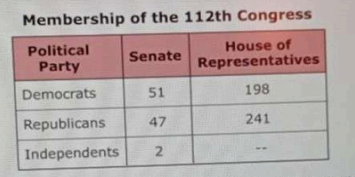
- A. The party that passed more legislation could be anticipated.
- B. The party that would win the next presidential election could be predicted.
- C. Party divisions were a challenge to the legislative process.
- D. Party affiliations are a requirement for congressional membership.
Correct Answer & Rationale
Correct Answer: C
The data suggests that party divisions significantly impacted the legislative process in 2011, indicating that partisan alignment often hindered bipartisan cooperation. Option A incorrectly implies that the quantity of legislation passed directly correlates with party strength, which is not supported by the information. Option B assumes a direct link between legislative success and electoral outcomes, which cannot be inferred from party voting patterns alone. Option D misrepresents the nature of congressional membership, as party affiliation is not a formal requirement but rather a common practice among members.
The data suggests that party divisions significantly impacted the legislative process in 2011, indicating that partisan alignment often hindered bipartisan cooperation. Option A incorrectly implies that the quantity of legislation passed directly correlates with party strength, which is not supported by the information. Option B assumes a direct link between legislative success and electoral outcomes, which cannot be inferred from party voting patterns alone. Option D misrepresents the nature of congressional membership, as party affiliation is not a formal requirement but rather a common practice among members.
How did the position expressed by President Johnson differ from the position expressed by Senator Russell?
- A. Only Senator Russell said that state governments were sufficiently protecting the rights of citizens.
- B. Only Senator Russell supported the federal government's intervention.
- C. Only President Johnson supported the state governments' rights to manage their own affairs.
- D. Only President Johnson believed that the federal government was authorized to intervene.
Correct Answer & Rationale
Correct Answer: A
President Johnson emphasized the need for federal intervention to protect citizens' rights, believing that state governments were often inadequate. In contrast, Senator Russell argued that state governments were effectively safeguarding those rights, reflecting a stance of local governance. Option B is incorrect because Senator Russell did not support federal intervention. Option C misrepresents Johnson’s position; he favored federal oversight rather than state autonomy. Option D inaccurately attributes the belief in federal authority solely to Johnson, as Russell did not share this view. Thus, the distinction lies in Russell's confidence in state governments versus Johnson's call for federal action.
President Johnson emphasized the need for federal intervention to protect citizens' rights, believing that state governments were often inadequate. In contrast, Senator Russell argued that state governments were effectively safeguarding those rights, reflecting a stance of local governance. Option B is incorrect because Senator Russell did not support federal intervention. Option C misrepresents Johnson’s position; he favored federal oversight rather than state autonomy. Option D inaccurately attributes the belief in federal authority solely to Johnson, as Russell did not share this view. Thus, the distinction lies in Russell's confidence in state governments versus Johnson's call for federal action.