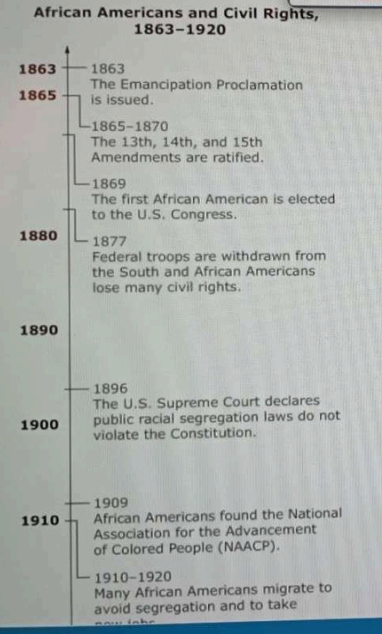
Based on the timeline and the map, what was one way African Americans dealt with Jim Crow laws?
- A. by taking service jobs in southern cities
- B. by seeking factory jobs in urban areas of the North
- C. by becoming tenant farmers in other parts of the South
- D. by gaining technical skills in northern schools
Correct Answer & Rationale
Correct Answer: B
African Americans responded to Jim Crow laws by seeking factory jobs in urban areas of the North, as this migration offered better economic opportunities and a chance to escape oppressive conditions in the South. Option A, taking service jobs in southern cities, often perpetuated the same discriminatory practices found under Jim Crow. Option C, becoming tenant farmers in other parts of the South, did not provide significant relief from the systemic racism and economic hardship prevalent in that region. Option D, gaining technical skills in northern schools, while beneficial, was not a widespread or immediate solution compared to the mass migration to northern factories.
African Americans responded to Jim Crow laws by seeking factory jobs in urban areas of the North, as this migration offered better economic opportunities and a chance to escape oppressive conditions in the South. Option A, taking service jobs in southern cities, often perpetuated the same discriminatory practices found under Jim Crow. Option C, becoming tenant farmers in other parts of the South, did not provide significant relief from the systemic racism and economic hardship prevalent in that region. Option D, gaining technical skills in northern schools, while beneficial, was not a widespread or immediate solution compared to the mass migration to northern factories.
Other Related Questions
What basic assumption behind Marshall's remarks is not behind Reagan's remarks?
- A. The framers of the U.S. Constitution have received more credit than they deserve for the governmental protections Americans enjoy.
- B. The framers of the U.S. Constitution have been credited with creating a document that protects all free people around the world.
- C. The U.S. Constitution created a government whose promises are yet to be realized by many around the world.
- D. The U.S. Constitution created a government based on the principles expressed in the Declaration of Independence.
Correct Answer & Rationale
Correct Answer: A
Marshall's remarks imply a critical view of the framers' contributions, suggesting they may not deserve as much credit for governmental protections as commonly believed. This contrasts with Reagan's perspective, which typically emphasizes the positive legacy of the framers. Option B incorrectly assumes that both figures share the belief in the global impact of the Constitution, which Reagan often highlighted. Option C suggests an acknowledgment of unrealized promises, aligning with both perspectives, while option D reinforces a foundational agreement on principles that both figures would likely support. Thus, A stands out as the unique assumption absent in Reagan's remarks.
Marshall's remarks imply a critical view of the framers' contributions, suggesting they may not deserve as much credit for governmental protections as commonly believed. This contrasts with Reagan's perspective, which typically emphasizes the positive legacy of the framers. Option B incorrectly assumes that both figures share the belief in the global impact of the Constitution, which Reagan often highlighted. Option C suggests an acknowledgment of unrealized promises, aligning with both perspectives, while option D reinforces a foundational agreement on principles that both figures would likely support. Thus, A stands out as the unique assumption absent in Reagan's remarks.
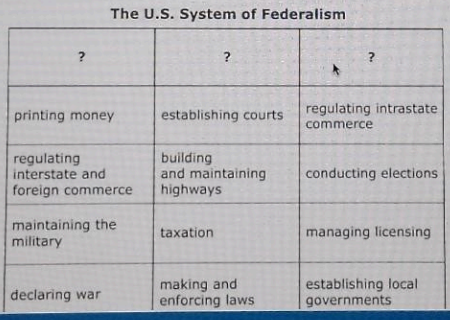
Complete the U.S. System of Federalism chart based on information from the passage. Click on the title below you want to select and drag it into the top of each column in the chart. - State Government Powers - National Government Powers - Shared Powers of National and State Governments -
Correct Answer & Rationale
Correct Answer:
In the U.S. system of federalism, powers are distributed among different levels of government. **State Government Powers** include authority over education, transportation, and local law enforcement, allowing states to address local needs effectively. **National Government Powers** encompass defense, foreign affairs, and immigration, ensuring a unified national policy in these critical areas. **Shared Powers** involve taxation, infrastructure, and law enforcement, illustrating collaboration between state and national governments to maintain order and promote welfare. Other options may misplace powers or overlook the collaborative nature of federalism, leading to misunderstandings about government functions.
In the U.S. system of federalism, powers are distributed among different levels of government. **State Government Powers** include authority over education, transportation, and local law enforcement, allowing states to address local needs effectively. **National Government Powers** encompass defense, foreign affairs, and immigration, ensuring a unified national policy in these critical areas. **Shared Powers** involve taxation, infrastructure, and law enforcement, illustrating collaboration between state and national governments to maintain order and promote welfare. Other options may misplace powers or overlook the collaborative nature of federalism, leading to misunderstandings about government functions.
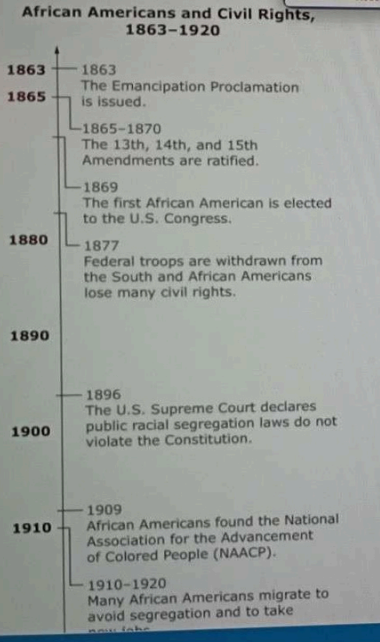
Which event counters the viewpoint expressed in the newspaper excerpt that African Americans refused to defend their civil rights?
- A. the ratification of the 13th, 14th, and 15th Amendments
- B. the issuance of the Emancipation Proclamation
- C. the founding of the National Association for the Advancement of Colored People
- D. the start of the Great Migration
Correct Answer & Rationale
Correct Answer: C
The founding of the National Association for the Advancement of Colored People (NAACP) directly counters the viewpoint that African Americans refused to defend their civil rights. Established in 1909, the NAACP actively fought for civil rights through legal challenges, advocacy, and public education, demonstrating a strong commitment to defending their rights. Option A, the ratification of the 13th, 14th, and 15th Amendments, although significant, primarily established legal rights rather than showcasing active defense. Option B, the Emancipation Proclamation, ended slavery but did not directly address civil rights activism. Option D, the Great Migration, reflects a movement for better opportunities but does not specifically illustrate organized efforts to defend civil rights.
The founding of the National Association for the Advancement of Colored People (NAACP) directly counters the viewpoint that African Americans refused to defend their civil rights. Established in 1909, the NAACP actively fought for civil rights through legal challenges, advocacy, and public education, demonstrating a strong commitment to defending their rights. Option A, the ratification of the 13th, 14th, and 15th Amendments, although significant, primarily established legal rights rather than showcasing active defense. Option B, the Emancipation Proclamation, ended slavery but did not directly address civil rights activism. Option D, the Great Migration, reflects a movement for better opportunities but does not specifically illustrate organized efforts to defend civil rights.
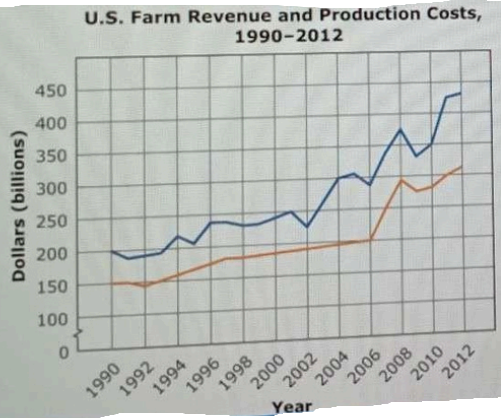
According to the information in the first graph, which statement correctly describes the period from 2006 to 2008?
- A. Gross farm income continued the decline that had characterized previous years.
- B. Gross farm income increased despite increases in production costs.
- C. Increases in production costs caused gross farm income to decline.
- D. Decreases in production costs continued throughout this period.
Correct Answer & Rationale
Correct Answer: B
During the period from 2006 to 2008, gross farm income saw an increase, even as production costs rose. This indicates that farmers managed to offset higher expenses with increased revenue. Option A is incorrect as it suggests a continuation of decline, which contradicts the data showing growth in income. Option C misinterprets the relationship between rising costs and income, as income actually increased despite those costs. Option D is inaccurate because it implies a consistent decrease in production costs, which is not supported by the graph indicating rising expenses during this timeframe.
During the period from 2006 to 2008, gross farm income saw an increase, even as production costs rose. This indicates that farmers managed to offset higher expenses with increased revenue. Option A is incorrect as it suggests a continuation of decline, which contradicts the data showing growth in income. Option C misinterprets the relationship between rising costs and income, as income actually increased despite those costs. Option D is inaccurate because it implies a consistent decrease in production costs, which is not supported by the graph indicating rising expenses during this timeframe.