The great inventor Thomas Edison received more than one thousand patents during his career and made a large contribution to how we live today. For example, in 1877, after discovering a way to record sound, Edison introduced the phonograph. In 1893 he invented the first motion-picture camera. Eight years before inventing the phonograph, Edison received his first patent for a vote recorder, which was intended to help record legislative votes quickly. The Innovation he is most known for is the electric light bulb. He filed a patent for his light bulb in 1879. Though others contributed to the invention of the light bulb, Edison's work made this invention a long-lasting, practical household item.
Which technology mentioned in the passage was the first one invented by Edison?
- A. vote recorder
- B. motion-picture camera
- C. electric light bulb
- D. phonograph
Correct Answer & Rationale
Correct Answer: A
The vote recorder was the first technology invented by Edison, designed to streamline the voting process. This innovation predates his more famous inventions. The motion-picture camera (B) and electric light bulb (C) came later, showcasing Edison's evolution as an inventor. The phonograph (D), although significant in audio technology, was also developed after the vote recorder. Understanding the chronological order of these inventions highlights Edison's early contributions to technology and their impact on society.
The vote recorder was the first technology invented by Edison, designed to streamline the voting process. This innovation predates his more famous inventions. The motion-picture camera (B) and electric light bulb (C) came later, showcasing Edison's evolution as an inventor. The phonograph (D), although significant in audio technology, was also developed after the vote recorder. Understanding the chronological order of these inventions highlights Edison's early contributions to technology and their impact on society.
Other Related Questions
According to Justice Marshall, what historical factor has contradicted the ideas expressed in the U.S. Constitution?
- A. slavery
- B. free enterprise
- C. religion
- D. class war
Correct Answer & Rationale
Correct Answer: A
Justice Marshall highlighted slavery as a significant historical contradiction to the principles of freedom and equality enshrined in the U.S. Constitution. Slavery directly undermined the Constitution's assertion that all men are created equal, creating a profound moral and ethical conflict. In contrast, free enterprise (B) aligns with the Constitution's emphasis on individual rights and economic freedom. Religion (C) is protected under the First Amendment, promoting freedom rather than contradiction. Class war (D) is a socio-economic conflict that, while relevant, does not directly challenge the foundational ideals of the Constitution in the same way slavery does.
Justice Marshall highlighted slavery as a significant historical contradiction to the principles of freedom and equality enshrined in the U.S. Constitution. Slavery directly undermined the Constitution's assertion that all men are created equal, creating a profound moral and ethical conflict. In contrast, free enterprise (B) aligns with the Constitution's emphasis on individual rights and economic freedom. Religion (C) is protected under the First Amendment, promoting freedom rather than contradiction. Class war (D) is a socio-economic conflict that, while relevant, does not directly challenge the foundational ideals of the Constitution in the same way slavery does.
Which statement is supported by both the table and the map?
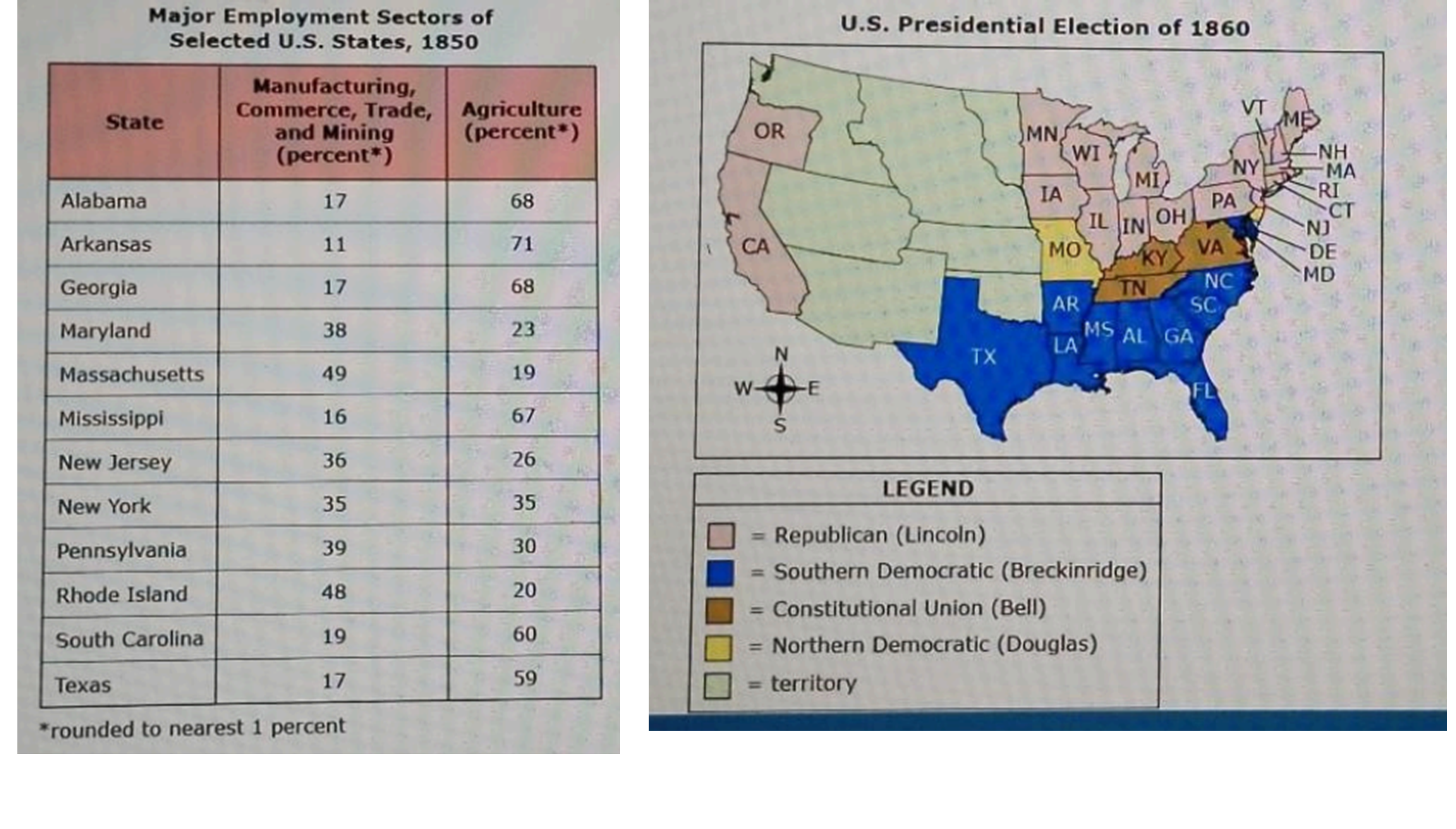
- A. Differences in the total populations of the states led to political differences between the North and the South.
- B. Differences among the economies of the states contributed to political differences between the North and the South.
- C. Political differences between the North and the South reflected differences in education among the states.
- D. Political differences between the North and the South reflected differences in the standards of living in the states.
Correct Answer & Rationale
Correct Answer: B
Option B is supported by both the table and the map, as they illustrate how varying economic structures—such as agriculture in the South versus industrialization in the North—contributed to distinct political ideologies and policies. Option A incorrectly attributes political differences solely to population size, overlooking the economic factors at play. Option C suggests education differences as the main cause, which is not evident in the provided data. Option D implies that living standards were the primary influence, but the economic context is more directly linked to the political divide. Thus, B effectively encapsulates the relationship between economy and political differences.
Option B is supported by both the table and the map, as they illustrate how varying economic structures—such as agriculture in the South versus industrialization in the North—contributed to distinct political ideologies and policies. Option A incorrectly attributes political differences solely to population size, overlooking the economic factors at play. Option C suggests education differences as the main cause, which is not evident in the provided data. Option D implies that living standards were the primary influence, but the economic context is more directly linked to the political divide. Thus, B effectively encapsulates the relationship between economy and political differences.
Which statement identifies the purpose of President Nixon's message?
- A. to convince Congress that technological advancement and population growth must be slowed to protect the environment
- B. to convince Congress that industrial polluters of the air and water should not pay for cleaning the environment
- C. to convince Congress that it must take part in action to address human damage to the environment
- D. to convince Congress that there should be no benefits for businesses that pollute the environment
Correct Answer & Rationale
Correct Answer: C
President Nixon's message aimed to mobilize Congress to actively engage in addressing environmental degradation caused by human activities. This focus on collective action underscores the urgency of legislative involvement in environmental protection. Option A misinterprets the goal, as Nixon did not advocate for slowing technological advancement but rather for responsible management. Option B inaccurately suggests that he supported industrial polluters avoiding responsibility, which contradicts his environmental stance. Option D implies a complete lack of support for businesses, neglecting the balanced approach Nixon promoted towards regulatory measures and economic growth.
President Nixon's message aimed to mobilize Congress to actively engage in addressing environmental degradation caused by human activities. This focus on collective action underscores the urgency of legislative involvement in environmental protection. Option A misinterprets the goal, as Nixon did not advocate for slowing technological advancement but rather for responsible management. Option B inaccurately suggests that he supported industrial polluters avoiding responsibility, which contradicts his environmental stance. Option D implies a complete lack of support for businesses, neglecting the balanced approach Nixon promoted towards regulatory measures and economic growth.
Which historical event most likely shaped the author's point of view?
- A. the development of the concept of Manifest Destiny
- B. the United States' involvement in World War I
- C. the United States' internal conflicts during the Great Depression
- D. the calls for social reform during Prohibition
Correct Answer & Rationale
Correct Answer: B
The author's perspective is significantly influenced by the United States' involvement in World War I, as this event marked a pivotal shift in national identity and global engagement. The war prompted discussions about democracy, freedom, and the role of the U.S. on the world stage, shaping the author's views on these themes. Option A, Manifest Destiny, pertains to 19th-century expansionism, which is less relevant to the author's context. Option C, the Great Depression, focuses on economic struggles rather than the broader geopolitical implications of war. Option D, social reform during Prohibition, addresses domestic issues but does not encompass the global impact and ideological shifts brought about by World War I.
The author's perspective is significantly influenced by the United States' involvement in World War I, as this event marked a pivotal shift in national identity and global engagement. The war prompted discussions about democracy, freedom, and the role of the U.S. on the world stage, shaping the author's views on these themes. Option A, Manifest Destiny, pertains to 19th-century expansionism, which is less relevant to the author's context. Option C, the Great Depression, focuses on economic struggles rather than the broader geopolitical implications of war. Option D, social reform during Prohibition, addresses domestic issues but does not encompass the global impact and ideological shifts brought about by World War I.