This excerpt is from a speech given by President Lyndon Johnson before a joint session of Congress in 1965.
1 I speak tonight for the dignity of man and the destiny of democracy....
2 At times history and fate meet at a single time in a single place to shape a turning point in man's unending search for freedom.... So it was a century ago at Appomattox. So it was last week in Selma, Alabama.
3 There, long-suffering men and women peacefully protested the denial of their rights as Americans. Many were brutally assaulted....
4 There is no constitutional issue here. The command of the Constitution is plain.
5 There is no moral issue. It is wrong, deadly wrong, to deny any of your fellow Americans the right to vote in this country.
6 There is no issue of States' rights or national rights. There is only the struggle for human rights....
7 We cannot... refuse to protect the right of every American to vote in every election that he may desire to participate in..Ù Ù
8 But even if we pass this bill, the battle will not be over.
9 Their cause must be our cause too. Because it is not just Negroes, but really it is all of us, who must overcome the crippling legacy of bigotry and injustice.
10 And we shall overcome..
11 This great, rich, restless country can offer opportunity and education and hope to all: black and white, North and South, sharecropper and city dweller. These are the enemies: poverty, Ignorance, disease. They are the enemies and not our fellow man, not our neighbor. And these enemies too, poverty, disease and ignorance, we shall overcome.
This excerpt is from a telegram Senator Richard Russell of Georgia sent to President Dwight Eisenhower in 1957.
12... As a citizen, as a senator of the United States, and as Chairman of the Senate Committee on Armed Services, I must vigorously protest the highhanded and illegal methods being
Which one statement identifies the main idea of President Johnson's speech?
- A. The federal government has the responsibility to guarantee the rights of citizens.
- B. The expansion of educational opportunities should be the next goal of the civil rights movement.
- C. The expansion of voting rights can eliminate poverty.
- D. The federal government has power over state governments.
Correct Answer & Rationale
Correct Answer: A
Option A accurately captures the essence of President Johnson's speech, which emphasizes the government's duty to protect citizens' rights, particularly in the context of civil rights and social justice. Option B, while relevant to the civil rights movement, does not encapsulate the primary focus of the speech, which is broader than just education. Option C suggests a direct correlation between voting rights and poverty alleviation, which, though important, is not the main thrust of Johnson's address. Option D misrepresents the speech's intent, as it does not primarily discuss the federal government's authority over states but rather its role in ensuring citizen rights.
Option A accurately captures the essence of President Johnson's speech, which emphasizes the government's duty to protect citizens' rights, particularly in the context of civil rights and social justice. Option B, while relevant to the civil rights movement, does not encapsulate the primary focus of the speech, which is broader than just education. Option C suggests a direct correlation between voting rights and poverty alleviation, which, though important, is not the main thrust of Johnson's address. Option D misrepresents the speech's intent, as it does not primarily discuss the federal government's authority over states but rather its role in ensuring citizen rights.
Other Related Questions
Which statement identifies the purpose of President Nixon's message?
- A. to convince Congress that technological advancement and population growth must be slowed to protect the environment
- B. to convince Congress that industrial polluters of the air and water should not pay for cleaning the environment
- C. to convince Congress that it must take part in action to address human damage to the environment
- D. to convince Congress that there should be no benefits for businesses that pollute the environment
Correct Answer & Rationale
Correct Answer: C
President Nixon's message aimed to mobilize Congress to actively engage in addressing environmental degradation caused by human activities. This focus on collective action underscores the urgency of legislative involvement in environmental protection. Option A misinterprets the goal, as Nixon did not advocate for slowing technological advancement but rather for responsible management. Option B inaccurately suggests that he supported industrial polluters avoiding responsibility, which contradicts his environmental stance. Option D implies a complete lack of support for businesses, neglecting the balanced approach Nixon promoted towards regulatory measures and economic growth.
President Nixon's message aimed to mobilize Congress to actively engage in addressing environmental degradation caused by human activities. This focus on collective action underscores the urgency of legislative involvement in environmental protection. Option A misinterprets the goal, as Nixon did not advocate for slowing technological advancement but rather for responsible management. Option B inaccurately suggests that he supported industrial polluters avoiding responsibility, which contradicts his environmental stance. Option D implies a complete lack of support for businesses, neglecting the balanced approach Nixon promoted towards regulatory measures and economic growth.
How does the U.S. Supreme Court's ruling differ from Justice Murphy's dissent?
- A. Only Justice Murphy's dissent acknowledged the dangers to the United States of having citizens from foreign lands.
- B. Only the Court's ruling acknowledged that the actions of fearful U.S. authorities can endanger the civil rights of citizens.
- C. Only the Court's ruling contended that Korematsu was ordered held in an internment camp because he was disloyal to the United States during time of war.
- D. Only Justice Murphy's dissent contended that U.S. internment camps were a clear-cut example of racial prejudice.
Correct Answer & Rationale
Correct Answer: D
Justice Murphy's dissent emphasized that the internment camps represented blatant racial prejudice, highlighting the unjust targeting of Japanese Americans based solely on their ethnicity. This perspective contrasts sharply with the majority opinion, which focused on national security concerns without addressing the racial implications. Option A is incorrect as both perspectives recognize the potential dangers of foreign nationals, albeit in different contexts. Option B misrepresents the majority's stance, which did not explicitly acknowledge civil rights violations. Option C inaccurately simplifies the Court's ruling, which did not solely attribute internment to disloyalty.
Justice Murphy's dissent emphasized that the internment camps represented blatant racial prejudice, highlighting the unjust targeting of Japanese Americans based solely on their ethnicity. This perspective contrasts sharply with the majority opinion, which focused on national security concerns without addressing the racial implications. Option A is incorrect as both perspectives recognize the potential dangers of foreign nationals, albeit in different contexts. Option B misrepresents the majority's stance, which did not explicitly acknowledge civil rights violations. Option C inaccurately simplifies the Court's ruling, which did not solely attribute internment to disloyalty.
Based on the timeline and the map, what was one way African Americans dealt with Jim Crow laws?
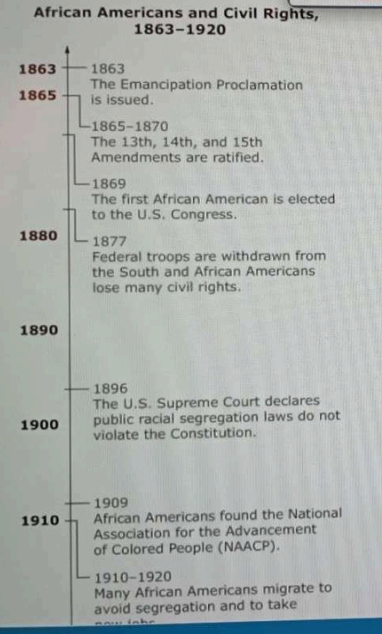
- A. by taking service jobs in southern cities
- B. by seeking factory jobs in urban areas of the North
- C. by becoming tenant farmers in other parts of the South
- D. by gaining technical skills in northern schools
Correct Answer & Rationale
Correct Answer: B
African Americans responded to Jim Crow laws by seeking factory jobs in urban areas of the North, as this migration offered better economic opportunities and a chance to escape oppressive conditions in the South. Option A, taking service jobs in southern cities, often perpetuated the same discriminatory practices found under Jim Crow. Option C, becoming tenant farmers in other parts of the South, did not provide significant relief from the systemic racism and economic hardship prevalent in that region. Option D, gaining technical skills in northern schools, while beneficial, was not a widespread or immediate solution compared to the mass migration to northern factories.
African Americans responded to Jim Crow laws by seeking factory jobs in urban areas of the North, as this migration offered better economic opportunities and a chance to escape oppressive conditions in the South. Option A, taking service jobs in southern cities, often perpetuated the same discriminatory practices found under Jim Crow. Option C, becoming tenant farmers in other parts of the South, did not provide significant relief from the systemic racism and economic hardship prevalent in that region. Option D, gaining technical skills in northern schools, while beneficial, was not a widespread or immediate solution compared to the mass migration to northern factories.
Which statement best explains the situation described in the paragraphs?
- A. Crude oil prices in 2014 encouraged U.S. families to buy less gasoline in 2015.
- B. Crude oil production levels have caused U.S. gasoline prices to fall.
- C. Greater crude oil reserves have caused the U.S. government to reduce gasoline prices.
- D. Lower crude oil production will cause U.S. gasoline prices to return to 2014 levels by 2016.
Correct Answer & Rationale
Correct Answer: B
Option B accurately reflects the relationship between crude oil production levels and gasoline prices. Increased production typically leads to lower prices, as supply outstrips demand. Option A incorrectly suggests a direct correlation between crude oil prices in 2014 and gasoline purchases in 2015, neglecting the influence of production levels. Option C misrepresents the role of reserves; while greater reserves can impact prices, it is production levels that directly affect market prices. Option D speculates on future price increases due to lower production, which is uncertain and not directly supported by the information provided.
Option B accurately reflects the relationship between crude oil production levels and gasoline prices. Increased production typically leads to lower prices, as supply outstrips demand. Option A incorrectly suggests a direct correlation between crude oil prices in 2014 and gasoline purchases in 2015, neglecting the influence of production levels. Option C misrepresents the role of reserves; while greater reserves can impact prices, it is production levels that directly affect market prices. Option D speculates on future price increases due to lower production, which is uncertain and not directly supported by the information provided.