This excerpt is from the U.S. State Department document, Outline of U.S. History.
Virginian George Mason was one of three delegates to the Constitutional Convention who had refused to sign the final document because it did not [guarantee] individual rights. Together with Patrick Henry, he campaigned vigorously against ratification of the Constitution by Virginia.... [F]ive states, including Massachusetts, ratified the Constitution on the condition that such amendments be added immediately. When the first Congress [met] in New York City in September 1789, the calls for amendments protecting individual rights were [almost] unanimous [B]y December 1791, enough states had ratified 10 amendments to make them part of the Constitution. Collectively, [these amendments] are known as the Bill of Rights.
This excerpt is taken from the public domain.
Based on the excerpt, which conclusion can be drawn about the U.S. Constitution and the Bill of Rights?
- A. Ratification of the Bill of Rights was completed before the Constitution was drafted.
- B. Ratification of the Constitution was dependent on the passage of the Bill of Rights.
- C. Most leaders were worried that the Bill of Rights would weaken the ruling class protected by the Constitution.
- D. Many leaders were concerned that the Bill of Rights would upset the balance of powers outlined in the Constitution.
Correct Answer & Rationale
Correct Answer: B
The conclusion that ratification of the Constitution was dependent on the passage of the Bill of Rights is supported by historical context, as many states required assurance of individual rights to approve the Constitution. Option A is incorrect because the Bill of Rights was introduced after the Constitution was drafted. Option C misrepresents the intent of the Bill of Rights; leaders were primarily concerned with protecting individual liberties rather than preserving the ruling class. Option D is also inaccurate, as the Bill of Rights aimed to safeguard citizens' rights without disrupting the balance of powers established by the Constitution.
The conclusion that ratification of the Constitution was dependent on the passage of the Bill of Rights is supported by historical context, as many states required assurance of individual rights to approve the Constitution. Option A is incorrect because the Bill of Rights was introduced after the Constitution was drafted. Option C misrepresents the intent of the Bill of Rights; leaders were primarily concerned with protecting individual liberties rather than preserving the ruling class. Option D is also inaccurate, as the Bill of Rights aimed to safeguard citizens' rights without disrupting the balance of powers established by the Constitution.
Other Related Questions
According to Justice Marshall, what historical factor has contradicted the ideas expressed in the U.S. Constitution?
- A. slavery
- B. free enterprise
- C. religion
- D. class war
Correct Answer & Rationale
Correct Answer: A
Justice Marshall highlighted slavery as a significant historical contradiction to the principles of freedom and equality enshrined in the U.S. Constitution. Slavery directly undermined the Constitution's assertion that all men are created equal, creating a profound moral and ethical conflict. In contrast, free enterprise (B) aligns with the Constitution's emphasis on individual rights and economic freedom. Religion (C) is protected under the First Amendment, promoting freedom rather than contradiction. Class war (D) is a socio-economic conflict that, while relevant, does not directly challenge the foundational ideals of the Constitution in the same way slavery does.
Justice Marshall highlighted slavery as a significant historical contradiction to the principles of freedom and equality enshrined in the U.S. Constitution. Slavery directly undermined the Constitution's assertion that all men are created equal, creating a profound moral and ethical conflict. In contrast, free enterprise (B) aligns with the Constitution's emphasis on individual rights and economic freedom. Religion (C) is protected under the First Amendment, promoting freedom rather than contradiction. Class war (D) is a socio-economic conflict that, while relevant, does not directly challenge the foundational ideals of the Constitution in the same way slavery does.
According to this information, which philosopher would most likely support the presidential power to appoint federal judges with the consent of the U.S. Senate?
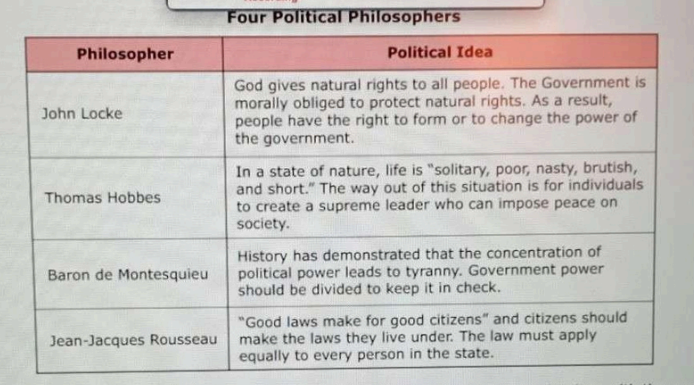
- A. Thomas Hobbes
- B. Baron de Montesquieu
- C. Jean-Jacques Rousseau
- D. John Locke
Correct Answer & Rationale
Correct Answer: B
Baron de Montesquieu advocated for the separation of powers within government, emphasizing the need for checks and balances to prevent tyranny. His support for a collaborative process in appointing judges aligns with the presidential power requiring Senate consent, ensuring that no single branch holds excessive authority. Thomas Hobbes, on the other hand, favored a strong central authority and would likely support concentrated power without the need for Senate approval. Jean-Jacques Rousseau emphasized the general will and popular sovereignty, which does not directly address the judicial appointment process. John Locke valued consent and governance but did not specifically advocate for the Senate's role in judicial appointments.
Baron de Montesquieu advocated for the separation of powers within government, emphasizing the need for checks and balances to prevent tyranny. His support for a collaborative process in appointing judges aligns with the presidential power requiring Senate consent, ensuring that no single branch holds excessive authority. Thomas Hobbes, on the other hand, favored a strong central authority and would likely support concentrated power without the need for Senate approval. Jean-Jacques Rousseau emphasized the general will and popular sovereignty, which does not directly address the judicial appointment process. John Locke valued consent and governance but did not specifically advocate for the Senate's role in judicial appointments.
Which statement provides the main idea of the passage?
- A. The founders understood the importance of dividing war powers in the U.S. Constitution.
- B. President Truman used presidential war powers to send troops to South Korea.
- C. Congress restricted presidential war powers as a result of the Vietnam War.
- D. A conflict over presidential war powers exists in the U.S. government.
Correct Answer & Rationale
Correct Answer: D
Option D effectively captures the overarching theme of the passage by highlighting the ongoing conflict regarding presidential war powers within the U.S. government. This statement reflects the central issue discussed throughout the text. Option A, while relevant, focuses solely on the founders' intentions rather than the current implications of war powers. Option B is too specific, addressing a single historical instance rather than the broader concept of power dynamics. Option C, although it mentions a relevant event, limits the discussion to the Vietnam War and does not encompass the ongoing nature of the conflict over these powers.
Option D effectively captures the overarching theme of the passage by highlighting the ongoing conflict regarding presidential war powers within the U.S. government. This statement reflects the central issue discussed throughout the text. Option A, while relevant, focuses solely on the founders' intentions rather than the current implications of war powers. Option B is too specific, addressing a single historical instance rather than the broader concept of power dynamics. Option C, although it mentions a relevant event, limits the discussion to the Vietnam War and does not encompass the ongoing nature of the conflict over these powers.
Which event counters the viewpoint expressed in the newspaper excerpt that African Americans refused to defend their civil rights?
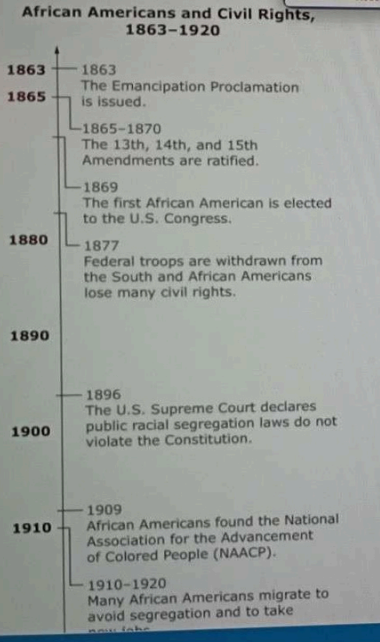
- A. the ratification of the 13th, 14th, and 15th Amendments
- B. the issuance of the Emancipation Proclamation
- C. the founding of the National Association for the Advancement of Colored People
- D. the start of the Great Migration
Correct Answer & Rationale
Correct Answer: C
The founding of the National Association for the Advancement of Colored People (NAACP) directly counters the viewpoint that African Americans refused to defend their civil rights. Established in 1909, the NAACP actively fought for civil rights through legal challenges, advocacy, and public education, demonstrating a strong commitment to defending their rights. Option A, the ratification of the 13th, 14th, and 15th Amendments, although significant, primarily established legal rights rather than showcasing active defense. Option B, the Emancipation Proclamation, ended slavery but did not directly address civil rights activism. Option D, the Great Migration, reflects a movement for better opportunities but does not specifically illustrate organized efforts to defend civil rights.
The founding of the National Association for the Advancement of Colored People (NAACP) directly counters the viewpoint that African Americans refused to defend their civil rights. Established in 1909, the NAACP actively fought for civil rights through legal challenges, advocacy, and public education, demonstrating a strong commitment to defending their rights. Option A, the ratification of the 13th, 14th, and 15th Amendments, although significant, primarily established legal rights rather than showcasing active defense. Option B, the Emancipation Proclamation, ended slavery but did not directly address civil rights activism. Option D, the Great Migration, reflects a movement for better opportunities but does not specifically illustrate organized efforts to defend civil rights.