The first excerpt is from the 1944 U.S. Supreme Court ruling in Korematsu v. United States.
To cast this case into outlines of racial prejudice, without reference to the real military dangers which were presented, merely confuses the issue. Korematsu was not excluded from the Military Area because of hostility to him or his race. He was excluded because we are at war with the Japanese Empire, because the properly constituted military authorities feared an invasion of our West Coast and felt constrained to take proper security measures.... There was evidence of disloyalty on the part of some, the military authorities considered that the need for action was great, and time was short. We cannot-by availing ourselves of the calm perspective of hindsight-now say that, at that time, these actions were unjustified.
The second excerpt is from Justice Frank Murphy's dissent in the Korematsu case.
I dissent, therefore, from this legalization of racism. Racial discrimination in any form and in any degree has no justifiable part whatever in our democratic way of life. It is unattractive in any setting, but it is utterly revolting among a free people who have embraced the principles set forth in the Constitution of the United States. All residents of this nation are kin in some way by blood or culture to a foreign land. Yet they are primarily and necessarily a part of the new and distinct civilization of the United States. They must, accordingly, be treated at all times as the heirs of the American experiment, and as entitled to all the rights and freedoms guaranteed by the Constitution.
How does the U.S. Supreme Court's ruling differ from Justice Murphy's dissent?
- A. Only Justice Murphy's dissent acknowledged the dangers to the United States of having citizens from foreign lands.
- B. Only the Court's ruling acknowledged that the actions of fearful U.S. authorities can endanger the civil rights of citizens.
- C. Only the Court's ruling contended that Korematsu was ordered held in an internment camp because he was disloyal to the United States during time of war.
- D. Only Justice Murphy's dissent contended that U.S. internment camps were a clear-cut example of racial prejudice.
Correct Answer & Rationale
Correct Answer: D
Justice Murphy's dissent emphasized that the internment camps represented blatant racial prejudice, highlighting the unjust targeting of Japanese Americans based solely on their ethnicity. This perspective contrasts sharply with the majority opinion, which focused on national security concerns without addressing the racial implications. Option A is incorrect as both perspectives recognize the potential dangers of foreign nationals, albeit in different contexts. Option B misrepresents the majority's stance, which did not explicitly acknowledge civil rights violations. Option C inaccurately simplifies the Court's ruling, which did not solely attribute internment to disloyalty.
Justice Murphy's dissent emphasized that the internment camps represented blatant racial prejudice, highlighting the unjust targeting of Japanese Americans based solely on their ethnicity. This perspective contrasts sharply with the majority opinion, which focused on national security concerns without addressing the racial implications. Option A is incorrect as both perspectives recognize the potential dangers of foreign nationals, albeit in different contexts. Option B misrepresents the majority's stance, which did not explicitly acknowledge civil rights violations. Option C inaccurately simplifies the Court's ruling, which did not solely attribute internment to disloyalty.
Other Related Questions
Based on the excerpt, which conclusion can be drawn about the U.S. Constitution and the Bill of Rights?
- A. Ratification of the Bill of Rights was completed before the Constitution was drafted.
- B. Ratification of the Constitution was dependent on the passage of the Bill of Rights.
- C. Most leaders were worried that the Bill of Rights would weaken the ruling class protected by the Constitution.
- D. Many leaders were concerned that the Bill of Rights would upset the balance of powers outlined in the Constitution.
Correct Answer & Rationale
Correct Answer: B
The conclusion that ratification of the Constitution was dependent on the passage of the Bill of Rights is supported by historical context, as many states required assurance of individual rights to approve the Constitution. Option A is incorrect because the Bill of Rights was introduced after the Constitution was drafted. Option C misrepresents the intent of the Bill of Rights; leaders were primarily concerned with protecting individual liberties rather than preserving the ruling class. Option D is also inaccurate, as the Bill of Rights aimed to safeguard citizens' rights without disrupting the balance of powers established by the Constitution.
The conclusion that ratification of the Constitution was dependent on the passage of the Bill of Rights is supported by historical context, as many states required assurance of individual rights to approve the Constitution. Option A is incorrect because the Bill of Rights was introduced after the Constitution was drafted. Option C misrepresents the intent of the Bill of Rights; leaders were primarily concerned with protecting individual liberties rather than preserving the ruling class. Option D is also inaccurate, as the Bill of Rights aimed to safeguard citizens' rights without disrupting the balance of powers established by the Constitution.
Which statement about the ratification of the 19th Amendment is based on the passage?
- A. Ratification was the result of the Seneca Falls Convention.
- B. Ratification occurred in return for the military service of women during World War I.
- C. Ratification occurred prior to the granting of voting rights to freed slaves.
- D. Ratification was the result of the accumulated efforts of women for decades.
Correct Answer & Rationale
Correct Answer: D
The ratification of the 19th Amendment was the culmination of decades of advocacy and activism by women who fought tirelessly for their voting rights, making option D the most accurate statement. Option A incorrectly attributes the ratification solely to the Seneca Falls Convention, which was just one of many events in the long struggle for women's suffrage. Option B suggests a direct exchange of military service for voting rights, which oversimplifies the complex social and political factors involved. Option C misrepresents the timeline, as the 19th Amendment was ratified after the Civil War, but the fight for voting rights for freed slaves and women evolved concurrently, not sequentially.
The ratification of the 19th Amendment was the culmination of decades of advocacy and activism by women who fought tirelessly for their voting rights, making option D the most accurate statement. Option A incorrectly attributes the ratification solely to the Seneca Falls Convention, which was just one of many events in the long struggle for women's suffrage. Option B suggests a direct exchange of military service for voting rights, which oversimplifies the complex social and political factors involved. Option C misrepresents the timeline, as the 19th Amendment was ratified after the Civil War, but the fight for voting rights for freed slaves and women evolved concurrently, not sequentially.
Which historical event most likely shaped the author's point of view?
- A. the development of the concept of Manifest Destiny
- B. the United States' involvement in World War I
- C. the United States' internal conflicts during the Great Depression
- D. the calls for social reform during Prohibition
Correct Answer & Rationale
Correct Answer: B
The author's perspective is significantly influenced by the United States' involvement in World War I, as this event marked a pivotal shift in national identity and global engagement. The war prompted discussions about democracy, freedom, and the role of the U.S. on the world stage, shaping the author's views on these themes. Option A, Manifest Destiny, pertains to 19th-century expansionism, which is less relevant to the author's context. Option C, the Great Depression, focuses on economic struggles rather than the broader geopolitical implications of war. Option D, social reform during Prohibition, addresses domestic issues but does not encompass the global impact and ideological shifts brought about by World War I.
The author's perspective is significantly influenced by the United States' involvement in World War I, as this event marked a pivotal shift in national identity and global engagement. The war prompted discussions about democracy, freedom, and the role of the U.S. on the world stage, shaping the author's views on these themes. Option A, Manifest Destiny, pertains to 19th-century expansionism, which is less relevant to the author's context. Option C, the Great Depression, focuses on economic struggles rather than the broader geopolitical implications of war. Option D, social reform during Prohibition, addresses domestic issues but does not encompass the global impact and ideological shifts brought about by World War I.
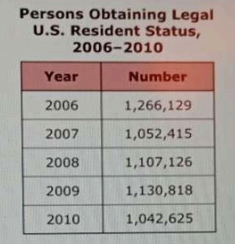
What is the mean number of people who became legal residents of the United States during this five-year period?
- A. 1,119,823
- B. 223,504
- C. 5,599,113
- D. 1,107,126
Correct Answer & Rationale
Correct Answer: A
To determine the mean number of legal residents over the five-year period, one must sum the total number of residents and divide by five. The correct calculation yields a mean of 1,119,823, reflecting the average annual influx. Option B (223,504) represents a miscalculation, likely reflecting a single year's data rather than an average. Option C (5,599,113) incorrectly totals the residents without division, suggesting a cumulative number rather than an average. Option D (1,107,126) is close but does not accurately reflect the mean, indicating a minor arithmetic error.
To determine the mean number of legal residents over the five-year period, one must sum the total number of residents and divide by five. The correct calculation yields a mean of 1,119,823, reflecting the average annual influx. Option B (223,504) represents a miscalculation, likely reflecting a single year's data rather than an average. Option C (5,599,113) incorrectly totals the residents without division, suggesting a cumulative number rather than an average. Option D (1,107,126) is close but does not accurately reflect the mean, indicating a minor arithmetic error.