These excerpts are from the first volume of Alexis de Tocquevilles osoit Delhicciacy in America, published in 1835.
Excerpt 1
A majority... may be regarded as a being whose opinions, and most frequently whose interests, are opposed to those of another being, which is styled a minority. If it be admitted that a man, possessing absolute power, may misuse that power by wronging his adversaries, why should a majority not be liable to the same reproach?
Excerpt 2
If there existed in America a class of citizens whom the... majority sought to deprive of exclusive privileges which they had possessed for ages... it is probable that the minority would be less ready to comply with its laws.
These excerpts are taken from the public domain.
Which feature of the U.S. system of government did de Tocqueville believe might cause conflict in society?
- A. The majority is able to achieve special rights.
- B. The minority is able to block popular legislation.
- C. Legislators must represent minority interests.
- D. Legislators sometimes act against majority rule.
Correct Answer & Rationale
Correct Answer: A
De Tocqueville observed that when the majority in a democracy can impose its will, it might lead to the oppression of minority groups, creating societal conflict. This reflects his concern about "tyranny of the majority," where the dominant group's interests overshadow the rights of others. Option B is incorrect because while minorities can influence legislation, de Tocqueville focused more on majority power. Option C misrepresents his views; he acknowledged the importance of minority representation but did not see it as a source of conflict. Option D is also inaccurate, as de Tocqueville emphasized the potential for the majority to dominate rather than legislators opposing the majority.
De Tocqueville observed that when the majority in a democracy can impose its will, it might lead to the oppression of minority groups, creating societal conflict. This reflects his concern about "tyranny of the majority," where the dominant group's interests overshadow the rights of others. Option B is incorrect because while minorities can influence legislation, de Tocqueville focused more on majority power. Option C misrepresents his views; he acknowledged the importance of minority representation but did not see it as a source of conflict. Option D is also inaccurate, as de Tocqueville emphasized the potential for the majority to dominate rather than legislators opposing the majority.
Other Related Questions
Which event occurred first?
- A. Michael moved to Ohio.
- B. Michael attained U.S. citizenship.
- C. The IRO was created.
- D. The UN was established.
Correct Answer & Rationale
Correct Answer: D
To determine the sequence of events, it’s essential to consider historical timelines. The United Nations (UN) was established in 1945, laying the groundwork for international cooperation. The International Refugee Organization (IRO) was created shortly after, in 1946, to address post-war refugee issues. Michael attaining U.S. citizenship likely occurred after these events, as it typically follows immigration processes. Lastly, Michael moving to Ohio would depend on his citizenship status and individual circumstances, making it the most recent event in this context.
To determine the sequence of events, it’s essential to consider historical timelines. The United Nations (UN) was established in 1945, laying the groundwork for international cooperation. The International Refugee Organization (IRO) was created shortly after, in 1946, to address post-war refugee issues. Michael attaining U.S. citizenship likely occurred after these events, as it typically follows immigration processes. Lastly, Michael moving to Ohio would depend on his citizenship status and individual circumstances, making it the most recent event in this context.
Which quotation from the excerpt reveals the author's bias about the relationship between the rule of the majority and the rights of the minority?
- A. "The wishes of the smaller group will override the wishes of the larger group and this will create resentment."
- B. "Requiring a unanimous vote or more than a majority vote is meant to provide a safeguard against oppression."
- C. "In these circumstances, expect constant scheming, trickery, and tiresome delays, resulting in disgraceful deals that violate the public good."
- D. "In times of national emergency, the goodness, badness, weakness, and strength of the government is supremely important."
Correct Answer & Rationale
Correct Answer: C
Option C highlights the author's bias by suggesting that the majority's decisions can lead to unethical behavior that undermines public welfare. This reveals a concern for minority rights, indicating that the author believes majority rule may result in negative consequences for those not in power. Option A misrepresents the author's view, as it suggests that the smaller group's wishes will always be overridden, which does not directly reflect bias against majority rule. Option B focuses on safeguards against oppression, which does not convey bias but rather a protective measure. Option D addresses the government's performance during emergencies but fails to connect to the relationship between majority rule and minority rights, missing the core issue of bias.
Option C highlights the author's bias by suggesting that the majority's decisions can lead to unethical behavior that undermines public welfare. This reveals a concern for minority rights, indicating that the author believes majority rule may result in negative consequences for those not in power. Option A misrepresents the author's view, as it suggests that the smaller group's wishes will always be overridden, which does not directly reflect bias against majority rule. Option B focuses on safeguards against oppression, which does not convey bias but rather a protective measure. Option D addresses the government's performance during emergencies but fails to connect to the relationship between majority rule and minority rights, missing the core issue of bias.
Which conclusion is best supported by information in the table and article?
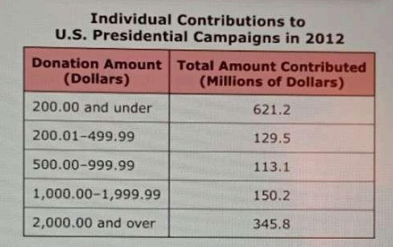
- A. Individuals contributed a total amount of money equal to the total of all other sources of donations.
- B. Individuals contributing the smallest quantity of money insignificantly impact presidential campaigns.
- C. Individuals donated the greatest total amount although many contributions were relatively small.
- D. Individuals have more influence on the proposed policies of presidential candidates than groups do.
Correct Answer & Rationale
Correct Answer: C
Option C is supported by the data, indicating that while many individual contributions were small, they collectively formed the largest portion of total donations to presidential campaigns. This highlights the significant role individuals play despite the size of their contributions. Option A is incorrect as it suggests individuals’ contributions equaled all other sources, which is not supported by the data. Option B misrepresents the impact of smaller donations; even small contributions can collectively influence campaign funding significantly. Option D overstates individuals' influence on policy compared to groups, which often have more resources and organized lobbying power.
Option C is supported by the data, indicating that while many individual contributions were small, they collectively formed the largest portion of total donations to presidential campaigns. This highlights the significant role individuals play despite the size of their contributions. Option A is incorrect as it suggests individuals’ contributions equaled all other sources, which is not supported by the data. Option B misrepresents the impact of smaller donations; even small contributions can collectively influence campaign funding significantly. Option D overstates individuals' influence on policy compared to groups, which often have more resources and organized lobbying power.
What is the mean number of people who became legal residents of the United States during this five-year period?
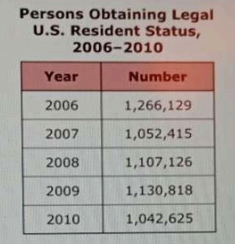
- A. 1,119,823
- B. 223,504
- C. 5,599,113
- D. 1,107,126
Correct Answer & Rationale
Correct Answer: A
To determine the mean number of legal residents over the five-year period, one must sum the total number of residents and divide by five. The correct calculation yields a mean of 1,119,823, reflecting the average annual influx. Option B (223,504) represents a miscalculation, likely reflecting a single year's data rather than an average. Option C (5,599,113) incorrectly totals the residents without division, suggesting a cumulative number rather than an average. Option D (1,107,126) is close but does not accurately reflect the mean, indicating a minor arithmetic error.
To determine the mean number of legal residents over the five-year period, one must sum the total number of residents and divide by five. The correct calculation yields a mean of 1,119,823, reflecting the average annual influx. Option B (223,504) represents a miscalculation, likely reflecting a single year's data rather than an average. Option C (5,599,113) incorrectly totals the residents without division, suggesting a cumulative number rather than an average. Option D (1,107,126) is close but does not accurately reflect the mean, indicating a minor arithmetic error.