This passage provides information about the Roman Republic.
The Roman Republic was founded in 509 BCE and lasted for almost 500 years. The pillars of the republic were the consuls and magistrates, the Senate, and the Popular Assemblies.
Two leaders (called consuls) were elected by the Senate, and they served for one year each. Each consul could veto acts of the other. They were responsible for the conduct of war, finances, and the judiciary. Although powerful, the consuls governed with the advice of the Senate. The magistrates served as public officials in the executive branch of the government and were elected to terms with defined limits.
The Senate consisted of heads of clans and former consuls, and members served for life. Besides electing and advising consuls, the Senate's role was to enact "decrees of the Senate." These decrees did not have formal authority but were often considered in legal cases.
The common people also formed the Popular Assemblies, where they approved laws proposed by magistrates. The common people in the assemblies voted for tribunes who had the power to support or reject laws, senatorial decrees, and election results. Tribunes served one-year terms.
Based on the information in this passage, which feature of ancient Roman government most influenced the Founders in framing the U.S. Constitution?
- A. A popularly elected representative vetoed legislation.
- B. Magistrates proposed laws.
- C. A system of checks and balances limited power.
- D. Senators elected the consuls.
Correct Answer & Rationale
Correct Answer: C
The feature that most influenced the Founders in framing the U.S. Constitution is the system of checks and balances, which limited the power of government branches to prevent tyranny. This principle is evident in the U.S. system, where each branch can check the others, ensuring a balance of power. Option A is incorrect because while representatives play a role in legislation, the emphasis on a veto by a popularly elected official is not a defining characteristic of Roman governance. Option B, proposing laws by magistrates, describes a function of government but does not reflect the broader concept of power limitation. Option D incorrectly focuses on the election of consuls, which is less relevant to the Founders' emphasis on checks and balances.
The feature that most influenced the Founders in framing the U.S. Constitution is the system of checks and balances, which limited the power of government branches to prevent tyranny. This principle is evident in the U.S. system, where each branch can check the others, ensuring a balance of power. Option A is incorrect because while representatives play a role in legislation, the emphasis on a veto by a popularly elected official is not a defining characteristic of Roman governance. Option B, proposing laws by magistrates, describes a function of government but does not reflect the broader concept of power limitation. Option D incorrectly focuses on the election of consuls, which is less relevant to the Founders' emphasis on checks and balances.
Other Related Questions
Which statement identifies the purpose of President Nixon's message?
- A. to convince Congress that technological advancement and population growth must be slowed to protect the environment
- B. to convince Congress that industrial polluters of the air and water should not pay for cleaning the environment
- C. to convince Congress that it must take part in action to address human damage to the environment
- D. to convince Congress that there should be no benefits for businesses that pollute the environment
Correct Answer & Rationale
Correct Answer: C
President Nixon's message aimed to mobilize Congress to actively engage in addressing environmental degradation caused by human activities. This focus on collective action underscores the urgency of legislative involvement in environmental protection. Option A misinterprets the goal, as Nixon did not advocate for slowing technological advancement but rather for responsible management. Option B inaccurately suggests that he supported industrial polluters avoiding responsibility, which contradicts his environmental stance. Option D implies a complete lack of support for businesses, neglecting the balanced approach Nixon promoted towards regulatory measures and economic growth.
President Nixon's message aimed to mobilize Congress to actively engage in addressing environmental degradation caused by human activities. This focus on collective action underscores the urgency of legislative involvement in environmental protection. Option A misinterprets the goal, as Nixon did not advocate for slowing technological advancement but rather for responsible management. Option B inaccurately suggests that he supported industrial polluters avoiding responsibility, which contradicts his environmental stance. Option D implies a complete lack of support for businesses, neglecting the balanced approach Nixon promoted towards regulatory measures and economic growth.
Which statement from the passage is an opinion?
- A. "The ill-advised rush to extract new discoveries of shale oil and natural gas is a case in point."
- B. "...if the result is polluted water and ghost towns, it is not a sustainable model."
- C. “‘Sustainability' means using natural resources responsibly so that they are available to future generations."
- D. "... to achieve sustainability a business will not view profit only in terms of dollars."
Correct Answer & Rationale
Correct Answer: A
Option A expresses a subjective viewpoint about the extraction of shale oil and natural gas, labeling it as "ill-advised." This indicates a personal judgment rather than an objective fact. In contrast, Option B presents a consequence of unsustainable practices, framing it as a logical outcome rather than an opinion. Option C defines "sustainability" in a factual manner, outlining its meaning without personal bias. Lastly, Option D describes a business approach towards sustainability, focusing on a principle rather than expressing a personal belief. Thus, A stands out as the only statement rooted in opinion.
Option A expresses a subjective viewpoint about the extraction of shale oil and natural gas, labeling it as "ill-advised." This indicates a personal judgment rather than an objective fact. In contrast, Option B presents a consequence of unsustainable practices, framing it as a logical outcome rather than an opinion. Option C defines "sustainability" in a factual manner, outlining its meaning without personal bias. Lastly, Option D describes a business approach towards sustainability, focusing on a principle rather than expressing a personal belief. Thus, A stands out as the only statement rooted in opinion.
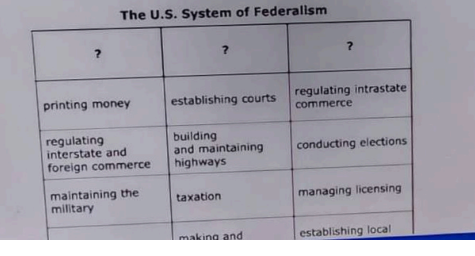
Complete the U.S. System of Federalism chart based on information from the passage. Click on the title below you want to select and drag it into the top of each column in the chart.
Correct Answer & Rationale
Correct Answer:
**Correct answer:** Federal Government **Rationale:** The Federal Government is responsible for national issues such as defense, immigration, and foreign policy, which distinguishes it from state governments. State Governments handle local matters like education and transportation, focusing on regional needs. The option "Local Government" refers to municipal or county levels, which operate under the authority of the state and do not encompass federal responsibilities. Therefore, the Federal Government is accurately placed at the top of the federalism chart, while the other options misrepresent the hierarchy and scope of governance in the U.S. system.
**Correct answer:** Federal Government **Rationale:** The Federal Government is responsible for national issues such as defense, immigration, and foreign policy, which distinguishes it from state governments. State Governments handle local matters like education and transportation, focusing on regional needs. The option "Local Government" refers to municipal or county levels, which operate under the authority of the state and do not encompass federal responsibilities. Therefore, the Federal Government is accurately placed at the top of the federalism chart, while the other options misrepresent the hierarchy and scope of governance in the U.S. system.
Which basic assumption is only behind the speech?
- A. Freedom of speech must be protected in schools.
- B. Citizens can express their views through symbols.
- C. Citizens should be able to express their views on issues.
- D. Freedom of speech has some restrictions
Correct Answer & Rationale
Correct Answer: D
The assumption that freedom of speech has some restrictions is solely focused on the speech itself, acknowledging that while individuals have the right to express themselves, this right is not absolute. Option A discusses the protection of speech specifically in schools, which implies a context rather than the nature of speech itself. Option B refers to expression through symbols, indicating non-verbal communication, thus not limited to speech. Option C emphasizes the ability to express views on issues broadly, again not confined to speech alone. Each of these options extends beyond the core principle of speech restrictions.
The assumption that freedom of speech has some restrictions is solely focused on the speech itself, acknowledging that while individuals have the right to express themselves, this right is not absolute. Option A discusses the protection of speech specifically in schools, which implies a context rather than the nature of speech itself. Option B refers to expression through symbols, indicating non-verbal communication, thus not limited to speech. Option C emphasizes the ability to express views on issues broadly, again not confined to speech alone. Each of these options extends beyond the core principle of speech restrictions.