The information in the table is from the U.S. Census Bureau. The information in the map is from the Library of Congress.
Which statement is supported by both the table and the map?
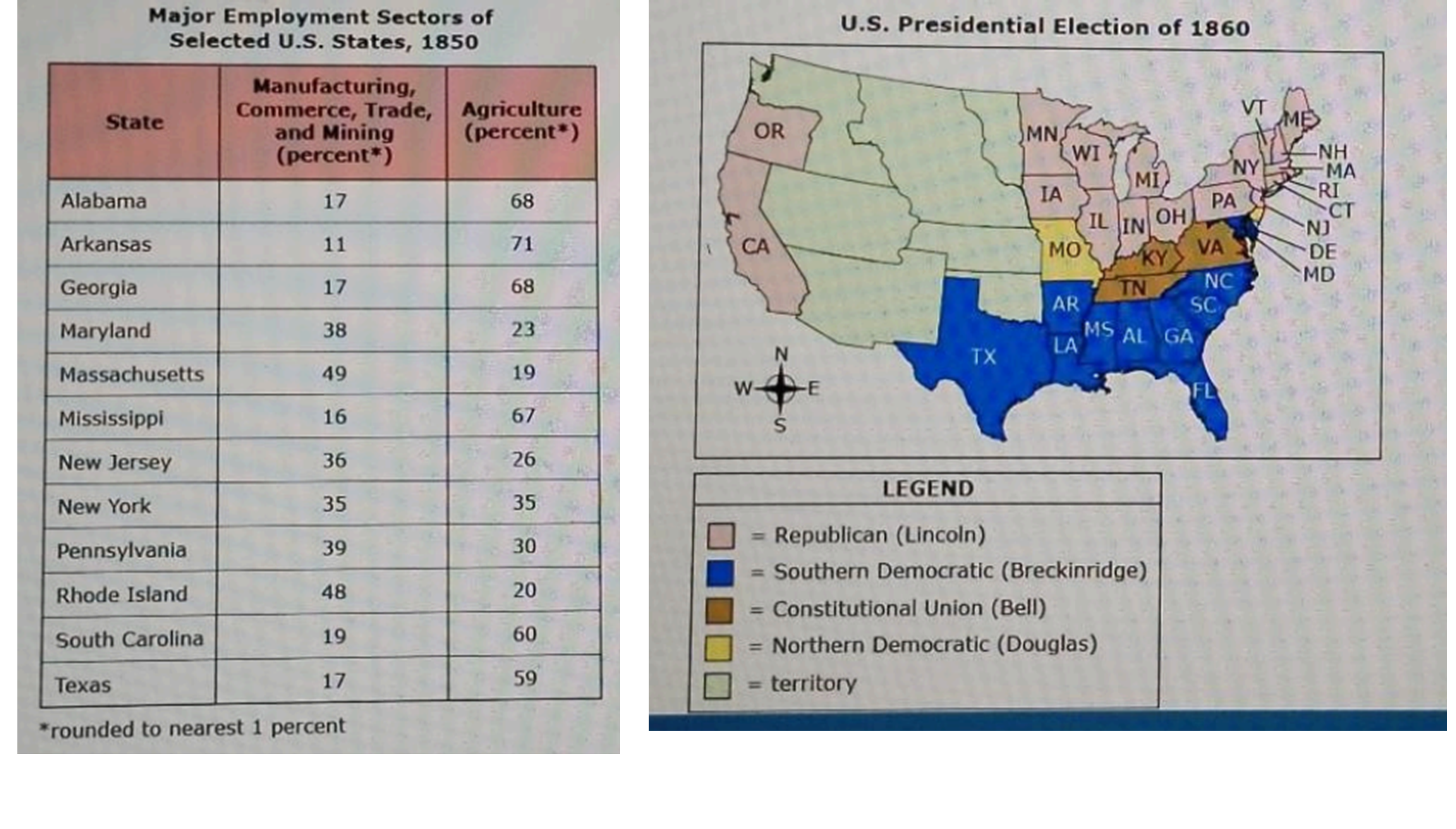
- A. Differences in the total populations of the states led to political differences between the North and the South.
- B. Differences among the economies of the states contributed to political differences between the North and the South.
- C. Political differences between the North and the South reflected differences in education among the states.
- D. Political differences between the North and the South reflected differences in the standards of living in the states.
Correct Answer & Rationale
Correct Answer: B
Option B is supported by both the table and the map, as they illustrate how varying economic structures—such as agriculture in the South versus industrialization in the North—contributed to distinct political ideologies and policies. Option A incorrectly attributes political differences solely to population size, overlooking the economic factors at play. Option C suggests education differences as the main cause, which is not evident in the provided data. Option D implies that living standards were the primary influence, but the economic context is more directly linked to the political divide. Thus, B effectively encapsulates the relationship between economy and political differences.
Option B is supported by both the table and the map, as they illustrate how varying economic structures—such as agriculture in the South versus industrialization in the North—contributed to distinct political ideologies and policies. Option A incorrectly attributes political differences solely to population size, overlooking the economic factors at play. Option C suggests education differences as the main cause, which is not evident in the provided data. Option D implies that living standards were the primary influence, but the economic context is more directly linked to the political divide. Thus, B effectively encapsulates the relationship between economy and political differences.
Other Related Questions
Which statement provides the main idea of the passage?
- A. The founders understood the importance of dividing war powers in the U.S. Constitution.
- B. President Truman used presidential war powers to send troops to South Korea.
- C. Congress restricted presidential war powers as a result of the Vietnam War.
- D. A conflict over presidential war powers exists in the U.S. government.
Correct Answer & Rationale
Correct Answer: D
Option D effectively captures the overarching theme of the passage by highlighting the ongoing conflict regarding presidential war powers within the U.S. government. This statement reflects the central issue discussed throughout the text. Option A, while relevant, focuses solely on the founders' intentions rather than the current implications of war powers. Option B is too specific, addressing a single historical instance rather than the broader concept of power dynamics. Option C, although it mentions a relevant event, limits the discussion to the Vietnam War and does not encompass the ongoing nature of the conflict over these powers.
Option D effectively captures the overarching theme of the passage by highlighting the ongoing conflict regarding presidential war powers within the U.S. government. This statement reflects the central issue discussed throughout the text. Option A, while relevant, focuses solely on the founders' intentions rather than the current implications of war powers. Option B is too specific, addressing a single historical instance rather than the broader concept of power dynamics. Option C, although it mentions a relevant event, limits the discussion to the Vietnam War and does not encompass the ongoing nature of the conflict over these powers.
What is the meaning of confederation in this passage?
- A. a government in which the whole population of a country votes to make laws for the people
- B. a political union in which power is divided between a strong central authority and the various other political units
- C. a political union in which the component units retain significant independence from the central government
- D. a government in which people vote to elect representatives who make laws for the people
Correct Answer & Rationale
Correct Answer: C
Confederation refers to a political union where individual components maintain considerable autonomy while cooperating for mutual benefit. Option C accurately captures this definition, emphasizing the independence of component units from the central authority. Option A describes a direct democracy, which is not aligned with the concept of confederation. Option B suggests a balance of power that leans towards a strong central authority, contradicting the essence of a confederation. Option D outlines a representative democracy, which does not inherently involve the independence of component units, thus misrepresenting the nature of a confederation.
Confederation refers to a political union where individual components maintain considerable autonomy while cooperating for mutual benefit. Option C accurately captures this definition, emphasizing the independence of component units from the central authority. Option A describes a direct democracy, which is not aligned with the concept of confederation. Option B suggests a balance of power that leans towards a strong central authority, contradicting the essence of a confederation. Option D outlines a representative democracy, which does not inherently involve the independence of component units, thus misrepresenting the nature of a confederation.
Which statement from President Polk's address is a fact rather than an opinion?
- A. "Our title to… Oregon is 'clear and unquestionable,' and already are our people preparing to perfect that title by occupying it with their wives and children..."
- B. "[O]ur people… have filled the eastern valley of the Mississippi,... ascended the Missouri to its headsprings..."
- C. "Nor will it become in a less degree my duty to… maintain by all constitutional means the right of the United States to that portion of our territory which lies beyond the Rocky Mountains."
- D. "The jurisdiction of our laws and the benefits of our republican institutions should be extended over them in the distant regions which they have selected for their homes."
Correct Answer & Rationale
Correct Answer: B
Option B presents a factual statement about the movement of people in the United States, specifically noting their migration patterns along the Mississippi and Missouri rivers. This statement can be verified through historical records, making it a fact. In contrast, Option A expresses a subjective belief regarding the clarity of the title to Oregon, which is an opinion rather than an objective truth. Option C discusses the duty of the President in a way that implies a commitment but does not provide verifiable information. Lastly, Option D suggests a normative view on governance and territorial expansion, reflecting a belief in the benefits of U.S. institutions rather than stating a fact.
Option B presents a factual statement about the movement of people in the United States, specifically noting their migration patterns along the Mississippi and Missouri rivers. This statement can be verified through historical records, making it a fact. In contrast, Option A expresses a subjective belief regarding the clarity of the title to Oregon, which is an opinion rather than an objective truth. Option C discusses the duty of the President in a way that implies a commitment but does not provide verifiable information. Lastly, Option D suggests a normative view on governance and territorial expansion, reflecting a belief in the benefits of U.S. institutions rather than stating a fact.
Based on the information in this passage, which feature of ancient Roman government most influenced the Founders in framing the U.S. Constitution?
- A. A popularly elected representative vetoed legislation.
- B. Magistrates proposed laws.
- C. A system of checks and balances limited power.
- D. Senators elected the consuls.
Correct Answer & Rationale
Correct Answer: C
The feature that most influenced the Founders in framing the U.S. Constitution is the system of checks and balances, which limited the power of government branches to prevent tyranny. This principle is evident in the U.S. system, where each branch can check the others, ensuring a balance of power. Option A is incorrect because while representatives play a role in legislation, the emphasis on a veto by a popularly elected official is not a defining characteristic of Roman governance. Option B, proposing laws by magistrates, describes a function of government but does not reflect the broader concept of power limitation. Option D incorrectly focuses on the election of consuls, which is less relevant to the Founders' emphasis on checks and balances.
The feature that most influenced the Founders in framing the U.S. Constitution is the system of checks and balances, which limited the power of government branches to prevent tyranny. This principle is evident in the U.S. system, where each branch can check the others, ensuring a balance of power. Option A is incorrect because while representatives play a role in legislation, the emphasis on a veto by a popularly elected official is not a defining characteristic of Roman governance. Option B, proposing laws by magistrates, describes a function of government but does not reflect the broader concept of power limitation. Option D incorrectly focuses on the election of consuls, which is less relevant to the Founders' emphasis on checks and balances.