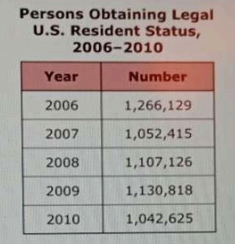
This table contains information from the U.S. Department of Homeland Security.
What is the mean number of people who became legal residents of the United States during this five-year period?
- A. 1,119,823
- B. 223,504
- C. 5,599,113
- D. 1,107,126
Correct Answer & Rationale
Correct Answer: A
To determine the mean number of legal residents over the five-year period, one must sum the total number of residents and divide by five. The correct calculation yields a mean of 1,119,823, reflecting the average annual influx. Option B (223,504) represents a miscalculation, likely reflecting a single year's data rather than an average. Option C (5,599,113) incorrectly totals the residents without division, suggesting a cumulative number rather than an average. Option D (1,107,126) is close but does not accurately reflect the mean, indicating a minor arithmetic error.
To determine the mean number of legal residents over the five-year period, one must sum the total number of residents and divide by five. The correct calculation yields a mean of 1,119,823, reflecting the average annual influx. Option B (223,504) represents a miscalculation, likely reflecting a single year's data rather than an average. Option C (5,599,113) incorrectly totals the residents without division, suggesting a cumulative number rather than an average. Option D (1,107,126) is close but does not accurately reflect the mean, indicating a minor arithmetic error.
Other Related Questions
How did the position expressed by President Johnson differ from the position expressed by Senator Russell?
- A. Only Senator Russell said that state governments were sufficiently protecting the rights of citizens.
- B. Only Senator Russell supported the federal government's intervention.
- C. Only President Johnson supported the state governments' rights to manage their own affairs.
- D. Only President Johnson believed that the federal government was authorized to intervene.
Correct Answer & Rationale
Correct Answer: A
President Johnson emphasized the need for federal intervention to protect citizens' rights, believing that state governments were often inadequate. In contrast, Senator Russell argued that state governments were effectively safeguarding those rights, reflecting a stance of local governance. Option B is incorrect because Senator Russell did not support federal intervention. Option C misrepresents Johnson’s position; he favored federal oversight rather than state autonomy. Option D inaccurately attributes the belief in federal authority solely to Johnson, as Russell did not share this view. Thus, the distinction lies in Russell's confidence in state governments versus Johnson's call for federal action.
President Johnson emphasized the need for federal intervention to protect citizens' rights, believing that state governments were often inadequate. In contrast, Senator Russell argued that state governments were effectively safeguarding those rights, reflecting a stance of local governance. Option B is incorrect because Senator Russell did not support federal intervention. Option C misrepresents Johnson’s position; he favored federal oversight rather than state autonomy. Option D inaccurately attributes the belief in federal authority solely to Johnson, as Russell did not share this view. Thus, the distinction lies in Russell's confidence in state governments versus Johnson's call for federal action.
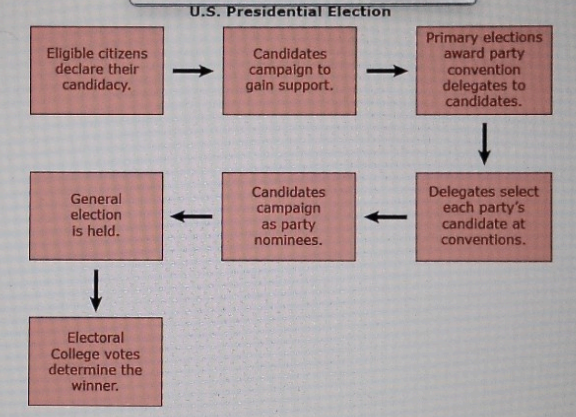
Based on the flowchart, how is a political party's presidential candidate selected?
- A. by balloting after the general election
- B. by balloting at the party convention
- C. by votes cast in party primary elections
- D. by votes cast in the general election
Correct Answer & Rationale
Correct Answer: C
The selection of a political party's presidential candidate primarily occurs through votes cast in party primary elections. This process allows party members to express their preferences for candidates before the general election, ensuring that the nominee reflects the party's values and priorities. Option A is incorrect because the general election occurs after the candidate has already been chosen. Option B, while related to the convention, is misleading as the convention typically formalizes the candidate chosen in the primaries rather than selecting them. Option D is also incorrect, as the general election determines the overall winner, not the party's candidate.
The selection of a political party's presidential candidate primarily occurs through votes cast in party primary elections. This process allows party members to express their preferences for candidates before the general election, ensuring that the nominee reflects the party's values and priorities. Option A is incorrect because the general election occurs after the candidate has already been chosen. Option B, while related to the convention, is misleading as the convention typically formalizes the candidate chosen in the primaries rather than selecting them. Option D is also incorrect, as the general election determines the overall winner, not the party's candidate.
Which statement about the ratification of the 19th Amendment is based on the passage?
- A. Ratification was the result of the Seneca Falls Convention.
- B. Ratification occurred in return for the military service of women during World War I.
- C. Ratification occurred prior to the granting of voting rights to freed slaves.
- D. Ratification was the result of the accumulated efforts of women for decades.
Correct Answer & Rationale
Correct Answer: D
The ratification of the 19th Amendment was the culmination of decades of advocacy and activism by women who fought tirelessly for their voting rights, making option D the most accurate statement. Option A incorrectly attributes the ratification solely to the Seneca Falls Convention, which was just one of many events in the long struggle for women's suffrage. Option B suggests a direct exchange of military service for voting rights, which oversimplifies the complex social and political factors involved. Option C misrepresents the timeline, as the 19th Amendment was ratified after the Civil War, but the fight for voting rights for freed slaves and women evolved concurrently, not sequentially.
The ratification of the 19th Amendment was the culmination of decades of advocacy and activism by women who fought tirelessly for their voting rights, making option D the most accurate statement. Option A incorrectly attributes the ratification solely to the Seneca Falls Convention, which was just one of many events in the long struggle for women's suffrage. Option B suggests a direct exchange of military service for voting rights, which oversimplifies the complex social and political factors involved. Option C misrepresents the timeline, as the 19th Amendment was ratified after the Civil War, but the fight for voting rights for freed slaves and women evolved concurrently, not sequentially.
What is the meaning of the word entrenched as used in this excerpt?
- A. in control
- B. strongly defended
- C. established and unlikely to change
- D. surrounded and unable to move
Correct Answer & Rationale
Correct Answer: C
The term "entrenched" conveys the idea of something that is firmly established and resistant to change, aligning with option C. This suggests a deep-rooted nature, often implying that it has become a significant part of a system or belief. Option A, "in control," does not capture the essence of being deeply embedded or resistant to alteration. Option B, "strongly defended," implies a protective stance rather than a state of being firmly established. Option D, "surrounded and unable to move," suggests physical confinement rather than the figurative sense of being firmly set in place.
The term "entrenched" conveys the idea of something that is firmly established and resistant to change, aligning with option C. This suggests a deep-rooted nature, often implying that it has become a significant part of a system or belief. Option A, "in control," does not capture the essence of being deeply embedded or resistant to alteration. Option B, "strongly defended," implies a protective stance rather than a state of being firmly established. Option D, "surrounded and unable to move," suggests physical confinement rather than the figurative sense of being firmly set in place.