This excerpt is from a message delivered by President Richard Nixon to the U.S. Congress in 1970.
[W]e in this century have too casually and too long abused our natural environment.
The fight against pollution is not a search for villains. For the most part, the damage done to our environment has not been the work of evil men, nor has it been the inevitable by-product either of advancing technology or of growing population. It results not so much from choices made, as from choices neglected; not from [evil] intention, but from failure to take into account the full consequences of our actions.
The tasks that need doing... call for fundamentally new philosophies of land, air and water use, for stricter regulation, for expanded government action, for greater citizen involvement, and for new programs to ensure that government, industry and individuals all are called on to do their share of the job and to pay their share of the cost.
Which statement identifies the purpose of President Nixon's message?
- A. to convince Congress that technological advancement and population growth must be slowed to protect the environment
- B. to convince Congress that industrial polluters of the air and water should not pay for cleaning the environment
- C. to convince Congress that it must take part in action to address human damage to the environment
- D. to convince Congress that there should be no benefits for businesses that pollute the environment
Correct Answer & Rationale
Correct Answer: C
President Nixon's message aimed to mobilize Congress to actively engage in addressing environmental degradation caused by human activities. This focus on collective action underscores the urgency of legislative involvement in environmental protection. Option A misinterprets the goal, as Nixon did not advocate for slowing technological advancement but rather for responsible management. Option B inaccurately suggests that he supported industrial polluters avoiding responsibility, which contradicts his environmental stance. Option D implies a complete lack of support for businesses, neglecting the balanced approach Nixon promoted towards regulatory measures and economic growth.
President Nixon's message aimed to mobilize Congress to actively engage in addressing environmental degradation caused by human activities. This focus on collective action underscores the urgency of legislative involvement in environmental protection. Option A misinterprets the goal, as Nixon did not advocate for slowing technological advancement but rather for responsible management. Option B inaccurately suggests that he supported industrial polluters avoiding responsibility, which contradicts his environmental stance. Option D implies a complete lack of support for businesses, neglecting the balanced approach Nixon promoted towards regulatory measures and economic growth.
Other Related Questions
Which statement best describes the action of the people in the photograph?
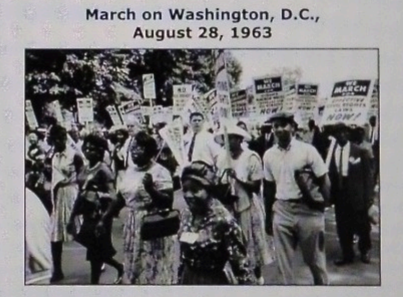
- A. They are utilizing an 8th Amendment right to secure the release of a colleague who was jailed unfairly.
- B. They are utilizing a 6th Amendment right to secure a fair trial for a jailed associate.
- C. They are utilizing a 1st Amendment right to secure equality under the law.
- D. They are utilizing a 14th Amendment right to secure the opportunity to vote in federal elections.
Correct Answer & Rationale
Correct Answer: C
The action depicted in the photograph aligns with the 1st Amendment, which guarantees freedoms concerning speech, assembly, and the right to petition the government. The individuals are likely advocating for equality under the law, a fundamental principle of democratic society. Option A incorrectly references the 8th Amendment, which focuses on protection against excessive bail and cruel punishment, not the right to protest for a colleague's release. Option B misapplies the 6th Amendment, which ensures the right to a fair trial, rather than addressing broader issues of equality. Option D inaccurately connects the situation to the 14th Amendment, which deals with citizenship rights and equal protection, not specifically voting rights.
The action depicted in the photograph aligns with the 1st Amendment, which guarantees freedoms concerning speech, assembly, and the right to petition the government. The individuals are likely advocating for equality under the law, a fundamental principle of democratic society. Option A incorrectly references the 8th Amendment, which focuses on protection against excessive bail and cruel punishment, not the right to protest for a colleague's release. Option B misapplies the 6th Amendment, which ensures the right to a fair trial, rather than addressing broader issues of equality. Option D inaccurately connects the situation to the 14th Amendment, which deals with citizenship rights and equal protection, not specifically voting rights.
Which prediction is supported by both graphs?
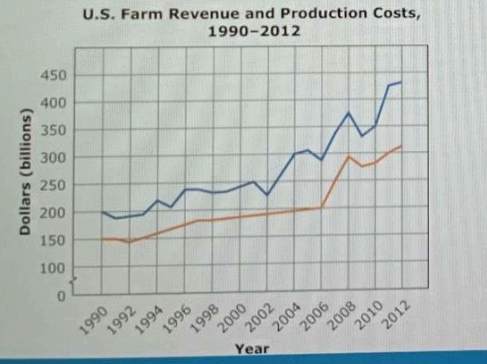
- A. The average wage for farm workers will decrease..
- B. The average cost for agricultural produce will decrease.
- C. The operating cost of running a farm will increase.
- D. The number of people required for producing food will increase.
Correct Answer & Rationale
Correct Answer: C
Option C is supported by both graphs, indicating an upward trend in operational costs due to factors like inflation and increased resource prices. This aligns with economic patterns observed in the agricultural sector. Option A is incorrect as both graphs do not show a decline in farm worker wages; rather, they suggest stability or growth. Option B is misleading; the graphs do not reflect a decrease in agricultural produce costs, which often correlate with rising operational expenses. Option D is also unsupported, as the data does not indicate an increase in labor requirements, but rather highlights efficiency improvements in farming practices.
Option C is supported by both graphs, indicating an upward trend in operational costs due to factors like inflation and increased resource prices. This aligns with economic patterns observed in the agricultural sector. Option A is incorrect as both graphs do not show a decline in farm worker wages; rather, they suggest stability or growth. Option B is misleading; the graphs do not reflect a decrease in agricultural produce costs, which often correlate with rising operational expenses. Option D is also unsupported, as the data does not indicate an increase in labor requirements, but rather highlights efficiency improvements in farming practices.
According to Justice Marshall, what historical factor has contradicted the ideas expressed in the U.S. Constitution?
- A. slavery
- B. free enterprise
- C. religion
- D. class war
Correct Answer & Rationale
Correct Answer: A
Justice Marshall highlighted slavery as a significant historical contradiction to the principles of freedom and equality enshrined in the U.S. Constitution. Slavery directly undermined the Constitution's assertion that all men are created equal, creating a profound moral and ethical conflict. In contrast, free enterprise (B) aligns with the Constitution's emphasis on individual rights and economic freedom. Religion (C) is protected under the First Amendment, promoting freedom rather than contradiction. Class war (D) is a socio-economic conflict that, while relevant, does not directly challenge the foundational ideals of the Constitution in the same way slavery does.
Justice Marshall highlighted slavery as a significant historical contradiction to the principles of freedom and equality enshrined in the U.S. Constitution. Slavery directly undermined the Constitution's assertion that all men are created equal, creating a profound moral and ethical conflict. In contrast, free enterprise (B) aligns with the Constitution's emphasis on individual rights and economic freedom. Religion (C) is protected under the First Amendment, promoting freedom rather than contradiction. Class war (D) is a socio-economic conflict that, while relevant, does not directly challenge the foundational ideals of the Constitution in the same way slavery does.
Which statement best explains the situation described in the paragraphs?
- A. Crude oil prices in 2014 encouraged U.S. families to buy less gasoline in 2015.
- B. Crude oil production levels have caused U.S. gasoline prices to fall.
- C. Greater crude oil reserves have caused the U.S. government to reduce gasoline prices.
- D. Lower crude oil production will cause U.S. gasoline prices to return to 2014 levels by 2016.
Correct Answer & Rationale
Correct Answer: B
Option B accurately reflects the relationship between crude oil production levels and gasoline prices. Increased production typically leads to lower prices, as supply outstrips demand. Option A incorrectly suggests a direct correlation between crude oil prices in 2014 and gasoline purchases in 2015, neglecting the influence of production levels. Option C misrepresents the role of reserves; while greater reserves can impact prices, it is production levels that directly affect market prices. Option D speculates on future price increases due to lower production, which is uncertain and not directly supported by the information provided.
Option B accurately reflects the relationship between crude oil production levels and gasoline prices. Increased production typically leads to lower prices, as supply outstrips demand. Option A incorrectly suggests a direct correlation between crude oil prices in 2014 and gasoline purchases in 2015, neglecting the influence of production levels. Option C misrepresents the role of reserves; while greater reserves can impact prices, it is production levels that directly affect market prices. Option D speculates on future price increases due to lower production, which is uncertain and not directly supported by the information provided.