This excerpt is from a 1987 speech by U.S. Supreme Court Justice Thurgood Marshall.
"I do not believe that the meaning of the Constitution was forever "fixed" at the Philadelphia Convention. Nor do I find the wisdom, foresight, and sense of justice exhibited by the Framers particularly profound. To the contrary, the government they devised was defective from the start, requiring several amendments, a civil war, and momentous social transformation to attain the system of constitutional government, and its respect for the individual freedoms and human rights, we hold as fundamental today. When contemporary Americans cite "The Constitution," they invoke concept that is vastly different from what the Framers barely began to construct two centurie ago... When the Founding Fathers used this phrase [We, the People) in 1787, they did not have in mind the majority of America's citizens. "We the People" included, in the words of the Framers, "the whole Number of free Persons."
This excerpt is from a 1987 speech by President Ronald Reagan.
“In a very real sense, it was then, in 1787, that the Revolution truly began. For it was with the writing of our Constitution, setting down the architecture of democratic government, that the noble sentiments and brave rhetoric of 1776 took on substance....
All men are created equal and endowed by their Creator with certain inalienable rights-until that moment some might have said that was just a high-blown sentiment, the dreams of a few philosophers and their hot-headed followers. But could one really construct a government, run a country, with such idealistic notions? But once those ideals took root in living, functioning institutions, once those notions became a nation-well, then, as I said, the revolution could really begin, not just in America but around the world, a revolution to free man from tyranny of every sort and secure his freedom the only way possible in this world, through the checks and balances and institutions of limited, democratic government.â€
According to Justice Marshall, what historical factor has contradicted the ideas expressed in the U.S. Constitution?
- A. slavery
- B. free enterprise
- C. religion
- D. class war
Correct Answer & Rationale
Correct Answer: A
Justice Marshall highlighted slavery as a significant historical contradiction to the principles of freedom and equality enshrined in the U.S. Constitution. Slavery directly undermined the Constitution's assertion that all men are created equal, creating a profound moral and ethical conflict. In contrast, free enterprise (B) aligns with the Constitution's emphasis on individual rights and economic freedom. Religion (C) is protected under the First Amendment, promoting freedom rather than contradiction. Class war (D) is a socio-economic conflict that, while relevant, does not directly challenge the foundational ideals of the Constitution in the same way slavery does.
Justice Marshall highlighted slavery as a significant historical contradiction to the principles of freedom and equality enshrined in the U.S. Constitution. Slavery directly undermined the Constitution's assertion that all men are created equal, creating a profound moral and ethical conflict. In contrast, free enterprise (B) aligns with the Constitution's emphasis on individual rights and economic freedom. Religion (C) is protected under the First Amendment, promoting freedom rather than contradiction. Class war (D) is a socio-economic conflict that, while relevant, does not directly challenge the foundational ideals of the Constitution in the same way slavery does.
Other Related Questions
Which historical event shaped President Wilson's point of view?
- A. the enactment of the Neutrality Acts
- B. the building of the Panama Canal
- C. the outcome of the Spanish-American War
- D. the fighting in World War I
Correct Answer & Rationale
Correct Answer: D
President Wilson's perspective was profoundly shaped by the fighting in World War I, as it highlighted the need for a new approach to international relations and the promotion of democracy. His commitment to a peaceful resolution and the establishment of the League of Nations stemmed from the devastation of the war. Option A, the Neutrality Acts, reflects a desire to avoid conflict, but they were enacted after Wilson's initial views were formed. Option B, the Panama Canal, was significant for U.S. expansion but did not directly influence Wilson's foreign policy. Option C, the Spanish-American War, marked an earlier phase of U.S. imperialism, contrasting with Wilson's focus on self-determination and peace.
President Wilson's perspective was profoundly shaped by the fighting in World War I, as it highlighted the need for a new approach to international relations and the promotion of democracy. His commitment to a peaceful resolution and the establishment of the League of Nations stemmed from the devastation of the war. Option A, the Neutrality Acts, reflects a desire to avoid conflict, but they were enacted after Wilson's initial views were formed. Option B, the Panama Canal, was significant for U.S. expansion but did not directly influence Wilson's foreign policy. Option C, the Spanish-American War, marked an earlier phase of U.S. imperialism, contrasting with Wilson's focus on self-determination and peace.
Which statement best explains the situation described in the paragraphs?
- A. Crude oil prices in 2014 encouraged U.S. families to buy less gasoline in 2015.
- B. Crude oil production levels have caused U.S. gasoline prices to fall.
- C. Greater crude oil reserves have caused the U.S. government to reduce gasoline prices.
- D. Lower crude oil production will cause U.S. gasoline prices to return to 2014 levels by 2016.
Correct Answer & Rationale
Correct Answer: B
Option B accurately reflects the relationship between crude oil production levels and gasoline prices. Increased production typically leads to lower prices, as supply outstrips demand. Option A incorrectly suggests a direct correlation between crude oil prices in 2014 and gasoline purchases in 2015, neglecting the influence of production levels. Option C misrepresents the role of reserves; while greater reserves can impact prices, it is production levels that directly affect market prices. Option D speculates on future price increases due to lower production, which is uncertain and not directly supported by the information provided.
Option B accurately reflects the relationship between crude oil production levels and gasoline prices. Increased production typically leads to lower prices, as supply outstrips demand. Option A incorrectly suggests a direct correlation between crude oil prices in 2014 and gasoline purchases in 2015, neglecting the influence of production levels. Option C misrepresents the role of reserves; while greater reserves can impact prices, it is production levels that directly affect market prices. Option D speculates on future price increases due to lower production, which is uncertain and not directly supported by the information provided.
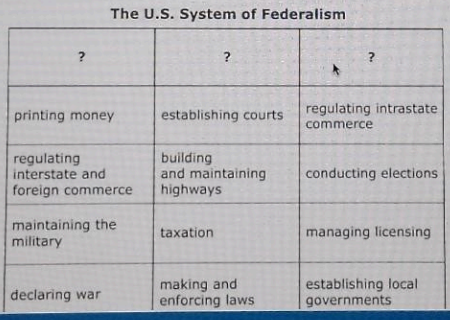
Complete the U.S. System of Federalism chart based on information from the passage. Click on the title below you want to select and drag it into the top of each column in the chart. - State Government Powers - National Government Powers - Shared Powers of National and State Governments -
Correct Answer & Rationale
Correct Answer:
In the U.S. system of federalism, powers are distributed among different levels of government. **State Government Powers** include authority over education, transportation, and local law enforcement, allowing states to address local needs effectively. **National Government Powers** encompass defense, foreign affairs, and immigration, ensuring a unified national policy in these critical areas. **Shared Powers** involve taxation, infrastructure, and law enforcement, illustrating collaboration between state and national governments to maintain order and promote welfare. Other options may misplace powers or overlook the collaborative nature of federalism, leading to misunderstandings about government functions.
In the U.S. system of federalism, powers are distributed among different levels of government. **State Government Powers** include authority over education, transportation, and local law enforcement, allowing states to address local needs effectively. **National Government Powers** encompass defense, foreign affairs, and immigration, ensuring a unified national policy in these critical areas. **Shared Powers** involve taxation, infrastructure, and law enforcement, illustrating collaboration between state and national governments to maintain order and promote welfare. Other options may misplace powers or overlook the collaborative nature of federalism, leading to misunderstandings about government functions.
Which statement about the ratification of the 19th Amendment is based on the passage?
- A. Ratification was the result of the Seneca Falls Convention.
- B. Ratification occurred in return for the military service of women during World War I.
- C. Ratification occurred prior to the granting of voting rights to freed slaves.
- D. Ratification was the result of the accumulated efforts of women for decades.
Correct Answer & Rationale
Correct Answer: D
The ratification of the 19th Amendment was the culmination of decades of advocacy and activism by women who fought tirelessly for their voting rights, making option D the most accurate statement. Option A incorrectly attributes the ratification solely to the Seneca Falls Convention, which was just one of many events in the long struggle for women's suffrage. Option B suggests a direct exchange of military service for voting rights, which oversimplifies the complex social and political factors involved. Option C misrepresents the timeline, as the 19th Amendment was ratified after the Civil War, but the fight for voting rights for freed slaves and women evolved concurrently, not sequentially.
The ratification of the 19th Amendment was the culmination of decades of advocacy and activism by women who fought tirelessly for their voting rights, making option D the most accurate statement. Option A incorrectly attributes the ratification solely to the Seneca Falls Convention, which was just one of many events in the long struggle for women's suffrage. Option B suggests a direct exchange of military service for voting rights, which oversimplifies the complex social and political factors involved. Option C misrepresents the timeline, as the 19th Amendment was ratified after the Civil War, but the fight for voting rights for freed slaves and women evolved concurrently, not sequentially.