This passage uses information published in zutz ty die National Archives.
In 2012 workers at the National Archives preparing an exhibition of the records of immigrants discovered a 1951 document concerning teenaged Holocaust survivor Michael Pupa. Michael, whose parents died in the Holocaust, was one of many war orphans who came to the United States following World War II. Because of relief efforts made by the United Nations (UN) after the war, Pupa became a U.S. citizen in 1957.
These relief efforts were the result of the humanitarian crisis the United States and its allies faced after World War II. Millions of persons who had been forced to leave their homes needed to be resettled. The United States heavily supported and funded the creation of the International Refugee Organization (IRO) in 1946 by the United Nations, which was founded a year earlier.
Michael Pupa arrived in the United States in May of 1951. After living for six months in a United Nations home for refugee children, he moved to Cleveland, Ohio, where he was raised by a foster family and began his life as an American.
Which event occurred first?
- A. Michael moved to Ohio.
- B. Michael attained U.S. citizenship.
- C. The IRO was created.
- D. The UN was established.
Correct Answer & Rationale
Correct Answer: D
To determine the sequence of events, it’s essential to consider historical timelines. The United Nations (UN) was established in 1945, laying the groundwork for international cooperation. The International Refugee Organization (IRO) was created shortly after, in 1946, to address post-war refugee issues. Michael attaining U.S. citizenship likely occurred after these events, as it typically follows immigration processes. Lastly, Michael moving to Ohio would depend on his citizenship status and individual circumstances, making it the most recent event in this context.
To determine the sequence of events, it’s essential to consider historical timelines. The United Nations (UN) was established in 1945, laying the groundwork for international cooperation. The International Refugee Organization (IRO) was created shortly after, in 1946, to address post-war refugee issues. Michael attaining U.S. citizenship likely occurred after these events, as it typically follows immigration processes. Lastly, Michael moving to Ohio would depend on his citizenship status and individual circumstances, making it the most recent event in this context.
Other Related Questions
How did Chief Justice Marshall contribute to the U.S. government system of checks and balances?
- A. by establishing the Supreme Court's power to check Congress
- B. by creating the power to remove the president from office
- C. by expanding the president's power to check Congress
- D. by giving the Supreme Court the power to control itself
Correct Answer & Rationale
Correct Answer: A
Chief Justice Marshall played a pivotal role in defining the Supreme Court's authority, notably through the landmark case Marbury v. Madison, which established the principle of judicial review. This empowered the Court to invalidate laws passed by Congress that it deemed unconstitutional, effectively allowing it to check legislative power. Option B is incorrect as the power to remove a president lies with Congress through impeachment, not the Supreme Court. Option C misrepresents Marshall's contributions, as he did not expand presidential power but rather clarified judicial authority. Option D is also inaccurate; the Supreme Court does not have self-regulating powers but operates within the framework of checks and balances.
Chief Justice Marshall played a pivotal role in defining the Supreme Court's authority, notably through the landmark case Marbury v. Madison, which established the principle of judicial review. This empowered the Court to invalidate laws passed by Congress that it deemed unconstitutional, effectively allowing it to check legislative power. Option B is incorrect as the power to remove a president lies with Congress through impeachment, not the Supreme Court. Option C misrepresents Marshall's contributions, as he did not expand presidential power but rather clarified judicial authority. Option D is also inaccurate; the Supreme Court does not have self-regulating powers but operates within the framework of checks and balances.
Which feature of the U.S. system of government did de Tocqueville believe might cause conflict in society?
- A. The majority is able to achieve special rights.
- B. The minority is able to block popular legislation.
- C. Legislators must represent minority interests.
- D. Legislators sometimes act against majority rule.
Correct Answer & Rationale
Correct Answer: A
De Tocqueville observed that when the majority in a democracy can impose its will, it might lead to the oppression of minority groups, creating societal conflict. This reflects his concern about "tyranny of the majority," where the dominant group's interests overshadow the rights of others. Option B is incorrect because while minorities can influence legislation, de Tocqueville focused more on majority power. Option C misrepresents his views; he acknowledged the importance of minority representation but did not see it as a source of conflict. Option D is also inaccurate, as de Tocqueville emphasized the potential for the majority to dominate rather than legislators opposing the majority.
De Tocqueville observed that when the majority in a democracy can impose its will, it might lead to the oppression of minority groups, creating societal conflict. This reflects his concern about "tyranny of the majority," where the dominant group's interests overshadow the rights of others. Option B is incorrect because while minorities can influence legislation, de Tocqueville focused more on majority power. Option C misrepresents his views; he acknowledged the importance of minority representation but did not see it as a source of conflict. Option D is also inaccurate, as de Tocqueville emphasized the potential for the majority to dominate rather than legislators opposing the majority.
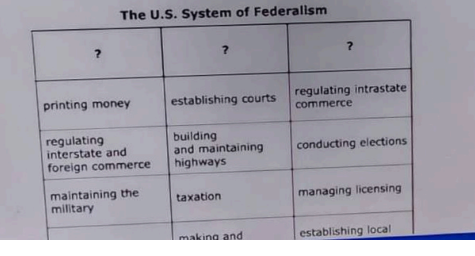
Complete the U.S. System of Federalism chart based on information from the passage. Click on the title below you want to select and drag it into the top of each column in the chart.
Correct Answer & Rationale
Correct Answer:
**Correct answer:** Federal Government **Rationale:** The Federal Government is responsible for national issues such as defense, immigration, and foreign policy, which distinguishes it from state governments. State Governments handle local matters like education and transportation, focusing on regional needs. The option "Local Government" refers to municipal or county levels, which operate under the authority of the state and do not encompass federal responsibilities. Therefore, the Federal Government is accurately placed at the top of the federalism chart, while the other options misrepresent the hierarchy and scope of governance in the U.S. system.
**Correct answer:** Federal Government **Rationale:** The Federal Government is responsible for national issues such as defense, immigration, and foreign policy, which distinguishes it from state governments. State Governments handle local matters like education and transportation, focusing on regional needs. The option "Local Government" refers to municipal or county levels, which operate under the authority of the state and do not encompass federal responsibilities. Therefore, the Federal Government is accurately placed at the top of the federalism chart, while the other options misrepresent the hierarchy and scope of governance in the U.S. system.
What is the meaning of confederation in this passage?
- A. a government in which the whole population of a country votes to make laws for the people
- B. a political union in which power is divided between a strong central authority and the various other political units
- C. a political union in which the component units retain significant independence from the central government
- D. a government in which people vote to elect representatives who make laws for the people
Correct Answer & Rationale
Correct Answer: C
Confederation refers to a political union where individual components maintain considerable autonomy while cooperating for mutual benefit. Option C accurately captures this definition, emphasizing the independence of component units from the central authority. Option A describes a direct democracy, which is not aligned with the concept of confederation. Option B suggests a balance of power that leans towards a strong central authority, contradicting the essence of a confederation. Option D outlines a representative democracy, which does not inherently involve the independence of component units, thus misrepresenting the nature of a confederation.
Confederation refers to a political union where individual components maintain considerable autonomy while cooperating for mutual benefit. Option C accurately captures this definition, emphasizing the independence of component units from the central authority. Option A describes a direct democracy, which is not aligned with the concept of confederation. Option B suggests a balance of power that leans towards a strong central authority, contradicting the essence of a confederation. Option D outlines a representative democracy, which does not inherently involve the independence of component units, thus misrepresenting the nature of a confederation.