This excerpt discussing the U.S. Supreme Court case of Marbury v. Madison (1803) is from an article published by the National Archives in 1995.
"A Law [opposed] to the Constitution is void. With these words written by Chief Justice Marshall, the Supreme Court for the first time declared unconstitutional a law passed by Congress and signed by the President. Nothing in the Constitution gave the Court this specific power. Marshall, however, believed that the Supreme Court should have a role equal to those of the other two branches of government. When James Madison, Alexander Hamilton, and John Jay wrote a defense of the Constitution in The Federalist, they explained... "You must first enable government to control the governed; and in the next place oblige it to control itself."... The Constitution gave Congress the power to... remove officials, including judges or the President himself. The President was given the veto power to restrain Congress and the authority to appoint members of the Supreme Court.... [T]he role of the Supreme Court had not been defined. It therefore fell to a strong Chief Justice like Marshall to complete the triangular structure of checks and balances by establishing the principle of judicial review.
How did Chief Justice Marshall contribute to the U.S. government system of checks and balances?
- A. by establishing the Supreme Court's power to check Congress
- B. by creating the power to remove the president from office
- C. by expanding the president's power to check Congress
- D. by giving the Supreme Court the power to control itself
Correct Answer & Rationale
Correct Answer: A
Chief Justice Marshall played a pivotal role in defining the Supreme Court's authority, notably through the landmark case Marbury v. Madison, which established the principle of judicial review. This empowered the Court to invalidate laws passed by Congress that it deemed unconstitutional, effectively allowing it to check legislative power. Option B is incorrect as the power to remove a president lies with Congress through impeachment, not the Supreme Court. Option C misrepresents Marshall's contributions, as he did not expand presidential power but rather clarified judicial authority. Option D is also inaccurate; the Supreme Court does not have self-regulating powers but operates within the framework of checks and balances.
Chief Justice Marshall played a pivotal role in defining the Supreme Court's authority, notably through the landmark case Marbury v. Madison, which established the principle of judicial review. This empowered the Court to invalidate laws passed by Congress that it deemed unconstitutional, effectively allowing it to check legislative power. Option B is incorrect as the power to remove a president lies with Congress through impeachment, not the Supreme Court. Option C misrepresents Marshall's contributions, as he did not expand presidential power but rather clarified judicial authority. Option D is also inaccurate; the Supreme Court does not have self-regulating powers but operates within the framework of checks and balances.
Other Related Questions
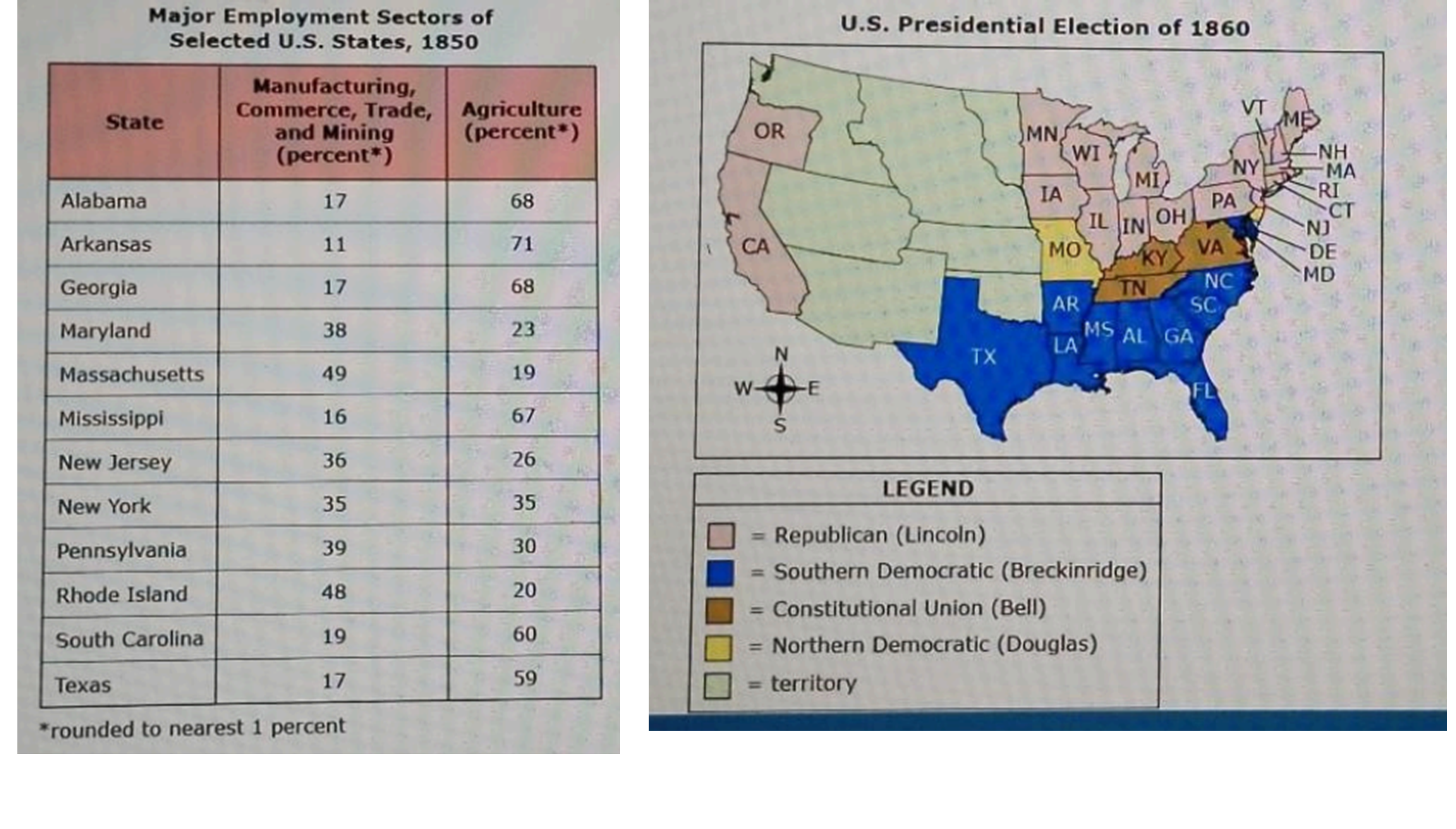
Which statement is supported by both the table and the map?
- A. Differences in the total populations of the states led to political differences between the North and the South.
- B. Differences among the economies of the states contributed to political differences between the North and the South.
- C. Political differences between the North and the South reflected differences in education among the states.
- D. Political differences between the North and the South reflected differences in the standards of living in the states.
Correct Answer & Rationale
Correct Answer: B
Option B is supported by both the table and the map, as they illustrate how varying economic structures—such as agriculture in the South versus industrialization in the North—contributed to distinct political ideologies and policies. Option A incorrectly attributes political differences solely to population size, overlooking the economic factors at play. Option C suggests education differences as the main cause, which is not evident in the provided data. Option D implies that living standards were the primary influence, but the economic context is more directly linked to the political divide. Thus, B effectively encapsulates the relationship between economy and political differences.
Option B is supported by both the table and the map, as they illustrate how varying economic structures—such as agriculture in the South versus industrialization in the North—contributed to distinct political ideologies and policies. Option A incorrectly attributes political differences solely to population size, overlooking the economic factors at play. Option C suggests education differences as the main cause, which is not evident in the provided data. Option D implies that living standards were the primary influence, but the economic context is more directly linked to the political divide. Thus, B effectively encapsulates the relationship between economy and political differences.
Which quotation from the excerpt reveals the author's bias about the relationship between the rule of the majority and the rights of the minority?
- A. "The wishes of the smaller group will override the wishes of the larger group and this will create resentment."
- B. "Requiring a unanimous vote or more than a majority vote is meant to provide a safeguard against oppression."
- C. "In these circumstances, expect constant scheming, trickery, and tiresome delays, resulting in disgraceful deals that violate the public good."
- D. "In times of national emergency, the goodness, badness, weakness, and strength of the government is supremely important."
Correct Answer & Rationale
Correct Answer: C
Option C highlights the author's bias by suggesting that the majority's decisions can lead to unethical behavior that undermines public welfare. This reveals a concern for minority rights, indicating that the author believes majority rule may result in negative consequences for those not in power. Option A misrepresents the author's view, as it suggests that the smaller group's wishes will always be overridden, which does not directly reflect bias against majority rule. Option B focuses on safeguards against oppression, which does not convey bias but rather a protective measure. Option D addresses the government's performance during emergencies but fails to connect to the relationship between majority rule and minority rights, missing the core issue of bias.
Option C highlights the author's bias by suggesting that the majority's decisions can lead to unethical behavior that undermines public welfare. This reveals a concern for minority rights, indicating that the author believes majority rule may result in negative consequences for those not in power. Option A misrepresents the author's view, as it suggests that the smaller group's wishes will always be overridden, which does not directly reflect bias against majority rule. Option B focuses on safeguards against oppression, which does not convey bias but rather a protective measure. Option D addresses the government's performance during emergencies but fails to connect to the relationship between majority rule and minority rights, missing the core issue of bias.
How did the position expressed by President Johnson differ from the position expressed by Senator Russell?
- A. Only Senator Russell said that state governments were sufficiently protecting the rights of citizens.
- B. Only Senator Russell supported the federal government's intervention.
- C. Only President Johnson supported the state governments' rights to manage their own affairs.
- D. Only President Johnson believed that the federal government was authorized to intervene.
Correct Answer & Rationale
Correct Answer: A
President Johnson emphasized the need for federal intervention to protect citizens' rights, believing that state governments were often inadequate. In contrast, Senator Russell argued that state governments were effectively safeguarding those rights, reflecting a stance of local governance. Option B is incorrect because Senator Russell did not support federal intervention. Option C misrepresents Johnson’s position; he favored federal oversight rather than state autonomy. Option D inaccurately attributes the belief in federal authority solely to Johnson, as Russell did not share this view. Thus, the distinction lies in Russell's confidence in state governments versus Johnson's call for federal action.
President Johnson emphasized the need for federal intervention to protect citizens' rights, believing that state governments were often inadequate. In contrast, Senator Russell argued that state governments were effectively safeguarding those rights, reflecting a stance of local governance. Option B is incorrect because Senator Russell did not support federal intervention. Option C misrepresents Johnson’s position; he favored federal oversight rather than state autonomy. Option D inaccurately attributes the belief in federal authority solely to Johnson, as Russell did not share this view. Thus, the distinction lies in Russell's confidence in state governments versus Johnson's call for federal action.
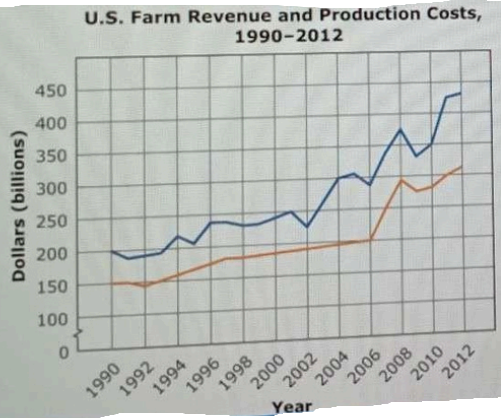
According to the information in the first graph, which statement correctly describes the period from 2006 to 2008?
- A. Gross farm income continued the decline that had characterized previous years.
- B. Gross farm income increased despite increases in production costs.
- C. Increases in production costs caused gross farm income to decline.
- D. Decreases in production costs continued throughout this period.
Correct Answer & Rationale
Correct Answer: B
During the period from 2006 to 2008, gross farm income saw an increase, even as production costs rose. This indicates that farmers managed to offset higher expenses with increased revenue. Option A is incorrect as it suggests a continuation of decline, which contradicts the data showing growth in income. Option C misinterprets the relationship between rising costs and income, as income actually increased despite those costs. Option D is inaccurate because it implies a consistent decrease in production costs, which is not supported by the graph indicating rising expenses during this timeframe.
During the period from 2006 to 2008, gross farm income saw an increase, even as production costs rose. This indicates that farmers managed to offset higher expenses with increased revenue. Option A is incorrect as it suggests a continuation of decline, which contradicts the data showing growth in income. Option C misinterprets the relationship between rising costs and income, as income actually increased despite those costs. Option D is inaccurate because it implies a consistent decrease in production costs, which is not supported by the graph indicating rising expenses during this timeframe.