Which event counters the viewpoint expressed in the newspaper excerpt that African Americans refused to defend their civil rights?
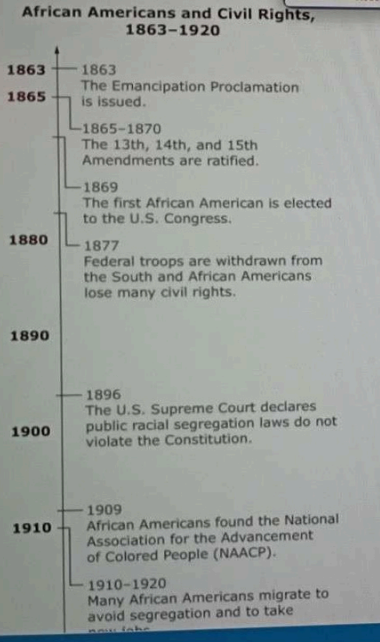
- A. the ratification of the 13th, 14th, and 15th Amendments
- B. the issuance of the Emancipation Proclamation
- C. the founding of the National Association for the Advancement of Colored People
- D. the start of the Great Migration
Correct Answer & Rationale
Correct Answer: C
The founding of the National Association for the Advancement of Colored People (NAACP) directly counters the viewpoint that African Americans refused to defend their civil rights. Established in 1909, the NAACP actively fought for civil rights through legal challenges, advocacy, and public education, demonstrating a strong commitment to defending their rights. Option A, the ratification of the 13th, 14th, and 15th Amendments, although significant, primarily established legal rights rather than showcasing active defense. Option B, the Emancipation Proclamation, ended slavery but did not directly address civil rights activism. Option D, the Great Migration, reflects a movement for better opportunities but does not specifically illustrate organized efforts to defend civil rights.
The founding of the National Association for the Advancement of Colored People (NAACP) directly counters the viewpoint that African Americans refused to defend their civil rights. Established in 1909, the NAACP actively fought for civil rights through legal challenges, advocacy, and public education, demonstrating a strong commitment to defending their rights. Option A, the ratification of the 13th, 14th, and 15th Amendments, although significant, primarily established legal rights rather than showcasing active defense. Option B, the Emancipation Proclamation, ended slavery but did not directly address civil rights activism. Option D, the Great Migration, reflects a movement for better opportunities but does not specifically illustrate organized efforts to defend civil rights.
Other Related Questions
Based on the excerpt, which conclusion can be drawn about the U.S. Constitution and the Bill of Rights?
- A. Ratification of the Bill of Rights was completed before the Constitution was drafted.
- B. Ratification of the Constitution was dependent on the passage of the Bill of Rights.
- C. Most leaders were worried that the Bill of Rights would weaken the ruling class protected by the Constitution.
- D. Many leaders were concerned that the Bill of Rights would upset the balance of powers outlined in the Constitution.
Correct Answer & Rationale
Correct Answer: B
The conclusion that ratification of the Constitution was dependent on the passage of the Bill of Rights is supported by historical context, as many states required assurance of individual rights to approve the Constitution. Option A is incorrect because the Bill of Rights was introduced after the Constitution was drafted. Option C misrepresents the intent of the Bill of Rights; leaders were primarily concerned with protecting individual liberties rather than preserving the ruling class. Option D is also inaccurate, as the Bill of Rights aimed to safeguard citizens' rights without disrupting the balance of powers established by the Constitution.
The conclusion that ratification of the Constitution was dependent on the passage of the Bill of Rights is supported by historical context, as many states required assurance of individual rights to approve the Constitution. Option A is incorrect because the Bill of Rights was introduced after the Constitution was drafted. Option C misrepresents the intent of the Bill of Rights; leaders were primarily concerned with protecting individual liberties rather than preserving the ruling class. Option D is also inaccurate, as the Bill of Rights aimed to safeguard citizens' rights without disrupting the balance of powers established by the Constitution.
According to the information in the first graph, which statement correctly describes the period from 2006 to 2008?
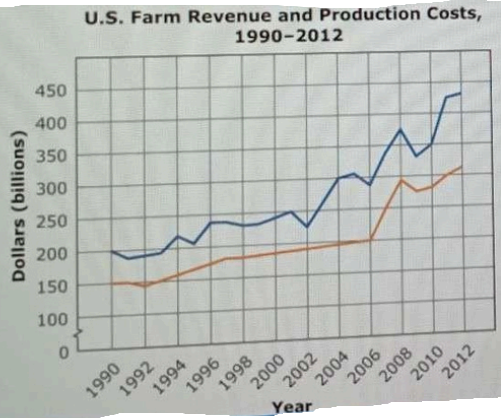
- A. Gross farm income continued the decline that had characterized previous years.
- B. Gross farm income increased despite increases in production costs.
- C. Increases in production costs caused gross farm income to decline.
- D. Decreases in production costs continued throughout this period.
Correct Answer & Rationale
Correct Answer: B
During the period from 2006 to 2008, gross farm income saw an increase, even as production costs rose. This indicates that farmers managed to offset higher expenses with increased revenue. Option A is incorrect as it suggests a continuation of decline, which contradicts the data showing growth in income. Option C misinterprets the relationship between rising costs and income, as income actually increased despite those costs. Option D is inaccurate because it implies a consistent decrease in production costs, which is not supported by the graph indicating rising expenses during this timeframe.
During the period from 2006 to 2008, gross farm income saw an increase, even as production costs rose. This indicates that farmers managed to offset higher expenses with increased revenue. Option A is incorrect as it suggests a continuation of decline, which contradicts the data showing growth in income. Option C misinterprets the relationship between rising costs and income, as income actually increased despite those costs. Option D is inaccurate because it implies a consistent decrease in production costs, which is not supported by the graph indicating rising expenses during this timeframe.
Which statement identifies a purpose of Roosevelt's speech?
- A. to convince his audience that preserving the environment is as important as national security
- B. to convince his audience that preserving the environment is the responsibility of ordinary citizens
- C. to gain support for using public lands to obtain vital productive resources
- D. to gain support for a candidate who wants to preserve the environment
Correct Answer & Rationale
Correct Answer: A
Option A effectively captures Roosevelt's emphasis on the interconnectedness of environmental preservation and national security. He aimed to highlight that a healthy environment is crucial for the nation's well-being and stability. Option B is incorrect as Roosevelt’s speech focuses more on broader national priorities rather than individual responsibilities. Option C misinterprets the message; while resource management is important, the speech primarily advocates for environmental preservation rather than exploitation. Option D is misleading; Roosevelt's speech is not about promoting a candidate but rather advocating for a national commitment to environmental stewardship.
Option A effectively captures Roosevelt's emphasis on the interconnectedness of environmental preservation and national security. He aimed to highlight that a healthy environment is crucial for the nation's well-being and stability. Option B is incorrect as Roosevelt’s speech focuses more on broader national priorities rather than individual responsibilities. Option C misinterprets the message; while resource management is important, the speech primarily advocates for environmental preservation rather than exploitation. Option D is misleading; Roosevelt's speech is not about promoting a candidate but rather advocating for a national commitment to environmental stewardship.
Which statement is correct about the change in racial and ethnic populations between 2000 and 2010?
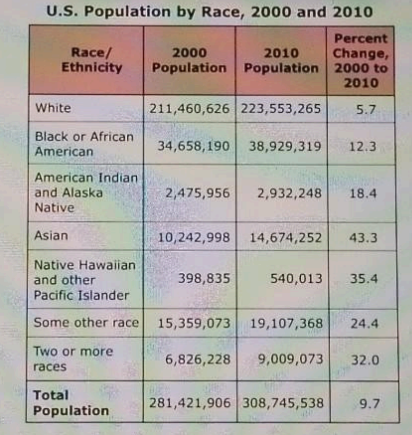
- A. The Black or African American population had the greatest percentage of growth.
- B. The Native Hawaiian and other Pacific Islander population grew by a greater proportion than the Asian population.
- C. The White population experienced the slowest growth of all groups.
- D. The American Indian and Alaska Native population experienced almost no change.
Correct Answer & Rationale
Correct Answer: B
Option B accurately reflects demographic trends, as the Native Hawaiian and other Pacific Islander population indeed saw a higher percentage increase compared to the Asian population during this period. Option A is incorrect; while the Black or African American population grew, it was not the greatest percentage increase among all racial groups. Option C misrepresents the data; although the White population's growth was slower compared to previous decades, it was not the slowest overall. Option D is misleading as well; the American Indian and Alaska Native population did experience some growth, albeit modest, rather than remaining unchanged.
Option B accurately reflects demographic trends, as the Native Hawaiian and other Pacific Islander population indeed saw a higher percentage increase compared to the Asian population during this period. Option A is incorrect; while the Black or African American population grew, it was not the greatest percentage increase among all racial groups. Option C misrepresents the data; although the White population's growth was slower compared to previous decades, it was not the slowest overall. Option D is misleading as well; the American Indian and Alaska Native population did experience some growth, albeit modest, rather than remaining unchanged.