This excerpt is from a 1987 speech by U.S. Supreme Court Justice Thurgood Marshall.
"I do not believe that the meaning of the Constitution was forever "fixed" at the Philadelphia Convention. Nor do I find the wisdom, foresight, and sense of justice exhibited by the Framers particularly profound. To the contrary, the government they devised was defective from the start, requiring several amendments, a civil war, and momentous social transformation to attain the system of constitutional government, and its respect for the individual freedoms and human rights, we hold as fundamental today. When contemporary Americans cite "The Constitution," they invoke concept that is vastly different from what the Framers barely began to construct two centurie ago... When the Founding Fathers used this phrase [We, the People) in 1787, they did not have in mind the majority of America's citizens. "We the People" included, in the words of the Framers, "the whole Number of free Persons."
This excerpt is from a 1987 speech by President Ronald Reagan.
“In a very real sense, it was then, in 1787, that the Revolution truly began. For it was with the writing of our Constitution, setting down the architecture of democratic government, that the noble sentiments and brave rhetoric of 1776 took on substance....
All men are created equal and endowed by their Creator with certain inalienable rights-until that moment some might have said that was just a high-blown sentiment, the dreams of a few philosophers and their hot-headed followers. But could one really construct a government, run a country, with such idealistic notions? But once those ideals took root in living, functioning institutions, once those notions became a nation-well, then, as I said, the revolution could really begin, not just in America but around the world, a revolution to free man from tyranny of every sort and secure his freedom the only way possible in this world, through the checks and balances and institutions of limited, democratic government.â€
What basic assumption behind Marshall's remarks is not behind Reagan's remarks?
- A. The framers of the U.S. Constitution have received more credit than they deserve for the governmental protections Americans enjoy.
- B. The framers of the U.S. Constitution have been credited with creating a document that protects all free people around the world.
- C. The U.S. Constitution created a government whose promises are yet to be realized by many around the world.
- D. The U.S. Constitution created a government based on the principles expressed in the Declaration of Independence.
Correct Answer & Rationale
Correct Answer: A
Marshall's remarks imply a critical view of the framers' contributions, suggesting they may not deserve as much credit for governmental protections as commonly believed. This contrasts with Reagan's perspective, which typically emphasizes the positive legacy of the framers. Option B incorrectly assumes that both figures share the belief in the global impact of the Constitution, which Reagan often highlighted. Option C suggests an acknowledgment of unrealized promises, aligning with both perspectives, while option D reinforces a foundational agreement on principles that both figures would likely support. Thus, A stands out as the unique assumption absent in Reagan's remarks.
Marshall's remarks imply a critical view of the framers' contributions, suggesting they may not deserve as much credit for governmental protections as commonly believed. This contrasts with Reagan's perspective, which typically emphasizes the positive legacy of the framers. Option B incorrectly assumes that both figures share the belief in the global impact of the Constitution, which Reagan often highlighted. Option C suggests an acknowledgment of unrealized promises, aligning with both perspectives, while option D reinforces a foundational agreement on principles that both figures would likely support. Thus, A stands out as the unique assumption absent in Reagan's remarks.
Other Related Questions
According to Justice Marshall, what historical factor has contradicted the ideas expressed in the U.S. Constitution?
- A. slavery
- B. free enterprise
- C. religion
- D. class war
Correct Answer & Rationale
Correct Answer: A
Justice Marshall highlighted slavery as a significant historical contradiction to the principles of freedom and equality enshrined in the U.S. Constitution. Slavery directly undermined the Constitution's assertion that all men are created equal, creating a profound moral and ethical conflict. In contrast, free enterprise (B) aligns with the Constitution's emphasis on individual rights and economic freedom. Religion (C) is protected under the First Amendment, promoting freedom rather than contradiction. Class war (D) is a socio-economic conflict that, while relevant, does not directly challenge the foundational ideals of the Constitution in the same way slavery does.
Justice Marshall highlighted slavery as a significant historical contradiction to the principles of freedom and equality enshrined in the U.S. Constitution. Slavery directly undermined the Constitution's assertion that all men are created equal, creating a profound moral and ethical conflict. In contrast, free enterprise (B) aligns with the Constitution's emphasis on individual rights and economic freedom. Religion (C) is protected under the First Amendment, promoting freedom rather than contradiction. Class war (D) is a socio-economic conflict that, while relevant, does not directly challenge the foundational ideals of the Constitution in the same way slavery does.
Which prediction is supported by both graphs?
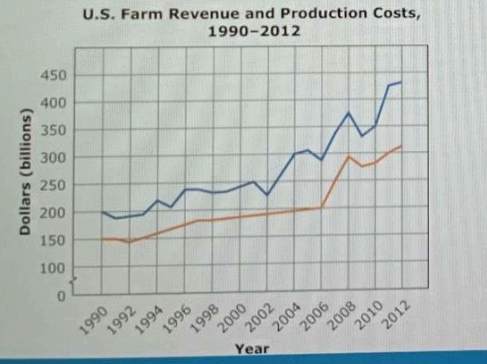
- A. The average wage for farm workers will decrease..
- B. The average cost for agricultural produce will decrease.
- C. The operating cost of running a farm will increase.
- D. The number of people required for producing food will increase.
Correct Answer & Rationale
Correct Answer: C
Option C is supported by both graphs, indicating an upward trend in operational costs due to factors like inflation and increased resource prices. This aligns with economic patterns observed in the agricultural sector. Option A is incorrect as both graphs do not show a decline in farm worker wages; rather, they suggest stability or growth. Option B is misleading; the graphs do not reflect a decrease in agricultural produce costs, which often correlate with rising operational expenses. Option D is also unsupported, as the data does not indicate an increase in labor requirements, but rather highlights efficiency improvements in farming practices.
Option C is supported by both graphs, indicating an upward trend in operational costs due to factors like inflation and increased resource prices. This aligns with economic patterns observed in the agricultural sector. Option A is incorrect as both graphs do not show a decline in farm worker wages; rather, they suggest stability or growth. Option B is misleading; the graphs do not reflect a decrease in agricultural produce costs, which often correlate with rising operational expenses. Option D is also unsupported, as the data does not indicate an increase in labor requirements, but rather highlights efficiency improvements in farming practices.
Based on the excerpts, which speaker would agree with each statement below? Drag each statement into the box labeled with that speaker's name. If neither would agree with a statement, drag it to the box labeled "Neither."
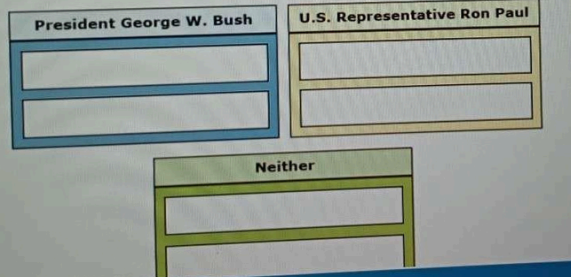
- A. Congress should spend money public education.
- B. Schools should meet federal education guidelines.
- C. Parents should hold public schools accountable.
- D. Local districts should set school guidelines.
Correct Answer & Rationale
Correct Answer:
Speaker A likely supports the idea that Congress should spend money on public education, as this aligns with a belief in federal investment in education for equitable access. Speaker B would agree that schools should meet federal education guidelines, as this emphasizes the importance of uniform standards for educational quality and accountability. Speaker C advocates for parental accountability in public schools, reflecting the belief that parents play a vital role in monitoring and improving educational outcomes. Speaker D likely supports the idea that local districts should set school guidelines, as this allows for tailored approaches that reflect community needs and values. If neither speaker aligns with a statement, it belongs in the "Neither" category.
Speaker A likely supports the idea that Congress should spend money on public education, as this aligns with a belief in federal investment in education for equitable access. Speaker B would agree that schools should meet federal education guidelines, as this emphasizes the importance of uniform standards for educational quality and accountability. Speaker C advocates for parental accountability in public schools, reflecting the belief that parents play a vital role in monitoring and improving educational outcomes. Speaker D likely supports the idea that local districts should set school guidelines, as this allows for tailored approaches that reflect community needs and values. If neither speaker aligns with a statement, it belongs in the "Neither" category.
Which statement identifies a purpose of Roosevelt's speech?
- A. to convince his audience that preserving the environment is as important as national security
- B. to convince his audience that preserving the environment is the responsibility of ordinary citizens
- C. to gain support for using public lands to obtain vital productive resources
- D. to gain support for a candidate who wants to preserve the environment
Correct Answer & Rationale
Correct Answer: A
Option A effectively captures Roosevelt's emphasis on the interconnectedness of environmental preservation and national security. He aimed to highlight that a healthy environment is crucial for the nation's well-being and stability. Option B is incorrect as Roosevelt’s speech focuses more on broader national priorities rather than individual responsibilities. Option C misinterprets the message; while resource management is important, the speech primarily advocates for environmental preservation rather than exploitation. Option D is misleading; Roosevelt's speech is not about promoting a candidate but rather advocating for a national commitment to environmental stewardship.
Option A effectively captures Roosevelt's emphasis on the interconnectedness of environmental preservation and national security. He aimed to highlight that a healthy environment is crucial for the nation's well-being and stability. Option B is incorrect as Roosevelt’s speech focuses more on broader national priorities rather than individual responsibilities. Option C misinterprets the message; while resource management is important, the speech primarily advocates for environmental preservation rather than exploitation. Option D is misleading; Roosevelt's speech is not about promoting a candidate but rather advocating for a national commitment to environmental stewardship.