This passage describes some activities of the U.S. Department of Agriculture (USDA).
The U.S. Department of Agriculture Risk Management Agency oversees the Commodity Insurance program. This program offers farmers a variety of forms of insurance. One form is known as the Revenue Protection Plan. This plan protects farmers against losing income due to falling prices or crop failures.
Under this plan, a farmer may choose to purchase insurance to guarantee revenue of at least 75% of the Actual Production History of the farm. The insurance on some crops, such as corn, is subsidized by the federal government at a much higher rate than most other crops. The insurance rates vary depending on the type of crop grown.
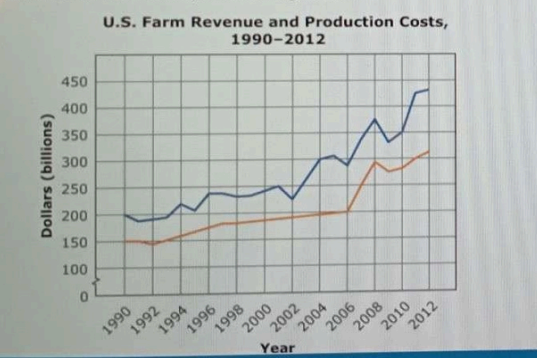
The USDA also has several agencies devoted to research. The Economic Research Service complies data about the total profits earned by U.S. farms. It measures the total income earned by farms and the total costs of production. Generally, both figures have increased over the past 10 years. This graph contains data from the U.S. Department of Agriculture.
What impact do the varying insurance rates of the Revenue Protection Plan have on farming?
- A. They maintain stable prices for certain crops.
- B. They give farmers an incentive to promote crop diversity.
- C. They ensure the steady increase of crop production levels.
- D. They give farmers an incentive to grow crops that have higher subsidies.
Correct Answer & Rationale
Correct Answer: D
The varying insurance rates of the Revenue Protection Plan incentivize farmers to cultivate crops that receive higher subsidies, as these crops can mitigate financial risks associated with farming. This option aligns with economic behavior, where farmers are likely to prioritize profitability. Option A is incorrect because insurance rates do not directly stabilize prices; they primarily provide financial protection. Option B misrepresents the incentive structure; while crop diversity is beneficial, the plan does not specifically encourage it through varying rates. Option C is misleading, as the plan does not guarantee increased production levels; it merely provides a safety net against revenue loss.
The varying insurance rates of the Revenue Protection Plan incentivize farmers to cultivate crops that receive higher subsidies, as these crops can mitigate financial risks associated with farming. This option aligns with economic behavior, where farmers are likely to prioritize profitability. Option A is incorrect because insurance rates do not directly stabilize prices; they primarily provide financial protection. Option B misrepresents the incentive structure; while crop diversity is beneficial, the plan does not specifically encourage it through varying rates. Option C is misleading, as the plan does not guarantee increased production levels; it merely provides a safety net against revenue loss.
Other Related Questions
How does the U.S. Supreme Court's ruling differ from Justice Murphy's dissent?
- A. Only Justice Murphy's dissent acknowledged the dangers to the United States of having citizens from foreign lands.
- B. Only the Court's ruling acknowledged that the actions of fearful U.S. authorities can endanger the civil rights of citizens.
- C. Only the Court's ruling contended that Korematsu was ordered held in an internment camp because he was disloyal to the United States during time of war.
- D. Only Justice Murphy's dissent contended that U.S. internment camps were a clear-cut example of racial prejudice.
Correct Answer & Rationale
Correct Answer: D
Justice Murphy's dissent emphasized that the internment camps represented blatant racial prejudice, highlighting the unjust targeting of Japanese Americans based solely on their ethnicity. This perspective contrasts sharply with the majority opinion, which focused on national security concerns without addressing the racial implications. Option A is incorrect as both perspectives recognize the potential dangers of foreign nationals, albeit in different contexts. Option B misrepresents the majority's stance, which did not explicitly acknowledge civil rights violations. Option C inaccurately simplifies the Court's ruling, which did not solely attribute internment to disloyalty.
Justice Murphy's dissent emphasized that the internment camps represented blatant racial prejudice, highlighting the unjust targeting of Japanese Americans based solely on their ethnicity. This perspective contrasts sharply with the majority opinion, which focused on national security concerns without addressing the racial implications. Option A is incorrect as both perspectives recognize the potential dangers of foreign nationals, albeit in different contexts. Option B misrepresents the majority's stance, which did not explicitly acknowledge civil rights violations. Option C inaccurately simplifies the Court's ruling, which did not solely attribute internment to disloyalty.
Which statement from the passage is an opinion?
- A. "The ill-advised rush to extract new discoveries of shale oil and natural gas is a case in point."
- B. "...if the result is polluted water and ghost towns, it is not a sustainable model."
- C. “‘Sustainability' means using natural resources responsibly so that they are available to future generations."
- D. "... to achieve sustainability a business will not view profit only in terms of dollars."
Correct Answer & Rationale
Correct Answer: A
Option A expresses a subjective viewpoint about the extraction of shale oil and natural gas, labeling it as "ill-advised." This indicates a personal judgment rather than an objective fact. In contrast, Option B presents a consequence of unsustainable practices, framing it as a logical outcome rather than an opinion. Option C defines "sustainability" in a factual manner, outlining its meaning without personal bias. Lastly, Option D describes a business approach towards sustainability, focusing on a principle rather than expressing a personal belief. Thus, A stands out as the only statement rooted in opinion.
Option A expresses a subjective viewpoint about the extraction of shale oil and natural gas, labeling it as "ill-advised." This indicates a personal judgment rather than an objective fact. In contrast, Option B presents a consequence of unsustainable practices, framing it as a logical outcome rather than an opinion. Option C defines "sustainability" in a factual manner, outlining its meaning without personal bias. Lastly, Option D describes a business approach towards sustainability, focusing on a principle rather than expressing a personal belief. Thus, A stands out as the only statement rooted in opinion.
Which statement is based on the text?
- A. Individuals spend their income in factor markets.
- B. Entrepreneurs profit from participation in product markets.
- C. Individuals sell their labor in factor markets.
- D. Resources are traded in product markets.
Correct Answer & Rationale
Correct Answer: C
Option C accurately reflects the concept that individuals offer their labor in factor markets, where resources like labor are exchanged for wages. This aligns with economic principles regarding labor supply. Option A is incorrect since individuals do not spend income in factor markets; rather, they purchase goods and services in product markets. Option B misrepresents the role of entrepreneurs, who primarily earn profits through innovation and sales in product markets, not simply from participation. Option D is also misleading, as resources are exchanged in factor markets, while product markets focus on the sale of finished goods and services.
Option C accurately reflects the concept that individuals offer their labor in factor markets, where resources like labor are exchanged for wages. This aligns with economic principles regarding labor supply. Option A is incorrect since individuals do not spend income in factor markets; rather, they purchase goods and services in product markets. Option B misrepresents the role of entrepreneurs, who primarily earn profits through innovation and sales in product markets, not simply from participation. Option D is also misleading, as resources are exchanged in factor markets, while product markets focus on the sale of finished goods and services.
Based on the excerpt, which change was a result of the National Security Act of 1947?
- A. The Central Intelligence Agency replaced the War Department.
- B. The National Security Council gained control over the Department of Defense.
- C. The Department of Homeland Security replaced the War Department.
- D. The Department of the Navy became part of the Department of Defense.
Correct Answer & Rationale
Correct Answer: D
The National Security Act of 1947 reorganized the U.S. military and intelligence community. Option D accurately reflects that the Department of the Navy became part of the newly established Department of Defense, streamlining military operations. Option A is incorrect; the CIA was created but did not replace the War Department directly. Option B is misleading; while the National Security Council was established, it does not control the Department of Defense. Option C is factually incorrect, as the Department of Homeland Security was created later, in 2003, not as a result of the 1947 Act.
The National Security Act of 1947 reorganized the U.S. military and intelligence community. Option D accurately reflects that the Department of the Navy became part of the newly established Department of Defense, streamlining military operations. Option A is incorrect; the CIA was created but did not replace the War Department directly. Option B is misleading; while the National Security Council was established, it does not control the Department of Defense. Option C is factually incorrect, as the Department of Homeland Security was created later, in 2003, not as a result of the 1947 Act.