This flow chart traces development of democratic government in England. Which event completes this sequence?

- A. The English Bill of Rights gave the king power to appoint most members of Parliament.
- B. The Magna Carta forced the nobles to give up their feudal lands.
- C. The English Bill of Rights guaranteed suffrage to most male citizens.
- D. The Magna Carta forced the king to share his political power.
Correct Answer & Rationale
Correct Answer: D
The correct choice, D, highlights the Magna Carta's pivotal role in limiting the king's absolute power and initiating the concept of shared governance. This foundational document established that the monarch must consult nobles before making decisions, laying the groundwork for parliamentary democracy. Option A is incorrect as the English Bill of Rights actually limited the king's power over Parliament, not enhanced it. Option B misrepresents the Magna Carta's purpose; it did not force nobles to relinquish their lands, but rather addressed their grievances against the king. Option C is also inaccurate, as the English Bill of Rights did not guarantee suffrage but focused on limiting royal authority and protecting certain rights.
The correct choice, D, highlights the Magna Carta's pivotal role in limiting the king's absolute power and initiating the concept of shared governance. This foundational document established that the monarch must consult nobles before making decisions, laying the groundwork for parliamentary democracy. Option A is incorrect as the English Bill of Rights actually limited the king's power over Parliament, not enhanced it. Option B misrepresents the Magna Carta's purpose; it did not force nobles to relinquish their lands, but rather addressed their grievances against the king. Option C is also inaccurate, as the English Bill of Rights did not guarantee suffrage but focused on limiting royal authority and protecting certain rights.
Other Related Questions
How did the position expressed by President Johnson differ from the position expressed by Senator Russell?
- A. Only Senator Russell said that state governments were sufficiently protecting the rights of citizens.
- B. Only Senator Russell supported the federal government's intervention.
- C. Only President Johnson supported the state governments' rights to manage their own affairs.
- D. Only President Johnson believed that the federal government was authorized to intervene.
Correct Answer & Rationale
Correct Answer: A
President Johnson emphasized the need for federal intervention to protect citizens' rights, believing that state governments were often inadequate. In contrast, Senator Russell argued that state governments were effectively safeguarding those rights, reflecting a stance of local governance. Option B is incorrect because Senator Russell did not support federal intervention. Option C misrepresents Johnson’s position; he favored federal oversight rather than state autonomy. Option D inaccurately attributes the belief in federal authority solely to Johnson, as Russell did not share this view. Thus, the distinction lies in Russell's confidence in state governments versus Johnson's call for federal action.
President Johnson emphasized the need for federal intervention to protect citizens' rights, believing that state governments were often inadequate. In contrast, Senator Russell argued that state governments were effectively safeguarding those rights, reflecting a stance of local governance. Option B is incorrect because Senator Russell did not support federal intervention. Option C misrepresents Johnson’s position; he favored federal oversight rather than state autonomy. Option D inaccurately attributes the belief in federal authority solely to Johnson, as Russell did not share this view. Thus, the distinction lies in Russell's confidence in state governments versus Johnson's call for federal action.
Which statement can be made based on both the passage and the table?
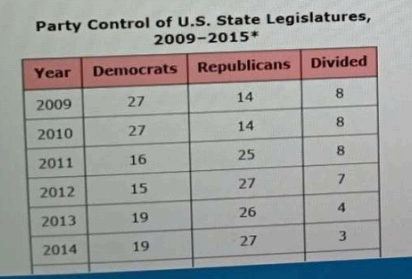
- A. The increase in independent voters has strengthened the influence of Democrats on the national level.
- B. The best political campaigns of Republicans and Democrats use modern media to communicate with voters.
- C. The most recent data shows that Republicans controlled almost three times the number of state legislatures as Democrats.
- D. The decrease in party identification has strengthened the influence of Republicans in state legislatures.
Correct Answer & Rationale
Correct Answer: B
Option B accurately reflects the information provided in both the passage and the table, highlighting the importance of modern media in effective political campaigns for both major parties. This statement emphasizes a shared strategy that transcends partisan lines, indicating a common approach to engaging voters. Option A incorrectly suggests a direct correlation between independent voters and the strengthening of Democrats, which is not supported by the data. Option C misrepresents the statistics regarding state legislature control, as the table likely shows a different ratio. Option D assumes that a decrease in party identification universally benefits Republicans, ignoring the complexities of voter behavior and preferences that the passage may address.
Option B accurately reflects the information provided in both the passage and the table, highlighting the importance of modern media in effective political campaigns for both major parties. This statement emphasizes a shared strategy that transcends partisan lines, indicating a common approach to engaging voters. Option A incorrectly suggests a direct correlation between independent voters and the strengthening of Democrats, which is not supported by the data. Option C misrepresents the statistics regarding state legislature control, as the table likely shows a different ratio. Option D assumes that a decrease in party identification universally benefits Republicans, ignoring the complexities of voter behavior and preferences that the passage may address.
Which statement identifies the purpose of President Nixon's message?
- A. to convince Congress that technological advancement and population growth must be slowed to protect the environment
- B. to convince Congress that industrial polluters of the air and water should not pay for cleaning the environment
- C. to convince Congress that it must take part in action to address human damage to the environment
- D. to convince Congress that there should be no benefits for businesses that pollute the environment
Correct Answer & Rationale
Correct Answer: C
President Nixon's message aimed to mobilize Congress to actively engage in addressing environmental degradation caused by human activities. This focus on collective action underscores the urgency of legislative involvement in environmental protection. Option A misinterprets the goal, as Nixon did not advocate for slowing technological advancement but rather for responsible management. Option B inaccurately suggests that he supported industrial polluters avoiding responsibility, which contradicts his environmental stance. Option D implies a complete lack of support for businesses, neglecting the balanced approach Nixon promoted towards regulatory measures and economic growth.
President Nixon's message aimed to mobilize Congress to actively engage in addressing environmental degradation caused by human activities. This focus on collective action underscores the urgency of legislative involvement in environmental protection. Option A misinterprets the goal, as Nixon did not advocate for slowing technological advancement but rather for responsible management. Option B inaccurately suggests that he supported industrial polluters avoiding responsibility, which contradicts his environmental stance. Option D implies a complete lack of support for businesses, neglecting the balanced approach Nixon promoted towards regulatory measures and economic growth.
Which feature of the U.S. system of government did de Tocqueville believe might cause conflict in society?
- A. The majority is able to achieve special rights.
- B. The minority is able to block popular legislation.
- C. Legislators must represent minority interests.
- D. Legislators sometimes act against majority rule.
Correct Answer & Rationale
Correct Answer: A
De Tocqueville observed that when the majority in a democracy can impose its will, it might lead to the oppression of minority groups, creating societal conflict. This reflects his concern about "tyranny of the majority," where the dominant group's interests overshadow the rights of others. Option B is incorrect because while minorities can influence legislation, de Tocqueville focused more on majority power. Option C misrepresents his views; he acknowledged the importance of minority representation but did not see it as a source of conflict. Option D is also inaccurate, as de Tocqueville emphasized the potential for the majority to dominate rather than legislators opposing the majority.
De Tocqueville observed that when the majority in a democracy can impose its will, it might lead to the oppression of minority groups, creating societal conflict. This reflects his concern about "tyranny of the majority," where the dominant group's interests overshadow the rights of others. Option B is incorrect because while minorities can influence legislation, de Tocqueville focused more on majority power. Option C misrepresents his views; he acknowledged the importance of minority representation but did not see it as a source of conflict. Option D is also inaccurate, as de Tocqueville emphasized the potential for the majority to dominate rather than legislators opposing the majority.