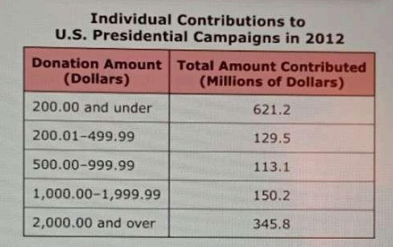
The table and the article are based on information from the U.S. Federal Election Commission.
U.S. presidential candidates receive financial contributions from many different sources. For the 2012 election cycle, political parties reported contributions of $34,750 to all candidates. Political action committees, groups that raise money to give to campaigns, reported contributions of $1.7 million to all candidates. Candidates personally contributed $5.8 million to their own campaigns. Additionally, the Presidential Election Campaign Fund, to which citizens may contribute by checking a box on their federal tax forms, gave $1.3 million to all candidates. The remainder came from individual contributions as shown in the table.
Which conclusion is best supported by information in the table and article?
- A. Individuals contributed a total amount of money equal to the total of all other sources of donations.
- B. Individuals contributing the smallest quantity of money insignificantly impact presidential campaigns.
- C. Individuals donated the greatest total amount although many contributions were relatively small.
- D. Individuals have more influence on the proposed policies of presidential candidates than groups do.
Correct Answer & Rationale
Correct Answer: C
Option C is supported by the data, indicating that while many individual contributions were small, they collectively formed the largest portion of total donations to presidential campaigns. This highlights the significant role individuals play despite the size of their contributions. Option A is incorrect as it suggests individuals’ contributions equaled all other sources, which is not supported by the data. Option B misrepresents the impact of smaller donations; even small contributions can collectively influence campaign funding significantly. Option D overstates individuals' influence on policy compared to groups, which often have more resources and organized lobbying power.
Option C is supported by the data, indicating that while many individual contributions were small, they collectively formed the largest portion of total donations to presidential campaigns. This highlights the significant role individuals play despite the size of their contributions. Option A is incorrect as it suggests individuals’ contributions equaled all other sources, which is not supported by the data. Option B misrepresents the impact of smaller donations; even small contributions can collectively influence campaign funding significantly. Option D overstates individuals' influence on policy compared to groups, which often have more resources and organized lobbying power.
Other Related Questions
Which statement about the ratification of the 19th Amendment is based on the passage?
- A. Ratification was the result of the Seneca Falls Convention.
- B. Ratification occurred in return for the military service of women during World War I.
- C. Ratification occurred prior to the granting of voting rights to freed slaves.
- D. Ratification was the result of the accumulated efforts of women for decades.
Correct Answer & Rationale
Correct Answer: D
The ratification of the 19th Amendment was the culmination of decades of advocacy and activism by women who fought tirelessly for their voting rights, making option D the most accurate statement. Option A incorrectly attributes the ratification solely to the Seneca Falls Convention, which was just one of many events in the long struggle for women's suffrage. Option B suggests a direct exchange of military service for voting rights, which oversimplifies the complex social and political factors involved. Option C misrepresents the timeline, as the 19th Amendment was ratified after the Civil War, but the fight for voting rights for freed slaves and women evolved concurrently, not sequentially.
The ratification of the 19th Amendment was the culmination of decades of advocacy and activism by women who fought tirelessly for their voting rights, making option D the most accurate statement. Option A incorrectly attributes the ratification solely to the Seneca Falls Convention, which was just one of many events in the long struggle for women's suffrage. Option B suggests a direct exchange of military service for voting rights, which oversimplifies the complex social and political factors involved. Option C misrepresents the timeline, as the 19th Amendment was ratified after the Civil War, but the fight for voting rights for freed slaves and women evolved concurrently, not sequentially.
How does the message presented by Senator Paul differ from the message presented by President Obama?
- A. Only Senator Paul promotes less government involvement in health care.
- B. Only Senator Paul wants to secure more health care for U.S. citizens.
- C. Only President Obama supports the Supreme Court's right to rule about health care.
- D. Only President Obama discusses problems in the health care industry.
Correct Answer & Rationale
Correct Answer: A
Senator Paul advocates for reduced government involvement in health care, emphasizing personal choice and market-driven solutions. This contrasts with President Obama's approach, which supports a more active role for the government in expanding access and regulating the industry. Option B is incorrect as both politicians aim to improve health care access, albeit through different methods. Option C misrepresents Obama's stance; he supports health care reforms that align with Supreme Court rulings but does not solely focus on this aspect. Option D is misleading; while Obama addresses health care issues, Senator Paul also discusses industry challenges, making this option inaccurate.
Senator Paul advocates for reduced government involvement in health care, emphasizing personal choice and market-driven solutions. This contrasts with President Obama's approach, which supports a more active role for the government in expanding access and regulating the industry. Option B is incorrect as both politicians aim to improve health care access, albeit through different methods. Option C misrepresents Obama's stance; he supports health care reforms that align with Supreme Court rulings but does not solely focus on this aspect. Option D is misleading; while Obama addresses health care issues, Senator Paul also discusses industry challenges, making this option inaccurate.
Which statement can be made based on both the passage and the table?
- A. The increase in independent voters has strengthened the influence of Democrats on the national level.
- B. The best political campaigns of Republicans and Democrats use modern media to communicate with voters.
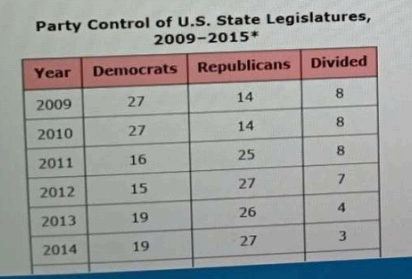
- C. The most recent data shows that Republicans controlled almost three times the number of state legislatures as Democrats.
- D. The decrease in party identification has strengthened the influence of Republicans in state legislatures.
Correct Answer & Rationale
Correct Answer: B
Option B accurately reflects the information provided in both the passage and the table, highlighting the importance of modern media in effective political campaigns for both major parties. This statement emphasizes a shared strategy that transcends partisan lines, indicating a common approach to engaging voters. Option A incorrectly suggests a direct correlation between independent voters and the strengthening of Democrats, which is not supported by the data. Option C misrepresents the statistics regarding state legislature control, as the table likely shows a different ratio. Option D assumes that a decrease in party identification universally benefits Republicans, ignoring the complexities of voter behavior and preferences that the passage may address.
Option B accurately reflects the information provided in both the passage and the table, highlighting the importance of modern media in effective political campaigns for both major parties. This statement emphasizes a shared strategy that transcends partisan lines, indicating a common approach to engaging voters. Option A incorrectly suggests a direct correlation between independent voters and the strengthening of Democrats, which is not supported by the data. Option C misrepresents the statistics regarding state legislature control, as the table likely shows a different ratio. Option D assumes that a decrease in party identification universally benefits Republicans, ignoring the complexities of voter behavior and preferences that the passage may address.
How did Chief Justice Marshall contribute to the U.S. government system of checks and balances?
- A. by establishing the Supreme Court's power to check Congress
- B. by creating the power to remove the president from office
- C. by expanding the president's power to check Congress
- D. by giving the Supreme Court the power to control itself
Correct Answer & Rationale
Correct Answer: A
Chief Justice Marshall played a pivotal role in defining the Supreme Court's authority, notably through the landmark case Marbury v. Madison, which established the principle of judicial review. This empowered the Court to invalidate laws passed by Congress that it deemed unconstitutional, effectively allowing it to check legislative power. Option B is incorrect as the power to remove a president lies with Congress through impeachment, not the Supreme Court. Option C misrepresents Marshall's contributions, as he did not expand presidential power but rather clarified judicial authority. Option D is also inaccurate; the Supreme Court does not have self-regulating powers but operates within the framework of checks and balances.
Chief Justice Marshall played a pivotal role in defining the Supreme Court's authority, notably through the landmark case Marbury v. Madison, which established the principle of judicial review. This empowered the Court to invalidate laws passed by Congress that it deemed unconstitutional, effectively allowing it to check legislative power. Option B is incorrect as the power to remove a president lies with Congress through impeachment, not the Supreme Court. Option C misrepresents Marshall's contributions, as he did not expand presidential power but rather clarified judicial authority. Option D is also inaccurate; the Supreme Court does not have self-regulating powers but operates within the framework of checks and balances.