The blog entry and speech excerpt below discuss the U.S. Supreme Court case of Tinker v. Des Moines (1969).
Blog
In the Tinker v. Des Moines case, the Court ruled that students lawfully exercised their rights when they wore black armbands in school as a protest against the Vietnam War. The ruling stated that school officials were wrong to suspend students from school for their act of protest. Students are not required to give up their rights when they enter a public school, especially freedom of speech, which is the foundation of democracy. These students modeled good citizenship by their actions. In contrast, school representatives placing restrictions on liberty provided a bad example to the future leaders of our country.
Speech
I believe the U.S. Supreme Court ruled correctly in Tinker v. Des Moines. Democracy requires individual expression, debate, and public protest. Still, freedom of speech is not the only issue to be considered when protests occur in public schools. School officials have a responsibility to provide a safe environment that is not disruptive to learning. Individual expression should not interfere with a school's mission to teach.
Which basic assumption is only behind the speech?
- A. Freedom of speech must be protected in schools.
- B. Citizens can express their views through symbols.
- C. Citizens should be able to express their views on issues.
- D. Freedom of speech has some restrictions
Correct Answer & Rationale
Correct Answer: D
The assumption that freedom of speech has some restrictions is solely focused on the speech itself, acknowledging that while individuals have the right to express themselves, this right is not absolute. Option A discusses the protection of speech specifically in schools, which implies a context rather than the nature of speech itself. Option B refers to expression through symbols, indicating non-verbal communication, thus not limited to speech. Option C emphasizes the ability to express views on issues broadly, again not confined to speech alone. Each of these options extends beyond the core principle of speech restrictions.
The assumption that freedom of speech has some restrictions is solely focused on the speech itself, acknowledging that while individuals have the right to express themselves, this right is not absolute. Option A discusses the protection of speech specifically in schools, which implies a context rather than the nature of speech itself. Option B refers to expression through symbols, indicating non-verbal communication, thus not limited to speech. Option C emphasizes the ability to express views on issues broadly, again not confined to speech alone. Each of these options extends beyond the core principle of speech restrictions.
Other Related Questions
How does the U.S. Supreme Court's ruling differ from Justice Murphy's dissent?
- A. Only Justice Murphy's dissent acknowledged the dangers to the United States of having citizens from foreign lands.
- B. Only the Court's ruling acknowledged that the actions of fearful U.S. authorities can endanger the civil rights of citizens.
- C. Only the Court's ruling contended that Korematsu was ordered held in an internment camp because he was disloyal to the United States during time of war.
- D. Only Justice Murphy's dissent contended that U.S. internment camps were a clear-cut example of racial prejudice.
Correct Answer & Rationale
Correct Answer: D
Justice Murphy's dissent emphasized that the internment camps represented blatant racial prejudice, highlighting the unjust targeting of Japanese Americans based solely on their ethnicity. This perspective contrasts sharply with the majority opinion, which focused on national security concerns without addressing the racial implications. Option A is incorrect as both perspectives recognize the potential dangers of foreign nationals, albeit in different contexts. Option B misrepresents the majority's stance, which did not explicitly acknowledge civil rights violations. Option C inaccurately simplifies the Court's ruling, which did not solely attribute internment to disloyalty.
Justice Murphy's dissent emphasized that the internment camps represented blatant racial prejudice, highlighting the unjust targeting of Japanese Americans based solely on their ethnicity. This perspective contrasts sharply with the majority opinion, which focused on national security concerns without addressing the racial implications. Option A is incorrect as both perspectives recognize the potential dangers of foreign nationals, albeit in different contexts. Option B misrepresents the majority's stance, which did not explicitly acknowledge civil rights violations. Option C inaccurately simplifies the Court's ruling, which did not solely attribute internment to disloyalty.
According to the information in the first graph, which statement correctly describes the period from 2006 to 2008?
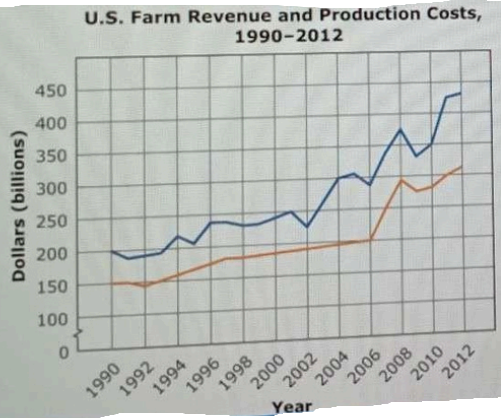
- A. Gross farm income continued the decline that had characterized previous years.
- B. Gross farm income increased despite increases in production costs.
- C. Increases in production costs caused gross farm income to decline.
- D. Decreases in production costs continued throughout this period.
Correct Answer & Rationale
Correct Answer: B
During the period from 2006 to 2008, gross farm income saw an increase, even as production costs rose. This indicates that farmers managed to offset higher expenses with increased revenue. Option A is incorrect as it suggests a continuation of decline, which contradicts the data showing growth in income. Option C misinterprets the relationship between rising costs and income, as income actually increased despite those costs. Option D is inaccurate because it implies a consistent decrease in production costs, which is not supported by the graph indicating rising expenses during this timeframe.
During the period from 2006 to 2008, gross farm income saw an increase, even as production costs rose. This indicates that farmers managed to offset higher expenses with increased revenue. Option A is incorrect as it suggests a continuation of decline, which contradicts the data showing growth in income. Option C misinterprets the relationship between rising costs and income, as income actually increased despite those costs. Option D is inaccurate because it implies a consistent decrease in production costs, which is not supported by the graph indicating rising expenses during this timeframe.
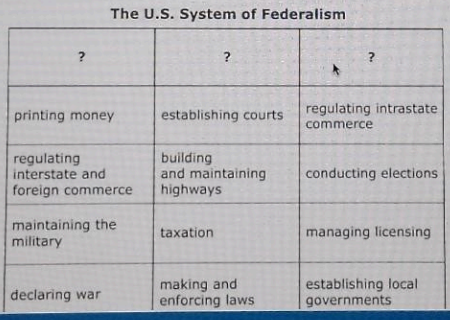
Complete the U.S. System of Federalism chart based on information from the passage. Click on the title below you want to select and drag it into the top of each column in the chart. - State Government Powers - National Government Powers - Shared Powers of National and State Governments -
Correct Answer & Rationale
Correct Answer:
In the U.S. system of federalism, powers are distributed among different levels of government. **State Government Powers** include authority over education, transportation, and local law enforcement, allowing states to address local needs effectively. **National Government Powers** encompass defense, foreign affairs, and immigration, ensuring a unified national policy in these critical areas. **Shared Powers** involve taxation, infrastructure, and law enforcement, illustrating collaboration between state and national governments to maintain order and promote welfare. Other options may misplace powers or overlook the collaborative nature of federalism, leading to misunderstandings about government functions.
In the U.S. system of federalism, powers are distributed among different levels of government. **State Government Powers** include authority over education, transportation, and local law enforcement, allowing states to address local needs effectively. **National Government Powers** encompass defense, foreign affairs, and immigration, ensuring a unified national policy in these critical areas. **Shared Powers** involve taxation, infrastructure, and law enforcement, illustrating collaboration between state and national governments to maintain order and promote welfare. Other options may misplace powers or overlook the collaborative nature of federalism, leading to misunderstandings about government functions.
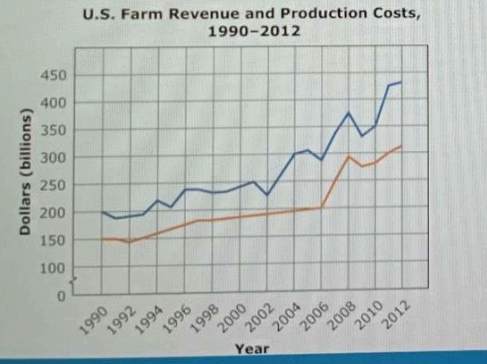
Which prediction is supported by both graphs?
- A. The average wage for farm workers will decrease..
- B. The average cost for agricultural produce will decrease.
- C. The operating cost of running a farm will increase.
- D. The number of people required for producing food will increase.
Correct Answer & Rationale
Correct Answer: C
Option C is supported by both graphs, indicating an upward trend in operational costs due to factors like inflation and increased resource prices. This aligns with economic patterns observed in the agricultural sector. Option A is incorrect as both graphs do not show a decline in farm worker wages; rather, they suggest stability or growth. Option B is misleading; the graphs do not reflect a decrease in agricultural produce costs, which often correlate with rising operational expenses. Option D is also unsupported, as the data does not indicate an increase in labor requirements, but rather highlights efficiency improvements in farming practices.
Option C is supported by both graphs, indicating an upward trend in operational costs due to factors like inflation and increased resource prices. This aligns with economic patterns observed in the agricultural sector. Option A is incorrect as both graphs do not show a decline in farm worker wages; rather, they suggest stability or growth. Option B is misleading; the graphs do not reflect a decrease in agricultural produce costs, which often correlate with rising operational expenses. Option D is also unsupported, as the data does not indicate an increase in labor requirements, but rather highlights efficiency improvements in farming practices.