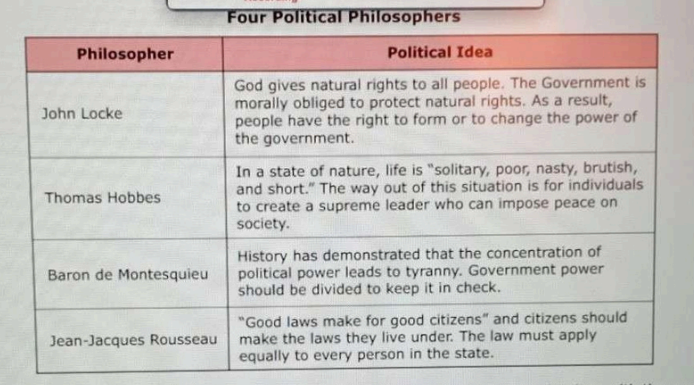
According to this information, which philosopher would most likely support the presidential power to appoint federal judges with the consent of the U.S. Senate?
- A. Thomas Hobbes
- B. Baron de Montesquieu
- C. Jean-Jacques Rousseau
- D. John Locke
Correct Answer & Rationale
Correct Answer: B
Baron de Montesquieu advocated for the separation of powers within government, emphasizing the need for checks and balances to prevent tyranny. His support for a collaborative process in appointing judges aligns with the presidential power requiring Senate consent, ensuring that no single branch holds excessive authority. Thomas Hobbes, on the other hand, favored a strong central authority and would likely support concentrated power without the need for Senate approval. Jean-Jacques Rousseau emphasized the general will and popular sovereignty, which does not directly address the judicial appointment process. John Locke valued consent and governance but did not specifically advocate for the Senate's role in judicial appointments.
Baron de Montesquieu advocated for the separation of powers within government, emphasizing the need for checks and balances to prevent tyranny. His support for a collaborative process in appointing judges aligns with the presidential power requiring Senate consent, ensuring that no single branch holds excessive authority. Thomas Hobbes, on the other hand, favored a strong central authority and would likely support concentrated power without the need for Senate approval. Jean-Jacques Rousseau emphasized the general will and popular sovereignty, which does not directly address the judicial appointment process. John Locke valued consent and governance but did not specifically advocate for the Senate's role in judicial appointments.
Other Related Questions
Which statement from Common Sense provides evidence that the author Thomas Paine supported American independence?
- A. "Absolute governments have this advantage with them, that they are simple..."
- B. "I challenge the warmest advocate for reconciliation, to [show], a single advantage that this continent can reap, by being connected with Great Britain."
- C. "The prejudice of Englishmen, in [favor] of their own government arises as much or more from national pride than reason."
- D. "Society in every state is a blessing, but government even in its best state is but a necessary evil."
Correct Answer & Rationale
Correct Answer: B
Option B provides clear evidence of Thomas Paine's support for American independence by challenging the benefits of remaining connected to Great Britain. By asking advocates for reconciliation to demonstrate any advantages, Paine emphasizes the futility of such ties and advocates for autonomy. Option A discusses the simplicity of absolute governments, which does not directly address the question of American independence. Option C critiques English national pride but lacks a direct link to the argument for independence. Option D presents a philosophical view on government but does not specifically advocate for breaking away from British rule.
Option B provides clear evidence of Thomas Paine's support for American independence by challenging the benefits of remaining connected to Great Britain. By asking advocates for reconciliation to demonstrate any advantages, Paine emphasizes the futility of such ties and advocates for autonomy. Option A discusses the simplicity of absolute governments, which does not directly address the question of American independence. Option C critiques English national pride but lacks a direct link to the argument for independence. Option D presents a philosophical view on government but does not specifically advocate for breaking away from British rule.
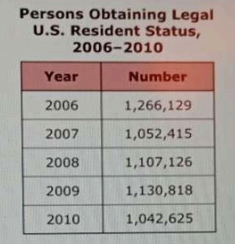
What is the mean number of people who became legal residents of the United States during this five-year period?
- A. 1,119,823
- B. 223,504
- C. 5,599,113
- D. 1,107,126
Correct Answer & Rationale
Correct Answer: A
To determine the mean number of legal residents over the five-year period, one must sum the total number of residents and divide by five. The correct calculation yields a mean of 1,119,823, reflecting the average annual influx. Option B (223,504) represents a miscalculation, likely reflecting a single year's data rather than an average. Option C (5,599,113) incorrectly totals the residents without division, suggesting a cumulative number rather than an average. Option D (1,107,126) is close but does not accurately reflect the mean, indicating a minor arithmetic error.
To determine the mean number of legal residents over the five-year period, one must sum the total number of residents and divide by five. The correct calculation yields a mean of 1,119,823, reflecting the average annual influx. Option B (223,504) represents a miscalculation, likely reflecting a single year's data rather than an average. Option C (5,599,113) incorrectly totals the residents without division, suggesting a cumulative number rather than an average. Option D (1,107,126) is close but does not accurately reflect the mean, indicating a minor arithmetic error.
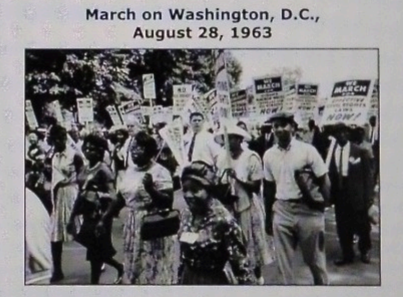
Which statement best describes the action of the people in the photograph?
- A. They are utilizing an 8th Amendment right to secure the release of a colleague who was jailed unfairly.
- B. They are utilizing a 6th Amendment right to secure a fair trial for a jailed associate.
- C. They are utilizing a 1st Amendment right to secure equality under the law.
- D. They are utilizing a 14th Amendment right to secure the opportunity to vote in federal elections.
Correct Answer & Rationale
Correct Answer: C
The action depicted in the photograph aligns with the 1st Amendment, which guarantees freedoms concerning speech, assembly, and the right to petition the government. The individuals are likely advocating for equality under the law, a fundamental principle of democratic society. Option A incorrectly references the 8th Amendment, which focuses on protection against excessive bail and cruel punishment, not the right to protest for a colleague's release. Option B misapplies the 6th Amendment, which ensures the right to a fair trial, rather than addressing broader issues of equality. Option D inaccurately connects the situation to the 14th Amendment, which deals with citizenship rights and equal protection, not specifically voting rights.
The action depicted in the photograph aligns with the 1st Amendment, which guarantees freedoms concerning speech, assembly, and the right to petition the government. The individuals are likely advocating for equality under the law, a fundamental principle of democratic society. Option A incorrectly references the 8th Amendment, which focuses on protection against excessive bail and cruel punishment, not the right to protest for a colleague's release. Option B misapplies the 6th Amendment, which ensures the right to a fair trial, rather than addressing broader issues of equality. Option D inaccurately connects the situation to the 14th Amendment, which deals with citizenship rights and equal protection, not specifically voting rights.
This flow chart traces development of democratic government in England. Which event completes this sequence?

- A. The English Bill of Rights gave the king power to appoint most members of Parliament.
- B. The Magna Carta forced the nobles to give up their feudal lands.
- C. The English Bill of Rights guaranteed suffrage to most male citizens.
- D. The Magna Carta forced the king to share his political power.
Correct Answer & Rationale
Correct Answer: D
The correct choice, D, highlights the Magna Carta's pivotal role in limiting the king's absolute power and initiating the concept of shared governance. This foundational document established that the monarch must consult nobles before making decisions, laying the groundwork for parliamentary democracy. Option A is incorrect as the English Bill of Rights actually limited the king's power over Parliament, not enhanced it. Option B misrepresents the Magna Carta's purpose; it did not force nobles to relinquish their lands, but rather addressed their grievances against the king. Option C is also inaccurate, as the English Bill of Rights did not guarantee suffrage but focused on limiting royal authority and protecting certain rights.
The correct choice, D, highlights the Magna Carta's pivotal role in limiting the king's absolute power and initiating the concept of shared governance. This foundational document established that the monarch must consult nobles before making decisions, laying the groundwork for parliamentary democracy. Option A is incorrect as the English Bill of Rights actually limited the king's power over Parliament, not enhanced it. Option B misrepresents the Magna Carta's purpose; it did not force nobles to relinquish their lands, but rather addressed their grievances against the king. Option C is also inaccurate, as the English Bill of Rights did not guarantee suffrage but focused on limiting royal authority and protecting certain rights.