This excerpt is from a speech given by President Lyndon Johnson before a joint session of Congress in 1965.
1 I speak tonight for the dignity of man and the destiny of democracy....
2 At times history and fate meet at a single time in a single place to shape a turning point in man's unending search for freedom.... So it was a century ago at Appomattox. So it was last week in Selma, Alabama.
3 There, long-suffering men and women peacefully protested the denial of their rights as Americans. Many were brutally assaulted....
4 There is no constitutional issue here. The command of the Constitution is plain.
5 There is no moral issue. It is wrong, deadly wrong, to deny any of your fellow Americans the right to vote in this country.
6 There is no issue of States' rights or national rights. There is only the struggle for human rights....
7 We cannot... refuse to protect the right of every American to vote in every election that he may desire to participate in..Ù Ù
8 But even if we pass this bill, the battle will not be over.
9 Their cause must be our cause too. Because it is not just Negroes, but really it is all of us, who must overcome the crippling legacy of bigotry and injustice.
10 And we shall overcome..
11 This great, rich, restless country can offer opportunity and education and hope to all: black and white, North and South, sharecropper and city dweller. These are the enemies: poverty, Ignorance, disease. They are the enemies and not our fellow man, not our neighbor. And these enemies too, poverty, disease and ignorance, we shall overcome.
This excerpt is from a telegram Senator Richard Russell of Georgia sent to President Dwight Eisenhower in 1957.
12... As a citizen, as a senator of the United States, and as Chairman of the Senate Committee on Armed Services, I must vigorously protest the highhanded and illegal methods being
How did the position expressed by President Johnson differ from the position expressed by Senator Russell?
- A. Only Senator Russell said that state governments were sufficiently protecting the rights of citizens.
- B. Only Senator Russell supported the federal government's intervention.
- C. Only President Johnson supported the state governments' rights to manage their own affairs.
- D. Only President Johnson believed that the federal government was authorized to intervene.
Correct Answer & Rationale
Correct Answer: A
President Johnson emphasized the need for federal intervention to protect citizens' rights, believing that state governments were often inadequate. In contrast, Senator Russell argued that state governments were effectively safeguarding those rights, reflecting a stance of local governance. Option B is incorrect because Senator Russell did not support federal intervention. Option C misrepresents Johnson’s position; he favored federal oversight rather than state autonomy. Option D inaccurately attributes the belief in federal authority solely to Johnson, as Russell did not share this view. Thus, the distinction lies in Russell's confidence in state governments versus Johnson's call for federal action.
President Johnson emphasized the need for federal intervention to protect citizens' rights, believing that state governments were often inadequate. In contrast, Senator Russell argued that state governments were effectively safeguarding those rights, reflecting a stance of local governance. Option B is incorrect because Senator Russell did not support federal intervention. Option C misrepresents Johnson’s position; he favored federal oversight rather than state autonomy. Option D inaccurately attributes the belief in federal authority solely to Johnson, as Russell did not share this view. Thus, the distinction lies in Russell's confidence in state governments versus Johnson's call for federal action.
Other Related Questions
Which statement about the ratification of the 19th Amendment is based on the passage?
- A. Ratification was the result of the Seneca Falls Convention.
- B. Ratification occurred in return for the military service of women during World War I.
- C. Ratification occurred prior to the granting of voting rights to freed slaves.
- D. Ratification was the result of the accumulated efforts of women for decades.
Correct Answer & Rationale
Correct Answer: D
The ratification of the 19th Amendment was the culmination of decades of advocacy and activism by women who fought tirelessly for their voting rights, making option D the most accurate statement. Option A incorrectly attributes the ratification solely to the Seneca Falls Convention, which was just one of many events in the long struggle for women's suffrage. Option B suggests a direct exchange of military service for voting rights, which oversimplifies the complex social and political factors involved. Option C misrepresents the timeline, as the 19th Amendment was ratified after the Civil War, but the fight for voting rights for freed slaves and women evolved concurrently, not sequentially.
The ratification of the 19th Amendment was the culmination of decades of advocacy and activism by women who fought tirelessly for their voting rights, making option D the most accurate statement. Option A incorrectly attributes the ratification solely to the Seneca Falls Convention, which was just one of many events in the long struggle for women's suffrage. Option B suggests a direct exchange of military service for voting rights, which oversimplifies the complex social and political factors involved. Option C misrepresents the timeline, as the 19th Amendment was ratified after the Civil War, but the fight for voting rights for freed slaves and women evolved concurrently, not sequentially.
According to this graph, in which year did the U.S. government first achieve a budget surplus?
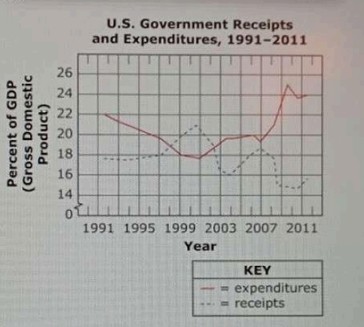
- A. 1996
- B. 1994
- C. 1998
- D. 2002
Correct Answer & Rationale
Correct Answer: C
The graph indicates that the U.S. government first achieved a budget surplus in 1998, as evidenced by the line crossing above the zero mark in that year. Option A (1996) shows a deficit, as the line remains below zero. Option B (1994) also reflects a deficit, indicating that the government had not yet balanced its budget. Option D (2002) is incorrect as it depicts a return to deficit after a surplus, confirming that the surplus was achieved earlier in 1998. Thus, 1998 is the first year when the budget surplus was realized.
The graph indicates that the U.S. government first achieved a budget surplus in 1998, as evidenced by the line crossing above the zero mark in that year. Option A (1996) shows a deficit, as the line remains below zero. Option B (1994) also reflects a deficit, indicating that the government had not yet balanced its budget. Option D (2002) is incorrect as it depicts a return to deficit after a surplus, confirming that the surplus was achieved earlier in 1998. Thus, 1998 is the first year when the budget surplus was realized.
Which statement is supported by both the table and the map?
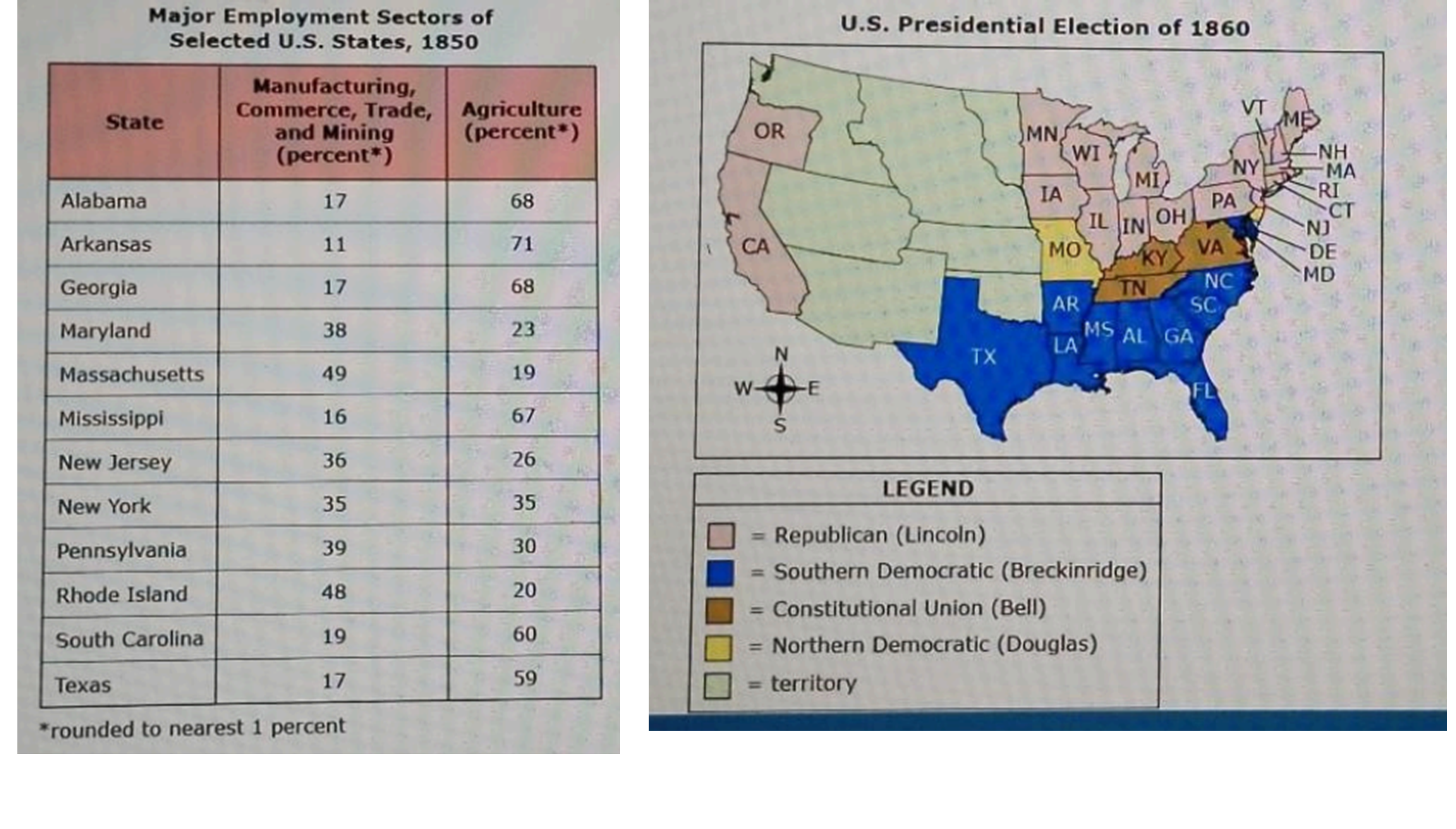
- A. Differences in the total populations of the states led to political differences between the North and the South.
- B. Differences among the economies of the states contributed to political differences between the North and the South.
- C. Political differences between the North and the South reflected differences in education among the states.
- D. Political differences between the North and the South reflected differences in the standards of living in the states.
Correct Answer & Rationale
Correct Answer: B
Option B is supported by both the table and the map, as they illustrate how varying economic structures—such as agriculture in the South versus industrialization in the North—contributed to distinct political ideologies and policies. Option A incorrectly attributes political differences solely to population size, overlooking the economic factors at play. Option C suggests education differences as the main cause, which is not evident in the provided data. Option D implies that living standards were the primary influence, but the economic context is more directly linked to the political divide. Thus, B effectively encapsulates the relationship between economy and political differences.
Option B is supported by both the table and the map, as they illustrate how varying economic structures—such as agriculture in the South versus industrialization in the North—contributed to distinct political ideologies and policies. Option A incorrectly attributes political differences solely to population size, overlooking the economic factors at play. Option C suggests education differences as the main cause, which is not evident in the provided data. Option D implies that living standards were the primary influence, but the economic context is more directly linked to the political divide. Thus, B effectively encapsulates the relationship between economy and political differences.
Which conclusion can be drawn from the diagrams?
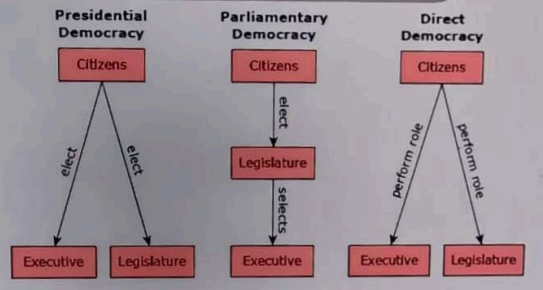
- A. The legislature is more representative of the people in a presidential democracy than in a parliamentary democracy.
- B. The branches of government are more independent of each other in a presidential democracy than in a parliamentary democracy.
- C. The executive branch is more accountable to the people in a parliamentary democracy than in a direct democracy.
- D. The people are more involved in governing in a presidential democracy than in a direct democracy.
Correct Answer & Rationale
Correct Answer: B
In a presidential democracy, the separation of powers is a key feature, allowing the executive, legislative, and judicial branches to operate independently. This independence enhances checks and balances, ensuring that no single branch can dominate. Option A is incorrect as both systems aim for representation, but the degree can vary based on specific contexts rather than the type of democracy. Option C misrepresents accountability; in parliamentary systems, the executive is directly accountable to the legislature, which is elected by the people. Option D is misleading; in a direct democracy, citizens have direct involvement in governance, often more so than in a presidential system.
In a presidential democracy, the separation of powers is a key feature, allowing the executive, legislative, and judicial branches to operate independently. This independence enhances checks and balances, ensuring that no single branch can dominate. Option A is incorrect as both systems aim for representation, but the degree can vary based on specific contexts rather than the type of democracy. Option C misrepresents accountability; in parliamentary systems, the executive is directly accountable to the legislature, which is elected by the people. Option D is misleading; in a direct democracy, citizens have direct involvement in governance, often more so than in a presidential system.