The Affordable Care Act was passed by the U.S. Congress in 2010, but faced numerous legal challenges after it took effect. In 2012, the U.S. Supreme Court ruled that the law was constitutional.
Excerpts from Senator Rand Paul's article against the Affordable Care Act, March 25, 2011
1 Excerpt 1: "For the first time in U.S. history, the federal government will force you to purchase health insurance."
2 Excerpt 2: "Like other areas of the economy where the federal government wields its heavy hand, health care is overregulated and in need of serious market reforms. But many see bigger government as the solution to this problem...."
3 Excerpt 3: "When people blame the current crisis on the free market, they are making a grave intellectual error. We have not even remotely tried a free market in health care. We put layer upon layer of rules and mandates on companies. We limit the choices available to consumers."
4 Excerpt 4: "The solutions we seek to our health care problems should therefore offer more freedom, not less."
Excerpts from President Obama's speech about the Supreme Court ruling on the Affordable Care Act, June 28, 2012
5 Excerpt 1: "... Earlier today, the Supreme Court upheld the constitutionality of the Affordable Care Act... [T]oday's decision was a victory for people all over this country whose lives will be more secure because of this law and the Supreme Court's decision to uphold it."
6 Excerpt 2: "Each state will take the lead in designing [its] own menu of [health care] options, and if states can come up with even better ways of covering more people at the same quality and cost, this law allows them to do that, too."
7 Excerpt 3: "That's why... we ultimately included a provision in the Affordable Care Act that people who can afford to buy health insurance should take the responsibility to do so."
Which statement from the excerpts is a fact?
- A. "When people blame the current crisis on the free market, they are making a grave intellectual error." (paragraph 3)
- B. "... we ultimately included a provision in the Affordable Care Act that people who can afford to buy health insurance should take the responsibility to do so." (paragraph 7)
- C. "Like other areas of the economy where the federal government wields its heavy hand, health care is overregulated and in need of serious market reforms." (paragraph 2)
- D. "... [T]oday's decision was a victory for people all over this country whose lives will be more secure because of this law and the Supreme Court's decision to uphold it." (paragraph 5)
Correct Answer & Rationale
Correct Answer: B
Option B presents a factual statement regarding the Affordable Care Act, specifically mentioning a provision that mandates individuals who can afford health insurance to take responsibility for purchasing it. This is a verifiable aspect of the legislation. In contrast, Option A expresses an opinion about blaming the free market, which is subjective and open to interpretation. Option C also conveys a viewpoint on government regulation and reform needs, lacking objective verification. Lastly, Option D describes a perceived outcome of a decision, reflecting an opinion on its impact rather than presenting a fact. Thus, only Option B stands as an objective statement grounded in legislation.
Option B presents a factual statement regarding the Affordable Care Act, specifically mentioning a provision that mandates individuals who can afford health insurance to take responsibility for purchasing it. This is a verifiable aspect of the legislation. In contrast, Option A expresses an opinion about blaming the free market, which is subjective and open to interpretation. Option C also conveys a viewpoint on government regulation and reform needs, lacking objective verification. Lastly, Option D describes a perceived outcome of a decision, reflecting an opinion on its impact rather than presenting a fact. Thus, only Option B stands as an objective statement grounded in legislation.
Other Related Questions
Which conclusion can be drawn from the diagrams?
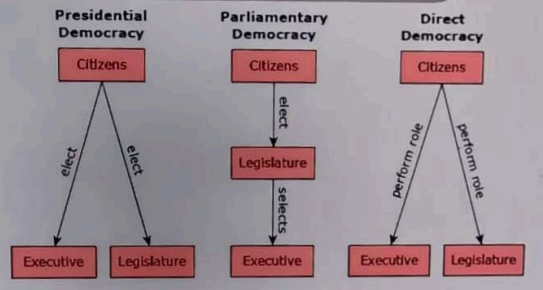
- A. The legislature is more representative of the people in a presidential democracy than in a parliamentary democracy.
- B. The branches of government are more independent of each other in a presidential democracy than in a parliamentary democracy.
- C. The executive branch is more accountable to the people in a parliamentary democracy than in a direct democracy.
- D. The people are more involved in governing in a presidential democracy than in a direct democracy.
Correct Answer & Rationale
Correct Answer: B
In a presidential democracy, the separation of powers is a key feature, allowing the executive, legislative, and judicial branches to operate independently. This independence enhances checks and balances, ensuring that no single branch can dominate. Option A is incorrect as both systems aim for representation, but the degree can vary based on specific contexts rather than the type of democracy. Option C misrepresents accountability; in parliamentary systems, the executive is directly accountable to the legislature, which is elected by the people. Option D is misleading; in a direct democracy, citizens have direct involvement in governance, often more so than in a presidential system.
In a presidential democracy, the separation of powers is a key feature, allowing the executive, legislative, and judicial branches to operate independently. This independence enhances checks and balances, ensuring that no single branch can dominate. Option A is incorrect as both systems aim for representation, but the degree can vary based on specific contexts rather than the type of democracy. Option C misrepresents accountability; in parliamentary systems, the executive is directly accountable to the legislature, which is elected by the people. Option D is misleading; in a direct democracy, citizens have direct involvement in governance, often more so than in a presidential system.
This flow chart traces development of democratic government in England. Which event completes this sequence?

- A. The English Bill of Rights gave the king power to appoint most members of Parliament.
- B. The Magna Carta forced the nobles to give up their feudal lands.
- C. The English Bill of Rights guaranteed suffrage to most male citizens.
- D. The Magna Carta forced the king to share his political power.
Correct Answer & Rationale
Correct Answer: D
The correct choice, D, highlights the Magna Carta's pivotal role in limiting the king's absolute power and initiating the concept of shared governance. This foundational document established that the monarch must consult nobles before making decisions, laying the groundwork for parliamentary democracy. Option A is incorrect as the English Bill of Rights actually limited the king's power over Parliament, not enhanced it. Option B misrepresents the Magna Carta's purpose; it did not force nobles to relinquish their lands, but rather addressed their grievances against the king. Option C is also inaccurate, as the English Bill of Rights did not guarantee suffrage but focused on limiting royal authority and protecting certain rights.
The correct choice, D, highlights the Magna Carta's pivotal role in limiting the king's absolute power and initiating the concept of shared governance. This foundational document established that the monarch must consult nobles before making decisions, laying the groundwork for parliamentary democracy. Option A is incorrect as the English Bill of Rights actually limited the king's power over Parliament, not enhanced it. Option B misrepresents the Magna Carta's purpose; it did not force nobles to relinquish their lands, but rather addressed their grievances against the king. Option C is also inaccurate, as the English Bill of Rights did not guarantee suffrage but focused on limiting royal authority and protecting certain rights.
The newspaper writer's opinion that
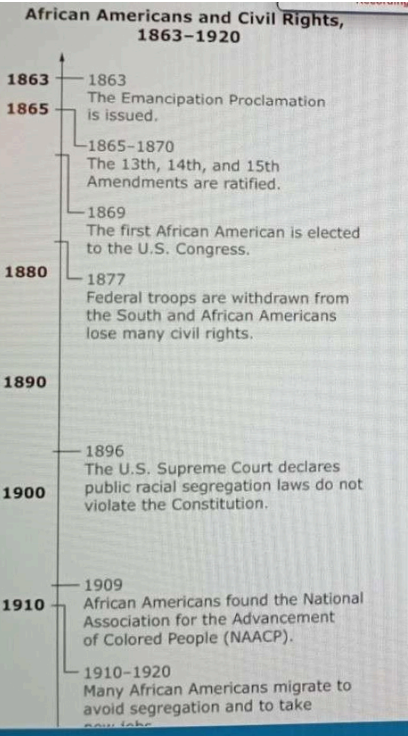
- A. slavery should have been preserved
- B. Jim Crow laws should have been stopped
- C. Jim Crow laws benefited the south
- D. Jim Crow laws had benefited the South constitutional changes were successful
Correct Answer & Rationale
Correct Answer: C
The opinion that Jim Crow laws benefited the South reflects a perspective that views these discriminatory laws as advantageous for maintaining social order and economic benefits for white populations, despite their oppressive nature. Option A suggests a support for slavery, which is widely condemned and not a mainstream opinion. Option B advocates for the cessation of Jim Crow laws, opposing the notion that they were beneficial. Option D incorrectly implies that constitutional changes related to Jim Crow were successful, overlooking the ongoing struggles for civil rights and equality. Thus, option C captures a historically inaccurate yet prevalent viewpoint of the time.
The opinion that Jim Crow laws benefited the South reflects a perspective that views these discriminatory laws as advantageous for maintaining social order and economic benefits for white populations, despite their oppressive nature. Option A suggests a support for slavery, which is widely condemned and not a mainstream opinion. Option B advocates for the cessation of Jim Crow laws, opposing the notion that they were beneficial. Option D incorrectly implies that constitutional changes related to Jim Crow were successful, overlooking the ongoing struggles for civil rights and equality. Thus, option C captures a historically inaccurate yet prevalent viewpoint of the time.
Which statement is supported by both the table and the map?
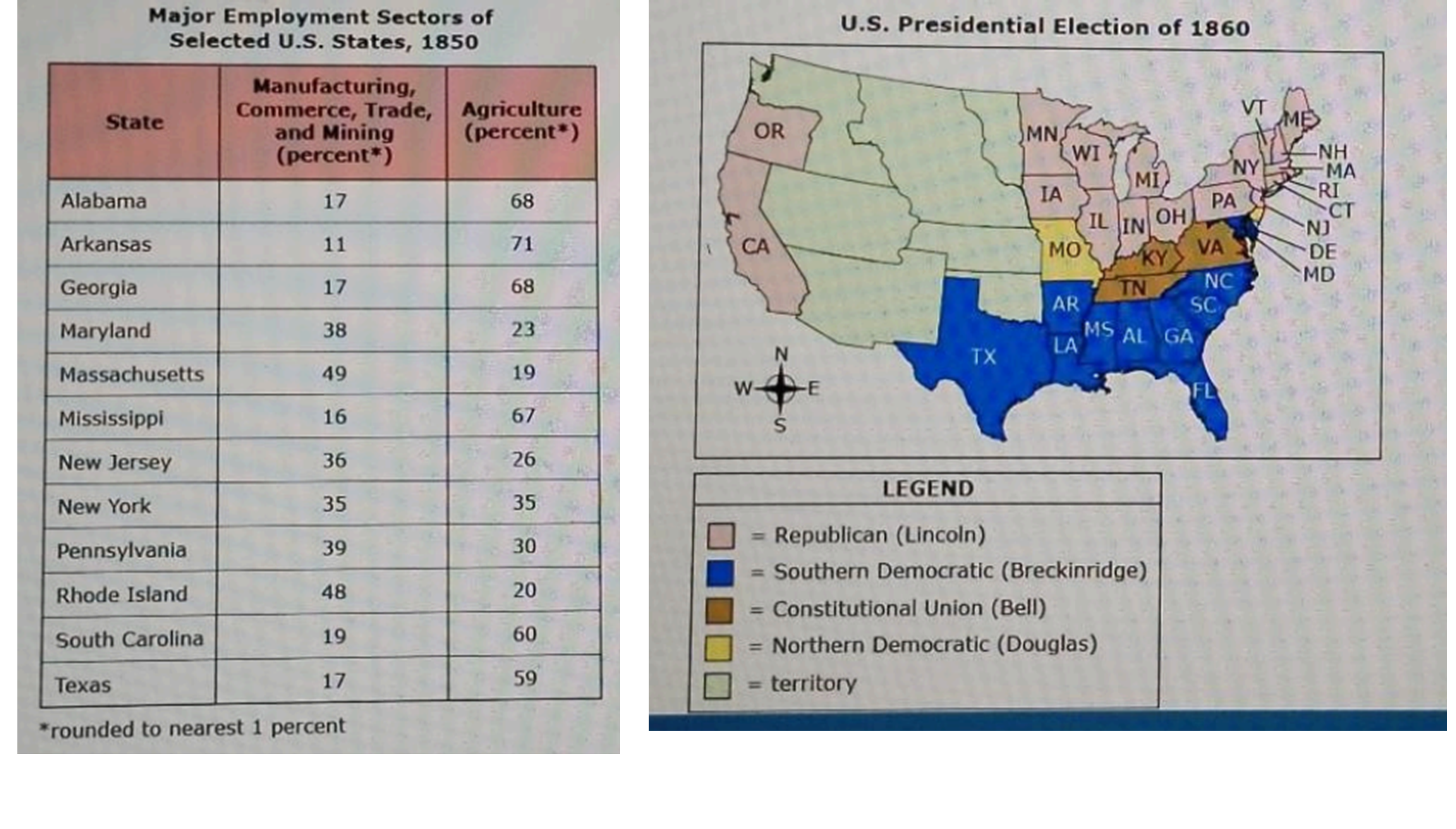
- A. Differences in the total populations of the states led to political differences between the North and the South.
- B. Differences among the economies of the states contributed to political differences between the North and the South.
- C. Political differences between the North and the South reflected differences in education among the states.
- D. Political differences between the North and the South reflected differences in the standards of living in the states.
Correct Answer & Rationale
Correct Answer: B
Option B is supported by both the table and the map, as they illustrate how varying economic structures—such as agriculture in the South versus industrialization in the North—contributed to distinct political ideologies and policies. Option A incorrectly attributes political differences solely to population size, overlooking the economic factors at play. Option C suggests education differences as the main cause, which is not evident in the provided data. Option D implies that living standards were the primary influence, but the economic context is more directly linked to the political divide. Thus, B effectively encapsulates the relationship between economy and political differences.
Option B is supported by both the table and the map, as they illustrate how varying economic structures—such as agriculture in the South versus industrialization in the North—contributed to distinct political ideologies and policies. Option A incorrectly attributes political differences solely to population size, overlooking the economic factors at play. Option C suggests education differences as the main cause, which is not evident in the provided data. Option D implies that living standards were the primary influence, but the economic context is more directly linked to the political divide. Thus, B effectively encapsulates the relationship between economy and political differences.