The slogan "54-40 or Fight" referred to the latitude line of 54 degrees 40 minutes, which was the northern boundary of the Oregon Territory. The United States and Britain had jointly occupied the territory for decades. Both nations felt they had a legitimate claim to the land and its wealth of resources.
This excerpt is from President James Polk's 1845 inaugural address.
Nor will it become in a less degree my duty to... maintain by all constitutional means the right of the United States to that portion of our territory which lles beyond the Rocky Mountains. Our title to... Oregon is "clear and unquestionable," and already are our people preparing to perfect that title by occupying it with their wives and ascended the Missouri to its headsprings, and are already engaged in establishing the children.. [0]ur people... have filled the eastern valley of the Mississippi, To us belongs the duty of protecting them adequately wherever they may be upon our blessings of self-government in valleys of which the rivers flow to the Pacific.. soil. The jurisdiction of our laws and the benefits of our republican institutions should be extended over them in the distant regions which they have selected for their homes.
Which statement from President Polk's address is a fact rather than an opinion?
- A. "Our title to… Oregon is 'clear and unquestionable,' and already are our people preparing to perfect that title by occupying it with their wives and children..."
- B. "[O]ur people… have filled the eastern valley of the Mississippi,... ascended the Missouri to its headsprings..."
- C. "Nor will it become in a less degree my duty to… maintain by all constitutional means the right of the United States to that portion of our territory which lies beyond the Rocky Mountains."
- D. "The jurisdiction of our laws and the benefits of our republican institutions should be extended over them in the distant regions which they have selected for their homes."
Correct Answer & Rationale
Correct Answer: B
Option B presents a factual statement about the movement of people in the United States, specifically noting their migration patterns along the Mississippi and Missouri rivers. This statement can be verified through historical records, making it a fact. In contrast, Option A expresses a subjective belief regarding the clarity of the title to Oregon, which is an opinion rather than an objective truth. Option C discusses the duty of the President in a way that implies a commitment but does not provide verifiable information. Lastly, Option D suggests a normative view on governance and territorial expansion, reflecting a belief in the benefits of U.S. institutions rather than stating a fact.
Option B presents a factual statement about the movement of people in the United States, specifically noting their migration patterns along the Mississippi and Missouri rivers. This statement can be verified through historical records, making it a fact. In contrast, Option A expresses a subjective belief regarding the clarity of the title to Oregon, which is an opinion rather than an objective truth. Option C discusses the duty of the President in a way that implies a commitment but does not provide verifiable information. Lastly, Option D suggests a normative view on governance and territorial expansion, reflecting a belief in the benefits of U.S. institutions rather than stating a fact.
Other Related Questions
Which prediction is supported by both graphs?
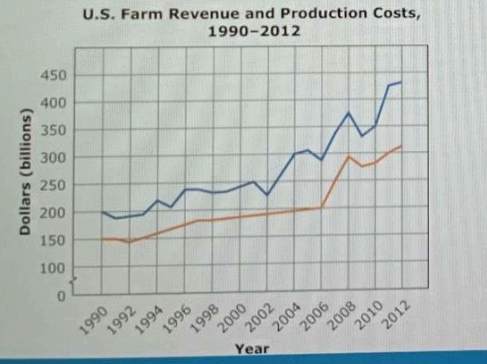
- A. The average wage for farm workers will decrease..
- B. The average cost for agricultural produce will decrease.
- C. The operating cost of running a farm will increase.
- D. The number of people required for producing food will increase.
Correct Answer & Rationale
Correct Answer: C
Option C is supported by both graphs, indicating an upward trend in operational costs due to factors like inflation and increased resource prices. This aligns with economic patterns observed in the agricultural sector. Option A is incorrect as both graphs do not show a decline in farm worker wages; rather, they suggest stability or growth. Option B is misleading; the graphs do not reflect a decrease in agricultural produce costs, which often correlate with rising operational expenses. Option D is also unsupported, as the data does not indicate an increase in labor requirements, but rather highlights efficiency improvements in farming practices.
Option C is supported by both graphs, indicating an upward trend in operational costs due to factors like inflation and increased resource prices. This aligns with economic patterns observed in the agricultural sector. Option A is incorrect as both graphs do not show a decline in farm worker wages; rather, they suggest stability or growth. Option B is misleading; the graphs do not reflect a decrease in agricultural produce costs, which often correlate with rising operational expenses. Option D is also unsupported, as the data does not indicate an increase in labor requirements, but rather highlights efficiency improvements in farming practices.
What basic assumption behind Marshall's remarks is not behind Reagan's remarks?
- A. The framers of the U.S. Constitution have received more credit than they deserve for the governmental protections Americans enjoy.
- B. The framers of the U.S. Constitution have been credited with creating a document that protects all free people around the world.
- C. The U.S. Constitution created a government whose promises are yet to be realized by many around the world.
- D. The U.S. Constitution created a government based on the principles expressed in the Declaration of Independence.
Correct Answer & Rationale
Correct Answer: A
Marshall's remarks imply a critical view of the framers' contributions, suggesting they may not deserve as much credit for governmental protections as commonly believed. This contrasts with Reagan's perspective, which typically emphasizes the positive legacy of the framers. Option B incorrectly assumes that both figures share the belief in the global impact of the Constitution, which Reagan often highlighted. Option C suggests an acknowledgment of unrealized promises, aligning with both perspectives, while option D reinforces a foundational agreement on principles that both figures would likely support. Thus, A stands out as the unique assumption absent in Reagan's remarks.
Marshall's remarks imply a critical view of the framers' contributions, suggesting they may not deserve as much credit for governmental protections as commonly believed. This contrasts with Reagan's perspective, which typically emphasizes the positive legacy of the framers. Option B incorrectly assumes that both figures share the belief in the global impact of the Constitution, which Reagan often highlighted. Option C suggests an acknowledgment of unrealized promises, aligning with both perspectives, while option D reinforces a foundational agreement on principles that both figures would likely support. Thus, A stands out as the unique assumption absent in Reagan's remarks.
According to Justice Marshall, what historical factor has contradicted the ideas expressed in the U.S. Constitution?
- A. slavery
- B. free enterprise
- C. religion
- D. class war
Correct Answer & Rationale
Correct Answer: A
Justice Marshall highlighted slavery as a significant historical contradiction to the principles of freedom and equality enshrined in the U.S. Constitution. Slavery directly undermined the Constitution's assertion that all men are created equal, creating a profound moral and ethical conflict. In contrast, free enterprise (B) aligns with the Constitution's emphasis on individual rights and economic freedom. Religion (C) is protected under the First Amendment, promoting freedom rather than contradiction. Class war (D) is a socio-economic conflict that, while relevant, does not directly challenge the foundational ideals of the Constitution in the same way slavery does.
Justice Marshall highlighted slavery as a significant historical contradiction to the principles of freedom and equality enshrined in the U.S. Constitution. Slavery directly undermined the Constitution's assertion that all men are created equal, creating a profound moral and ethical conflict. In contrast, free enterprise (B) aligns with the Constitution's emphasis on individual rights and economic freedom. Religion (C) is protected under the First Amendment, promoting freedom rather than contradiction. Class war (D) is a socio-economic conflict that, while relevant, does not directly challenge the foundational ideals of the Constitution in the same way slavery does.
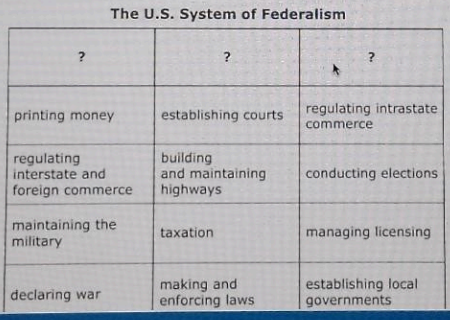
Complete the U.S. System of Federalism chart based on information from the passage. Click on the title below you want to select and drag it into the top of each column in the chart. - State Government Powers - National Government Powers - Shared Powers of National and State Governments -
Correct Answer & Rationale
Correct Answer:
In the U.S. system of federalism, powers are distributed among different levels of government. **State Government Powers** include authority over education, transportation, and local law enforcement, allowing states to address local needs effectively. **National Government Powers** encompass defense, foreign affairs, and immigration, ensuring a unified national policy in these critical areas. **Shared Powers** involve taxation, infrastructure, and law enforcement, illustrating collaboration between state and national governments to maintain order and promote welfare. Other options may misplace powers or overlook the collaborative nature of federalism, leading to misunderstandings about government functions.
In the U.S. system of federalism, powers are distributed among different levels of government. **State Government Powers** include authority over education, transportation, and local law enforcement, allowing states to address local needs effectively. **National Government Powers** encompass defense, foreign affairs, and immigration, ensuring a unified national policy in these critical areas. **Shared Powers** involve taxation, infrastructure, and law enforcement, illustrating collaboration between state and national governments to maintain order and promote welfare. Other options may misplace powers or overlook the collaborative nature of federalism, leading to misunderstandings about government functions.