These statements are from Essentials of Americanization, a book by soclology professor Emory S. Bogardus.
The Americanization movement had its primary, or immediate, origin in 1914 when... a renaissance of nationalism occurred throughout the civilized world.
Americanization begins with an examination of American traits and ends with... an assimilation movement... We may consider the Mayflower Compact as the initial statement of Americanism... and Theodore Roosevelt's and Woodrow Wilson's recent addresses as modern revisions....
Our national purpose must be clearly stated, taught to our people, and accepted throughout the land.... It will be necessary continually to shun... autocracy, imperialism, ambition for world domination, [and] Injustice in dealing with weak nations, classes, or persons.
[The United States] must transform her imperfect democracy, not into another strong nation-state... but into a perfected democracy dedicated to the task of pushing forward the principles of democracy throughout the world.
Which historical event most likely shaped the author's point of view?
- A. the development of the concept of Manifest Destiny
- B. the United States' involvement in World War I
- C. the United States' internal conflicts during the Great Depression
- D. the calls for social reform during Prohibition
Correct Answer & Rationale
Correct Answer: B
The author's perspective is significantly influenced by the United States' involvement in World War I, as this event marked a pivotal shift in national identity and global engagement. The war prompted discussions about democracy, freedom, and the role of the U.S. on the world stage, shaping the author's views on these themes. Option A, Manifest Destiny, pertains to 19th-century expansionism, which is less relevant to the author's context. Option C, the Great Depression, focuses on economic struggles rather than the broader geopolitical implications of war. Option D, social reform during Prohibition, addresses domestic issues but does not encompass the global impact and ideological shifts brought about by World War I.
The author's perspective is significantly influenced by the United States' involvement in World War I, as this event marked a pivotal shift in national identity and global engagement. The war prompted discussions about democracy, freedom, and the role of the U.S. on the world stage, shaping the author's views on these themes. Option A, Manifest Destiny, pertains to 19th-century expansionism, which is less relevant to the author's context. Option C, the Great Depression, focuses on economic struggles rather than the broader geopolitical implications of war. Option D, social reform during Prohibition, addresses domestic issues but does not encompass the global impact and ideological shifts brought about by World War I.
Other Related Questions
Which statement is supported by both the table and the map?
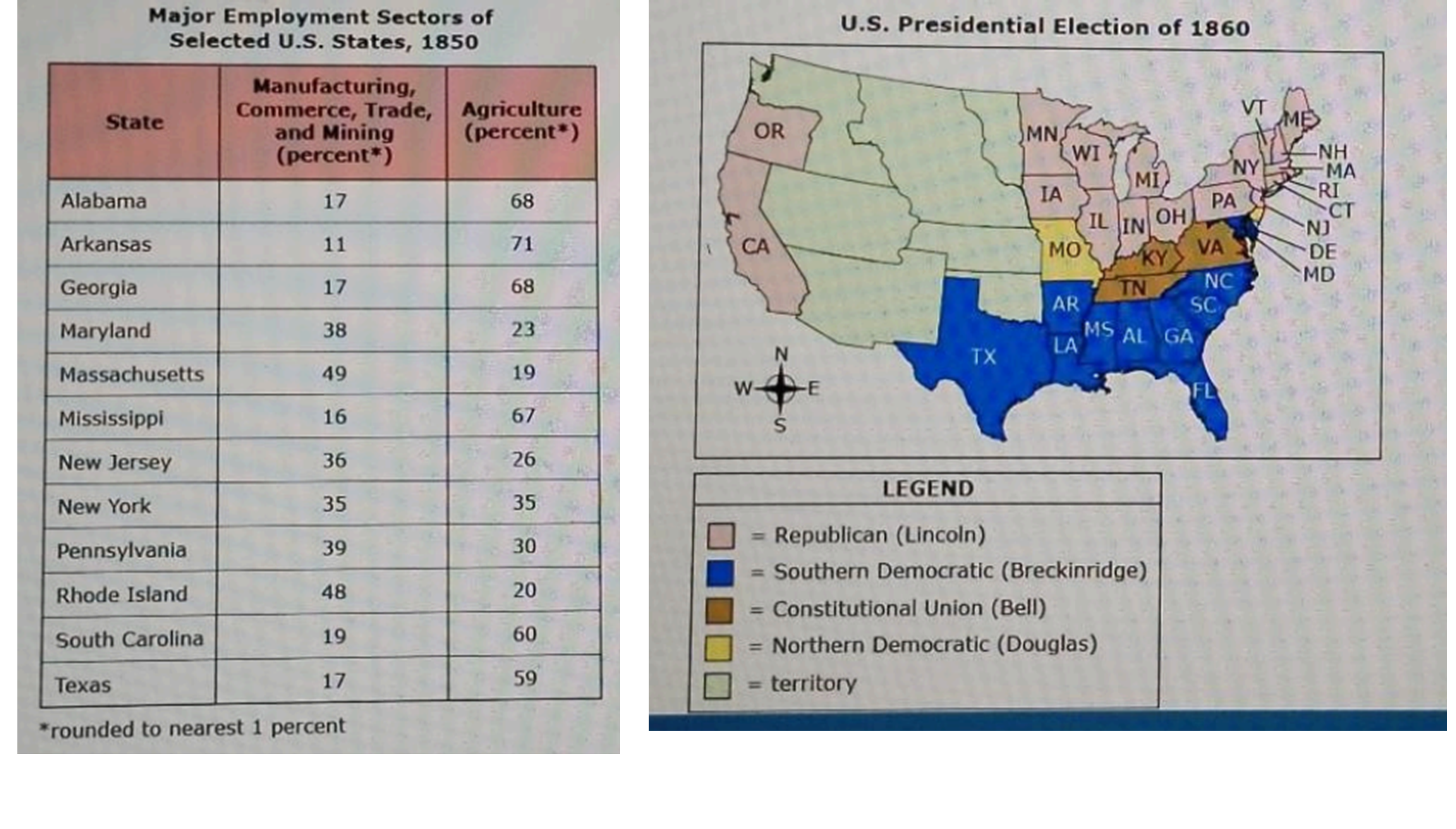
- A. Differences in the total populations of the states led to political differences between the North and the South.
- B. Differences among the economies of the states contributed to political differences between the North and the South.
- C. Political differences between the North and the South reflected differences in education among the states.
- D. Political differences between the North and the South reflected differences in the standards of living in the states.
Correct Answer & Rationale
Correct Answer: B
Option B is supported by both the table and the map, as they illustrate how varying economic structures—such as agriculture in the South versus industrialization in the North—contributed to distinct political ideologies and policies. Option A incorrectly attributes political differences solely to population size, overlooking the economic factors at play. Option C suggests education differences as the main cause, which is not evident in the provided data. Option D implies that living standards were the primary influence, but the economic context is more directly linked to the political divide. Thus, B effectively encapsulates the relationship between economy and political differences.
Option B is supported by both the table and the map, as they illustrate how varying economic structures—such as agriculture in the South versus industrialization in the North—contributed to distinct political ideologies and policies. Option A incorrectly attributes political differences solely to population size, overlooking the economic factors at play. Option C suggests education differences as the main cause, which is not evident in the provided data. Option D implies that living standards were the primary influence, but the economic context is more directly linked to the political divide. Thus, B effectively encapsulates the relationship between economy and political differences.
Which statement is correct about the change in racial and ethnic populations between 2000 and 2010?
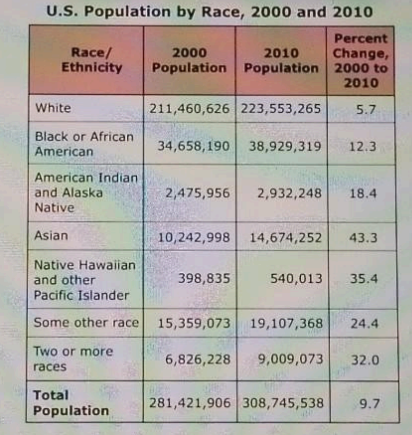
- A. The Black or African American population had the greatest percentage of growth.
- B. The Native Hawaiian and other Pacific Islander population grew by a greater proportion than the Asian population.
- C. The White population experienced the slowest growth of all groups.
- D. The American Indian and Alaska Native population experienced almost no change.
Correct Answer & Rationale
Correct Answer: B
Option B accurately reflects demographic trends, as the Native Hawaiian and other Pacific Islander population indeed saw a higher percentage increase compared to the Asian population during this period. Option A is incorrect; while the Black or African American population grew, it was not the greatest percentage increase among all racial groups. Option C misrepresents the data; although the White population's growth was slower compared to previous decades, it was not the slowest overall. Option D is misleading as well; the American Indian and Alaska Native population did experience some growth, albeit modest, rather than remaining unchanged.
Option B accurately reflects demographic trends, as the Native Hawaiian and other Pacific Islander population indeed saw a higher percentage increase compared to the Asian population during this period. Option A is incorrect; while the Black or African American population grew, it was not the greatest percentage increase among all racial groups. Option C misrepresents the data; although the White population's growth was slower compared to previous decades, it was not the slowest overall. Option D is misleading as well; the American Indian and Alaska Native population did experience some growth, albeit modest, rather than remaining unchanged.
According to Justice Marshall, what historical factor has contradicted the ideas expressed in the U.S. Constitution?
- A. slavery
- B. free enterprise
- C. religion
- D. class war
Correct Answer & Rationale
Correct Answer: A
Justice Marshall highlighted slavery as a significant historical contradiction to the principles of freedom and equality enshrined in the U.S. Constitution. Slavery directly undermined the Constitution's assertion that all men are created equal, creating a profound moral and ethical conflict. In contrast, free enterprise (B) aligns with the Constitution's emphasis on individual rights and economic freedom. Religion (C) is protected under the First Amendment, promoting freedom rather than contradiction. Class war (D) is a socio-economic conflict that, while relevant, does not directly challenge the foundational ideals of the Constitution in the same way slavery does.
Justice Marshall highlighted slavery as a significant historical contradiction to the principles of freedom and equality enshrined in the U.S. Constitution. Slavery directly undermined the Constitution's assertion that all men are created equal, creating a profound moral and ethical conflict. In contrast, free enterprise (B) aligns with the Constitution's emphasis on individual rights and economic freedom. Religion (C) is protected under the First Amendment, promoting freedom rather than contradiction. Class war (D) is a socio-economic conflict that, while relevant, does not directly challenge the foundational ideals of the Constitution in the same way slavery does.
Which statement from the excerpts is a fact?
- A. "When people blame the current crisis on the free market, they are making a grave intellectual error." (paragraph 3)
- B. "... we ultimately included a provision in the Affordable Care Act that people who can afford to buy health insurance should take the responsibility to do so." (paragraph 7)
- C. "Like other areas of the economy where the federal government wields its heavy hand, health care is overregulated and in need of serious market reforms." (paragraph 2)
- D. "... [T]oday's decision was a victory for people all over this country whose lives will be more secure because of this law and the Supreme Court's decision to uphold it." (paragraph 5)
Correct Answer & Rationale
Correct Answer: B
Option B presents a factual statement regarding the Affordable Care Act, specifically mentioning a provision that mandates individuals who can afford health insurance to take responsibility for purchasing it. This is a verifiable aspect of the legislation. In contrast, Option A expresses an opinion about blaming the free market, which is subjective and open to interpretation. Option C also conveys a viewpoint on government regulation and reform needs, lacking objective verification. Lastly, Option D describes a perceived outcome of a decision, reflecting an opinion on its impact rather than presenting a fact. Thus, only Option B stands as an objective statement grounded in legislation.
Option B presents a factual statement regarding the Affordable Care Act, specifically mentioning a provision that mandates individuals who can afford health insurance to take responsibility for purchasing it. This is a verifiable aspect of the legislation. In contrast, Option A expresses an opinion about blaming the free market, which is subjective and open to interpretation. Option C also conveys a viewpoint on government regulation and reform needs, lacking objective verification. Lastly, Option D describes a perceived outcome of a decision, reflecting an opinion on its impact rather than presenting a fact. Thus, only Option B stands as an objective statement grounded in legislation.