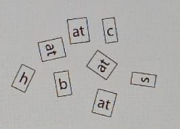
A teacher is working with a group of students at a literacy station. The students are expected to use the cards shown to form as many words as possible.
Which of the following concepts is best illustrated by the activity?
- A. Mastering sight words
- B. Working with syllabication
- C. Creating word families-
- D. Identifying prefixes and suffixes
Correct Answer & Rationale
Correct Answer: C
Creating word families demonstrates how words share a common base or root, allowing students to see relationships between words and enhance their vocabulary. This activity encourages learners to group words with similar structures, fostering an understanding of language patterns. Mastering sight words focuses on recognizing high-frequency words, which does not directly illustrate the concept of word families. Working with syllabication emphasizes breaking words into syllables rather than exploring their relationships. Identifying prefixes and suffixes involves understanding word parts but does not encompass the broader connections found in word families.
Creating word families demonstrates how words share a common base or root, allowing students to see relationships between words and enhance their vocabulary. This activity encourages learners to group words with similar structures, fostering an understanding of language patterns. Mastering sight words focuses on recognizing high-frequency words, which does not directly illustrate the concept of word families. Working with syllabication emphasizes breaking words into syllables rather than exploring their relationships. Identifying prefixes and suffixes involves understanding word parts but does not encompass the broader connections found in word families.
Other Related Questions
Which of the following best describes the phonological skill the student is practicing?
- A. Blending
- B. Segmenting
- C. Substituting
- D. Deleting
Correct Answer & Rationale
Correct Answer: D
The student is practicing deleting, which involves removing specific sounds from words to create new words. For example, removing the initial sound from "smile" to form "mile." Blending (Option A) refers to combining individual sounds to form a word, such as merging /s/, /m/, /i/, and /l/ into "smile." Segmenting (Option B) is the opposite, where a word is broken down into its individual sounds, like separating "cat" into /k/, /æ/, and /t/. Substituting (Option C) involves replacing one sound with another, such as changing the /s/ in "sat" to /h/ to make "hat." Each of these skills plays a distinct role in phonological awareness, but only deleting accurately describes the student's activity.
The student is practicing deleting, which involves removing specific sounds from words to create new words. For example, removing the initial sound from "smile" to form "mile." Blending (Option A) refers to combining individual sounds to form a word, such as merging /s/, /m/, /i/, and /l/ into "smile." Segmenting (Option B) is the opposite, where a word is broken down into its individual sounds, like separating "cat" into /k/, /æ/, and /t/. Substituting (Option C) involves replacing one sound with another, such as changing the /s/ in "sat" to /h/ to make "hat." Each of these skills plays a distinct role in phonological awareness, but only deleting accurately describes the student's activity.
Which of the following statements best explains the effect fluency has on reading comprehension?
- A. Once a student has mastered fluency, the student can easily comprehend a text.
- B. Fluency takes the focus off of decoding and allows the student to comprehend meaning in a text.
- C. Fluency decreases for students reading texts below reading level, which affects reading comprehension.
- D. Assessing a student's fluency while reading a text will also reveal the student's reading comprehension level.
Correct Answer & Rationale
Correct Answer: B
Fluency in reading enables students to focus their cognitive resources on understanding the text rather than on decoding words. This shift enhances comprehension, as students can engage with the material's meaning and context. Option A oversimplifies the relationship; mastery of fluency does not guarantee comprehension, as background knowledge and vocabulary also play significant roles. Option C incorrectly suggests that fluency decreases when reading below level; students may struggle with comprehension due to a lack of engagement or interest rather than fluency alone. Option D conflates fluency assessment with comprehension assessment; while related, fluency does not directly measure comprehension.
Fluency in reading enables students to focus their cognitive resources on understanding the text rather than on decoding words. This shift enhances comprehension, as students can engage with the material's meaning and context. Option A oversimplifies the relationship; mastery of fluency does not guarantee comprehension, as background knowledge and vocabulary also play significant roles. Option C incorrectly suggests that fluency decreases when reading below level; students may struggle with comprehension due to a lack of engagement or interest rather than fluency alone. Option D conflates fluency assessment with comprehension assessment; while related, fluency does not directly measure comprehension.
Which of the following is a compound-complex sentence?
- A. I want to go on vacation with Sally to Mexico, Costa Rica, and Florida.
- B. Even though the sun was shining, my mother told me I could not go to the pool.
- C. Holly needs to go to the grocery store, but she does not have enough time to go there today.
- D. Since we like to go on roller coasters, we go all the time, but we have not been on that coaster yet.
Correct Answer & Rationale
Correct Answer: D
A compound-complex sentence contains at least two independent clauses and one or more dependent clauses. Option D meets this criterion with "Since we like to go on roller coasters" (dependent clause) and "we go all the time, but we have not been on that coaster yet" (two independent clauses). Option A is a simple sentence with a list and lacks any dependent clauses. Option B contains one independent clause and one dependent clause, making it a complex sentence, not compound-complex. Option C is a compound sentence with two independent clauses but lacks a dependent clause. Thus, only option D fulfills the requirements for a compound-complex sentence.
A compound-complex sentence contains at least two independent clauses and one or more dependent clauses. Option D meets this criterion with "Since we like to go on roller coasters" (dependent clause) and "we go all the time, but we have not been on that coaster yet" (two independent clauses). Option A is a simple sentence with a list and lacks any dependent clauses. Option B contains one independent clause and one dependent clause, making it a complex sentence, not compound-complex. Option C is a compound sentence with two independent clauses but lacks a dependent clause. Thus, only option D fulfills the requirements for a compound-complex sentence.
Prosody, as it relates to fluency, is best defined as which of the following?
- A. Decoding words in a text accurately, with no errors
- B. Reading with expression, proper intonation, and phrasing
- C. Fast, effortless recognition of words through familiarity and memorization
- D. Volume of words read in a given time period, usually measured in minutes
Correct Answer & Rationale
Correct Answer: B
Prosody refers to the rhythmic and melodic aspects of spoken language, which includes expression, intonation, and phrasing. This makes option B the most accurate definition, as it emphasizes the importance of reading with emotional nuance and clarity. Option A focuses solely on decoding, which is about recognizing words accurately but does not encompass the expressive quality of reading. Option C describes fluent word recognition but neglects the essential elements of expression and phrasing inherent in prosody. Option D measures speed rather than the qualitative aspects of reading, which are central to understanding prosody.
Prosody refers to the rhythmic and melodic aspects of spoken language, which includes expression, intonation, and phrasing. This makes option B the most accurate definition, as it emphasizes the importance of reading with emotional nuance and clarity. Option A focuses solely on decoding, which is about recognizing words accurately but does not encompass the expressive quality of reading. Option C describes fluent word recognition but neglects the essential elements of expression and phrasing inherent in prosody. Option D measures speed rather than the qualitative aspects of reading, which are central to understanding prosody.