Which of the following strategies will best help a student to self-evaluate for verbal communication skills when preparing to deliver a speech?
- A. Using voice projection to the back of the room during speech delivery
- B. Looking in the mirror while delivering the speech
- C. Listening to a recording of the speech delivery
- D. Carefully organizing presentation notes before delivering the speech
Correct Answer & Rationale
Correct Answer: C
Listening to a recording of the speech delivery allows the student to hear their tone, pace, and clarity, enabling a comprehensive self-evaluation of verbal communication skills. This method provides direct feedback, highlighting areas for improvement. Option A, using voice projection, focuses on delivery but does not allow for reflection on other verbal skills. Option B, looking in the mirror, may help with body language but does not address vocal aspects. Option D, organizing notes, is essential for structure but does not facilitate self-evaluation of verbal communication itself.
Listening to a recording of the speech delivery allows the student to hear their tone, pace, and clarity, enabling a comprehensive self-evaluation of verbal communication skills. This method provides direct feedback, highlighting areas for improvement. Option A, using voice projection, focuses on delivery but does not allow for reflection on other verbal skills. Option B, looking in the mirror, may help with body language but does not address vocal aspects. Option D, organizing notes, is essential for structure but does not facilitate self-evaluation of verbal communication itself.
Other Related Questions
What is the primary reason for using figurative language in the preceding sentence?
- A. To make a reference to a different point in time
- B. To describe a comparison between two unlike things
- C. To exaggerate a point and reveal a sense of humor
- D. To name an action by imitating a sound associated with it
Correct Answer & Rationale
Correct Answer: C
Using figurative language primarily serves to exaggerate a point and reveal a sense of humor, enhancing the reader's engagement and understanding. This technique allows for a more vivid expression of ideas, making them memorable and relatable. Option A is incorrect as it implies a temporal reference, which is not the main function of figurative language. Option B, while relevant to similes and metaphors, does not capture the essence of humor in the context. Option D focuses on onomatopoeia, which is a specific type of figurative language, but does not encompass the broader purpose of humor and exaggeration.
Using figurative language primarily serves to exaggerate a point and reveal a sense of humor, enhancing the reader's engagement and understanding. This technique allows for a more vivid expression of ideas, making them memorable and relatable. Option A is incorrect as it implies a temporal reference, which is not the main function of figurative language. Option B, while relevant to similes and metaphors, does not capture the essence of humor in the context. Option D focuses on onomatopoeia, which is a specific type of figurative language, but does not encompass the broader purpose of humor and exaggeration.
Which of the following parts of speech expresses emotion?
- A. A verb
- B. An interjection
- C. An adverb
- D. A pronoun
Correct Answer & Rationale
Correct Answer: B
Interjections are unique parts of speech specifically designed to express emotion or exclamation, such as "wow!" or "ouch!" They stand apart from other categories. Verbs (A) denote actions or states of being, but do not inherently convey emotion. Adverbs (C) modify verbs, adjectives, or other adverbs, providing context like manner or degree, rather than emotional expression. Pronouns (D) replace nouns in sentences and serve a grammatical function without expressing feelings. Thus, interjections are the only option that directly conveys emotion.
Interjections are unique parts of speech specifically designed to express emotion or exclamation, such as "wow!" or "ouch!" They stand apart from other categories. Verbs (A) denote actions or states of being, but do not inherently convey emotion. Adverbs (C) modify verbs, adjectives, or other adverbs, providing context like manner or degree, rather than emotional expression. Pronouns (D) replace nouns in sentences and serve a grammatical function without expressing feelings. Thus, interjections are the only option that directly conveys emotion.
Which of the following concepts is best illustrated by the activity?
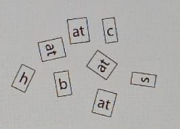
- A. Mastering sight words
- B. Working with syllabication
- C. Creating word families-
- D. Identifying prefixes and suffixes
Correct Answer & Rationale
Correct Answer: C
Creating word families demonstrates how words share a common base or root, allowing students to see relationships between words and enhance their vocabulary. This activity encourages learners to group words with similar structures, fostering an understanding of language patterns. Mastering sight words focuses on recognizing high-frequency words, which does not directly illustrate the concept of word families. Working with syllabication emphasizes breaking words into syllables rather than exploring their relationships. Identifying prefixes and suffixes involves understanding word parts but does not encompass the broader connections found in word families.
Creating word families demonstrates how words share a common base or root, allowing students to see relationships between words and enhance their vocabulary. This activity encourages learners to group words with similar structures, fostering an understanding of language patterns. Mastering sight words focuses on recognizing high-frequency words, which does not directly illustrate the concept of word families. Working with syllabication emphasizes breaking words into syllables rather than exploring their relationships. Identifying prefixes and suffixes involves understanding word parts but does not encompass the broader connections found in word families.
For each row, select ALL that apply. Some rows may be empty.
- A. And
- B. Said
- C. Win
Correct Answer & Rationale
Correct Answer: A: Sight Word/ Decodable Word, B: Sight Word, C: Decodable Word
Option A, "And," is categorized as a sight word and decodable word because it is frequently used in texts and can be phonetically sounded out. Option B, "Said," is a sight word, as it does not follow standard phonetic rules and is commonly recognized in reading, but it is not decodable. Option C, "Win," is a decodable word since it follows phonetic rules, allowing students to sound it out easily. Each option serves a different purpose in literacy development, highlighting the distinction between sight words and decodable words in reading instruction.
Option A, "And," is categorized as a sight word and decodable word because it is frequently used in texts and can be phonetically sounded out. Option B, "Said," is a sight word, as it does not follow standard phonetic rules and is commonly recognized in reading, but it is not decodable. Option C, "Win," is a decodable word since it follows phonetic rules, allowing students to sound it out easily. Each option serves a different purpose in literacy development, highlighting the distinction between sight words and decodable words in reading instruction.