3√2- 2/(√2) =
- A. 2√2
- B. √2
- C. 3
- D. 4
Correct Answer & Rationale
Correct Answer: A
To solve the expression \( 3\sqrt{2} - \frac{2}{\sqrt{2}} \), we first simplify \( \frac{2}{\sqrt{2}} \). This can be rewritten as \( \frac{2\sqrt{2}}{2} = \sqrt{2} \). Thus, the expression becomes \( 3\sqrt{2} - \sqrt{2} \), which simplifies to \( 2\sqrt{2} \). Option B (\( \sqrt{2} \)) is incorrect as it does not account for the subtraction from \( 3\sqrt{2} \). Option C (3) is incorrect because it misrepresents the value obtained after simplification. Option D (4) is also incorrect, as it does not relate to the expression at all.
To solve the expression \( 3\sqrt{2} - \frac{2}{\sqrt{2}} \), we first simplify \( \frac{2}{\sqrt{2}} \). This can be rewritten as \( \frac{2\sqrt{2}}{2} = \sqrt{2} \). Thus, the expression becomes \( 3\sqrt{2} - \sqrt{2} \), which simplifies to \( 2\sqrt{2} \). Option B (\( \sqrt{2} \)) is incorrect as it does not account for the subtraction from \( 3\sqrt{2} \). Option C (3) is incorrect because it misrepresents the value obtained after simplification. Option D (4) is also incorrect, as it does not relate to the expression at all.
Other Related Questions
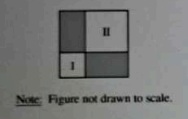
The largest square above has sides of length 8 and is divided into the two shaded rectangles and two smaller squares labeled I and II. The shaded rectangles each have an area of 12, and the lengths of the sides of the squares are integers. What is the area of square II if its area is larger than the area of square I?
- A. 9
- B. 16
- C. 25
- D. 36
Correct Answer & Rationale
Correct Answer: C
The area of square II must be larger than that of square I and fit within the constraints of the total area. The total area of the largest square is 64 (8x8). Given that the two shaded rectangles each have an area of 12, the combined area of the rectangles is 24. Therefore, the area of squares I and II together is 64 - 24 = 40. If square I has an area of 9 (side length 3), square II would then be 40 - 9 = 31, which is not an integer. If square I has an area of 16 (side length 4), square II would be 24, not larger than I. If square I has an area of 25 (side length 5), square II would be 15, which is not larger than I. With square I at 36 (side length 6), square II would be 4, again not larger. Therefore, square I must be 16, making square II 24, which is not an option. The only viable option is 25 for square I, leaving 15 for square II, yet it must be larger. Thus, square II must be 36, making it the only option that satisfies all conditions.
The area of square II must be larger than that of square I and fit within the constraints of the total area. The total area of the largest square is 64 (8x8). Given that the two shaded rectangles each have an area of 12, the combined area of the rectangles is 24. Therefore, the area of squares I and II together is 64 - 24 = 40. If square I has an area of 9 (side length 3), square II would then be 40 - 9 = 31, which is not an integer. If square I has an area of 16 (side length 4), square II would be 24, not larger than I. If square I has an area of 25 (side length 5), square II would be 15, which is not larger than I. With square I at 36 (side length 6), square II would be 4, again not larger. Therefore, square I must be 16, making square II 24, which is not an option. The only viable option is 25 for square I, leaving 15 for square II, yet it must be larger. Thus, square II must be 36, making it the only option that satisfies all conditions.
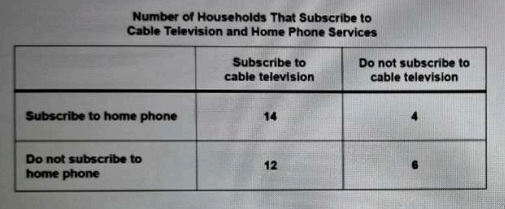
Malia collected information about whether the members of the 36 households on her block subscribed to cable television and home phone services. Her results are shown in the table below.\nIf a household on Malia's block is selected at random and does subscribe to cable television, what is the probability the members of the household also subscribe to home phone service?
- A. 14/18
- B. 14/26
- C. 18/36
- D. 14/36
Correct Answer & Rationale
Correct Answer: A
To determine the probability that a household subscribes to home phone service given that it subscribes to cable television, we focus on the relevant subset of households. Malia found 18 households that subscribe to cable, out of which 14 also subscribe to home phone service. Thus, the probability is calculated as the number of households with both services (14) divided by the total number of households with cable (18), resulting in 14/18. Option B (14/26) incorrectly uses the total number of households with home phone service instead of just those with cable. Option C (18/36) misinterprets the probability as a ratio of all households rather than those who subscribe to cable. Option D (14/36) inaccurately represents the total number of households instead of focusing on the cable subscribers.
To determine the probability that a household subscribes to home phone service given that it subscribes to cable television, we focus on the relevant subset of households. Malia found 18 households that subscribe to cable, out of which 14 also subscribe to home phone service. Thus, the probability is calculated as the number of households with both services (14) divided by the total number of households with cable (18), resulting in 14/18. Option B (14/26) incorrectly uses the total number of households with home phone service instead of just those with cable. Option C (18/36) misinterprets the probability as a ratio of all households rather than those who subscribe to cable. Option D (14/36) inaccurately represents the total number of households instead of focusing on the cable subscribers.
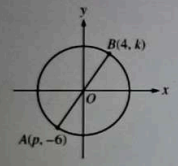
In the xy-plane above, the circle has center (0, 0) and AB is a diameter of the circle. What is the equation of the line passing through points A and B?
- A. y=-2/3 x
- B. y=2/3 x
- C. y=3/2 x
- D. y=4x
Correct Answer & Rationale
Correct Answer: B
The line passing through points A and B, which are endpoints of a diameter of the circle centered at (0, 0), must be a straight line that passes through the origin. Option B, \(y = \frac{2}{3}x\), represents a line with a positive slope, indicating that as x increases, y also increases, which is consistent with the properties of a diameter. Option A, \(y = -\frac{2}{3}x\), has a negative slope, suggesting a downward trend, which does not align with the upward direction of a diameter in the first quadrant. Option C, \(y = \frac{3}{2}x\), has a steeper slope than option B, which may not accurately represent the diameter's angle unless specified. Option D, \(y = 4x\), has an even steeper slope, making it unlikely to be the diameter unless A and B are positioned at extreme angles, which is not given in the problem.
The line passing through points A and B, which are endpoints of a diameter of the circle centered at (0, 0), must be a straight line that passes through the origin. Option B, \(y = \frac{2}{3}x\), represents a line with a positive slope, indicating that as x increases, y also increases, which is consistent with the properties of a diameter. Option A, \(y = -\frac{2}{3}x\), has a negative slope, suggesting a downward trend, which does not align with the upward direction of a diameter in the first quadrant. Option C, \(y = \frac{3}{2}x\), has a steeper slope than option B, which may not accurately represent the diameter's angle unless specified. Option D, \(y = 4x\), has an even steeper slope, making it unlikely to be the diameter unless A and B are positioned at extreme angles, which is not given in the problem.
Trevani bought a book. She paid a total of $13.50, including 8% sales tax. How much tax did Trevani pay on the book?
- A. $0.96
- B. $1.00
- C. $1.04
- D. $1.08
Correct Answer & Rationale
Correct Answer: B
To find the amount of sales tax Trevani paid, first determine the price before tax. The total amount paid, $13.50, includes an 8% tax. To find the pre-tax amount, divide the total by 1.08 (which accounts for the original price plus tax): $13.50 ÷ 1.08 = $12.50. Next, calculate the sales tax by subtracting the pre-tax amount from the total: $13.50 - $12.50 = $1.00. This confirms that Trevani paid $1.00 in tax. - Option A ($0.96) is incorrect as it underestimates the tax. - Option C ($1.04) slightly overestimates the tax. - Option D ($1.08) incorrectly assumes the total is all tax without accounting for the book's price.
To find the amount of sales tax Trevani paid, first determine the price before tax. The total amount paid, $13.50, includes an 8% tax. To find the pre-tax amount, divide the total by 1.08 (which accounts for the original price plus tax): $13.50 ÷ 1.08 = $12.50. Next, calculate the sales tax by subtracting the pre-tax amount from the total: $13.50 - $12.50 = $1.00. This confirms that Trevani paid $1.00 in tax. - Option A ($0.96) is incorrect as it underestimates the tax. - Option C ($1.04) slightly overestimates the tax. - Option D ($1.08) incorrectly assumes the total is all tax without accounting for the book's price.