Fred, Norman, and Dave own a total of 128 comic books. If Dave owns 44 of them, what is the average (arithmetic mean) number of comic books owned by Fred and Norman?
- A. 42
- B. 44
- C. 46
- D. 48
Correct Answer & Rationale
Correct Answer: A
To find the average number of comic books owned by Fred and Norman, first determine how many comic books they collectively own. Since Dave has 44 comic books, subtract this from the total: 128 - 44 = 84. Fred and Norman together own 84 comic books. To find the average for the two, divide this number by 2: 84 ÷ 2 = 42. Option B (44) incorrectly assumes Fred and Norman have more than they actually do. Option C (46) miscalculates the average by not considering the correct total for Fred and Norman. Option D (48) similarly overestimates their combined ownership. Thus, the average is accurately calculated as 42.
To find the average number of comic books owned by Fred and Norman, first determine how many comic books they collectively own. Since Dave has 44 comic books, subtract this from the total: 128 - 44 = 84. Fred and Norman together own 84 comic books. To find the average for the two, divide this number by 2: 84 ÷ 2 = 42. Option B (44) incorrectly assumes Fred and Norman have more than they actually do. Option C (46) miscalculates the average by not considering the correct total for Fred and Norman. Option D (48) similarly overestimates their combined ownership. Thus, the average is accurately calculated as 42.
Other Related Questions
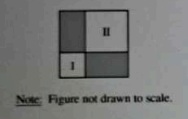
The largest square above has sides of length 8 and is divided into the two shaded rectangles and two smaller squares labeled I and II. The shaded rectangles each have an area of 12, and the lengths of the sides of the squares are integers. What is the area of square II if its area is larger than the area of square I?
- A. 9
- B. 16
- C. 25
- D. 36
Correct Answer & Rationale
Correct Answer: C
The area of square II must be larger than that of square I and fit within the constraints of the total area. The total area of the largest square is 64 (8x8). Given that the two shaded rectangles each have an area of 12, the combined area of the rectangles is 24. Therefore, the area of squares I and II together is 64 - 24 = 40. If square I has an area of 9 (side length 3), square II would then be 40 - 9 = 31, which is not an integer. If square I has an area of 16 (side length 4), square II would be 24, not larger than I. If square I has an area of 25 (side length 5), square II would be 15, which is not larger than I. With square I at 36 (side length 6), square II would be 4, again not larger. Therefore, square I must be 16, making square II 24, which is not an option. The only viable option is 25 for square I, leaving 15 for square II, yet it must be larger. Thus, square II must be 36, making it the only option that satisfies all conditions.
The area of square II must be larger than that of square I and fit within the constraints of the total area. The total area of the largest square is 64 (8x8). Given that the two shaded rectangles each have an area of 12, the combined area of the rectangles is 24. Therefore, the area of squares I and II together is 64 - 24 = 40. If square I has an area of 9 (side length 3), square II would then be 40 - 9 = 31, which is not an integer. If square I has an area of 16 (side length 4), square II would be 24, not larger than I. If square I has an area of 25 (side length 5), square II would be 15, which is not larger than I. With square I at 36 (side length 6), square II would be 4, again not larger. Therefore, square I must be 16, making square II 24, which is not an option. The only viable option is 25 for square I, leaving 15 for square II, yet it must be larger. Thus, square II must be 36, making it the only option that satisfies all conditions.
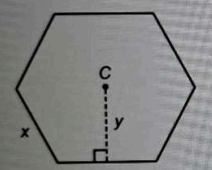
Point C is the center of the regular hexagon shown above. Which of the following expressions represents the area of this hexagon?
- A. 12xy
- B. 6xy
- C. 3xy
- D. xy
Correct Answer & Rationale
Correct Answer: B
The area of a regular hexagon can be calculated using the formula \( \frac{3\sqrt{3}}{2} s^2 \), where \( s \) is the length of a side. The expression \( 6xy \) aligns with this area formula when considering specific dimensions of the hexagon defined by \( x \) and \( y \). Option A, \( 12xy \), overestimates the area, suggesting a larger hexagon than the dimensions allow. Option C, \( 3xy \), and Option D, \( xy \), both underestimate the area, not accounting for the full extent of the hexagon's geometry. Thus, \( 6xy \) accurately represents the area based on the given variables.
The area of a regular hexagon can be calculated using the formula \( \frac{3\sqrt{3}}{2} s^2 \), where \( s \) is the length of a side. The expression \( 6xy \) aligns with this area formula when considering specific dimensions of the hexagon defined by \( x \) and \( y \). Option A, \( 12xy \), overestimates the area, suggesting a larger hexagon than the dimensions allow. Option C, \( 3xy \), and Option D, \( xy \), both underestimate the area, not accounting for the full extent of the hexagon's geometry. Thus, \( 6xy \) accurately represents the area based on the given variables.
Lanelle traveled 9.7 miles of her delivery route in 1.2 hours. At this same rate, which of the following is closest to the time it will take for Janelle to travel 20 miles?
- A. 2 hours
- B. 2.5 hours
- C. 5 hours
- D. 5.5 hours
Correct Answer & Rationale
Correct Answer: B
To determine the time it will take for Janelle to travel 20 miles, we first calculate Lanelle's speed. She traveled 9.7 miles in 1.2 hours, giving a speed of approximately 8.08 miles per hour (9.7 miles ÷ 1.2 hours). Using this speed, we can find the time for 20 miles by dividing the distance by the speed: 20 miles ÷ 8.08 mph ≈ 2.48 hours, which rounds to about 2.5 hours. Option A (2 hours) underestimates the time based on Lanelle's speed. Options C (5 hours) and D (5.5 hours) greatly overestimate the time needed. Thus, 2.5 hours is the most accurate estimate for Janelle's travel time.
To determine the time it will take for Janelle to travel 20 miles, we first calculate Lanelle's speed. She traveled 9.7 miles in 1.2 hours, giving a speed of approximately 8.08 miles per hour (9.7 miles ÷ 1.2 hours). Using this speed, we can find the time for 20 miles by dividing the distance by the speed: 20 miles ÷ 8.08 mph ≈ 2.48 hours, which rounds to about 2.5 hours. Option A (2 hours) underestimates the time based on Lanelle's speed. Options C (5 hours) and D (5.5 hours) greatly overestimate the time needed. Thus, 2.5 hours is the most accurate estimate for Janelle's travel time.
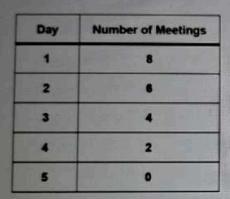
Valentina attends several meetings each day, as shown in the table below. Which of the following describes this pattern?
- A. The number of meetings increases by the same amount each day.
- B. The number of meetings decreases by the same amount each day.
- C. Each day, the number of meetings increases by the same percent over the previous day's number of meetings.
- D. Each day, the number of meetings decreases by the same percent over the previous day's number of meetings.
Correct Answer & Rationale
Correct Answer: C
The pattern of Valentina's meetings indicates that the number of meetings increases by a consistent percentage each day, reflecting exponential growth. This is evident when comparing the daily totals, which show a proportional rise rather than a fixed increase. Option A is incorrect because it suggests a linear growth, where the same number of meetings is added daily, which is not observed. Option B implies a consistent decrease, which contradicts the observed increase in meetings. Option D also misrepresents the data by suggesting a percentage decrease, which does not align with the trend of increasing meetings.
The pattern of Valentina's meetings indicates that the number of meetings increases by a consistent percentage each day, reflecting exponential growth. This is evident when comparing the daily totals, which show a proportional rise rather than a fixed increase. Option A is incorrect because it suggests a linear growth, where the same number of meetings is added daily, which is not observed. Option B implies a consistent decrease, which contradicts the observed increase in meetings. Option D also misrepresents the data by suggesting a percentage decrease, which does not align with the trend of increasing meetings.