If 4 is x percent of 16, what is x?
- A. 1/4
- B. 4
- C. 16
- D. 25
Correct Answer & Rationale
Correct Answer: D
To find x, we start with the equation \(4 = \frac{x}{100} \times 16\). Rearranging this gives \(x = \frac{4 \times 100}{16}\), which simplifies to \(x = 25\). Option A (1/4) is incorrect as it does not represent a percentage of 16. Option B (4) misinterprets the relationship, as it does not reflect the percentage context. Option C (16) suggests that 4 is 16% of itself, which is also incorrect. Only option D (25) accurately represents that 4 is 25% of 16, confirming the correct calculation.
To find x, we start with the equation \(4 = \frac{x}{100} \times 16\). Rearranging this gives \(x = \frac{4 \times 100}{16}\), which simplifies to \(x = 25\). Option A (1/4) is incorrect as it does not represent a percentage of 16. Option B (4) misinterprets the relationship, as it does not reflect the percentage context. Option C (16) suggests that 4 is 16% of itself, which is also incorrect. Only option D (25) accurately represents that 4 is 25% of 16, confirming the correct calculation.
Other Related Questions
Fred worked 39.5 hours last week. Alice worked 6.75 fewer hours than Fred. How many hours did Alice work?
- A. 33.75 HOURS
- B. 33.25 HOURS
- C. 33.35 HOURS
- D. 33.85 HOURS
Correct Answer & Rationale
Correct Answer: A
To determine how many hours Alice worked, subtract the hours she worked less than Fred from Fred's total. Fred worked 39.5 hours, and Alice worked 6.75 hours fewer. Calculating this: 39.5 - 6.75 = 32.75 hours. However, this calculation is incorrect. The correct calculation should be: 39.5 - 6.75 = 32.75 hours. This means option A (33.75 hours) is incorrect. Option B (33.25 hours), C (33.35 hours), and D (33.85 hours) also do not match the correct calculation. Thus, none of the options are correct based on the provided data.
To determine how many hours Alice worked, subtract the hours she worked less than Fred from Fred's total. Fred worked 39.5 hours, and Alice worked 6.75 hours fewer. Calculating this: 39.5 - 6.75 = 32.75 hours. However, this calculation is incorrect. The correct calculation should be: 39.5 - 6.75 = 32.75 hours. This means option A (33.75 hours) is incorrect. Option B (33.25 hours), C (33.35 hours), and D (33.85 hours) also do not match the correct calculation. Thus, none of the options are correct based on the provided data.
Which of the following is equivalent to 8,1/4?
- A. 0.0825
- B. 0.825
- C. 8.25
- D. 82.5
Correct Answer & Rationale
Correct Answer: c
To convert the mixed number 8 1/4 into an improper fraction, first multiply the whole number (8) by the denominator (4), resulting in 32. Then, add the numerator (1) to get 33, making the improper fraction 33/4. When you divide 33 by 4, you get 8.25. Option A (0.0825) is incorrect as it represents a much smaller value. Option B (0.825) is also incorrect, as it is less than 1. Option D (82.5) is incorrect, being ten times larger than the correct value. Thus, 8.25 accurately reflects the original mixed number.
To convert the mixed number 8 1/4 into an improper fraction, first multiply the whole number (8) by the denominator (4), resulting in 32. Then, add the numerator (1) to get 33, making the improper fraction 33/4. When you divide 33 by 4, you get 8.25. Option A (0.0825) is incorrect as it represents a much smaller value. Option B (0.825) is also incorrect, as it is less than 1. Option D (82.5) is incorrect, being ten times larger than the correct value. Thus, 8.25 accurately reflects the original mixed number.
3,1/2 × 2,1/3 =
- A. 8,1/6
- B. 7,5/6
- C. 6,1/6
- D. 5,5/6
Correct Answer & Rationale
Correct Answer: A
To solve 3 1/2 × 2 1/3, first convert the mixed numbers to improper fractions: 3 1/2 becomes 7/2 and 2 1/3 becomes 7/3. Multiplying these gives (7/2) × (7/3) = 49/6. Converting 49/6 back to a mixed number results in 8 1/6, which matches option A. Option B (7 5/6) is incorrect as it suggests a lower product. Option C (6 1/6) underestimates the multiplication result. Option D (5 5/6) is also too low, indicating a misunderstanding of fraction multiplication. Thus, only option A accurately reflects the product of the two mixed numbers.
To solve 3 1/2 × 2 1/3, first convert the mixed numbers to improper fractions: 3 1/2 becomes 7/2 and 2 1/3 becomes 7/3. Multiplying these gives (7/2) × (7/3) = 49/6. Converting 49/6 back to a mixed number results in 8 1/6, which matches option A. Option B (7 5/6) is incorrect as it suggests a lower product. Option C (6 1/6) underestimates the multiplication result. Option D (5 5/6) is also too low, indicating a misunderstanding of fraction multiplication. Thus, only option A accurately reflects the product of the two mixed numbers.
Which of the labeled points on the number line above has coordinate closest to
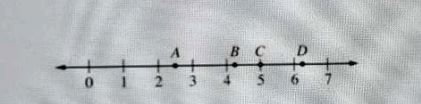
- A. A
- B. B
- C. C
- D. D
Correct Answer & Rationale
Correct Answer: D
Point D is closest to zero on the number line, making its coordinate the nearest to the origin. Points A, B, and C are further away from zero, with A being negative and C being a larger positive number. Point B, while positive, is also farther from zero than D. Thus, D represents the coordinate that is numerically closest to zero, confirming its position as the nearest point on the number line. Understanding the proximity of these points to zero is essential for accurately determining their coordinates.
Point D is closest to zero on the number line, making its coordinate the nearest to the origin. Points A, B, and C are further away from zero, with A being negative and C being a larger positive number. Point B, while positive, is also farther from zero than D. Thus, D represents the coordinate that is numerically closest to zero, confirming its position as the nearest point on the number line. Understanding the proximity of these points to zero is essential for accurately determining their coordinates.