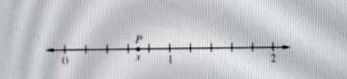
The coordinate of pointP on the number line above is x. The value of 10x is between
- A. 1 and 4
- B. 4 and 6
- C. 6 and 8
- D. 8 and 12
Correct Answer & Rationale
Correct Answer: B
To determine the correct range for \(10x\), we first need to assess the implications of each option based on the value of \(x\). - **Option A: 1 and 4** suggests \(0.1 < x < 0.4\). This would yield \(10x\) values less than 4, which is too low. - **Option B: 4 and 6** indicates \(0.4 < x < 0.6\). This range results in \(10x\) values between 4 and 6, aligning perfectly with the requirement. - **Option C: 6 and 8** implies \(0.6 < x < 0.8\). Here, \(10x\) would exceed 6, which is not valid. - **Option D: 8 and 12** indicates \(0.8 < x < 1.2\), leading to values of \(10x\) that exceed 8, thus also incorrect. Therefore, only Option B accurately reflects the condition for \(10x\) being between 4 and 6.
To determine the correct range for \(10x\), we first need to assess the implications of each option based on the value of \(x\). - **Option A: 1 and 4** suggests \(0.1 < x < 0.4\). This would yield \(10x\) values less than 4, which is too low. - **Option B: 4 and 6** indicates \(0.4 < x < 0.6\). This range results in \(10x\) values between 4 and 6, aligning perfectly with the requirement. - **Option C: 6 and 8** implies \(0.6 < x < 0.8\). Here, \(10x\) would exceed 6, which is not valid. - **Option D: 8 and 12** indicates \(0.8 < x < 1.2\), leading to values of \(10x\) that exceed 8, thus also incorrect. Therefore, only Option B accurately reflects the condition for \(10x\) being between 4 and 6.
Other Related Questions
2 + (2 × 2) + 2 =
- A. 8
- B. 10
- C. 12
- D. 16
Correct Answer & Rationale
Correct Answer: A
To solve the expression 2 + (2 × 2) + 2, it’s essential to follow the order of operations, often remembered by the acronym PEMDAS (Parentheses, Exponents, Multiplication and Division, Addition and Subtraction). First, calculate the value inside the parentheses: 2 × 2 equals 4. Next, substitute this back into the expression: 2 + 4 + 2. Then, perform the addition from left to right: 2 + 4 equals 6, and then 6 + 2 equals 8. Options B (10), C (12), and D (16) are incorrect because they do not adhere to the proper order of operations or miscalculate the addition steps.
To solve the expression 2 + (2 × 2) + 2, it’s essential to follow the order of operations, often remembered by the acronym PEMDAS (Parentheses, Exponents, Multiplication and Division, Addition and Subtraction). First, calculate the value inside the parentheses: 2 × 2 equals 4. Next, substitute this back into the expression: 2 + 4 + 2. Then, perform the addition from left to right: 2 + 4 equals 6, and then 6 + 2 equals 8. Options B (10), C (12), and D (16) are incorrect because they do not adhere to the proper order of operations or miscalculate the addition steps.
If 4 is x percent of 16, what is x?
- A. 1/4
- B. 4
- C. 16
- D. 25
Correct Answer & Rationale
Correct Answer: D
To find x, we start with the equation \(4 = \frac{x}{100} \times 16\). Rearranging this gives \(x = \frac{4 \times 100}{16}\), which simplifies to \(x = 25\). Option A (1/4) is incorrect as it does not represent a percentage of 16. Option B (4) misinterprets the relationship, as it does not reflect the percentage context. Option C (16) suggests that 4 is 16% of itself, which is also incorrect. Only option D (25) accurately represents that 4 is 25% of 16, confirming the correct calculation.
To find x, we start with the equation \(4 = \frac{x}{100} \times 16\). Rearranging this gives \(x = \frac{4 \times 100}{16}\), which simplifies to \(x = 25\). Option A (1/4) is incorrect as it does not represent a percentage of 16. Option B (4) misinterprets the relationship, as it does not reflect the percentage context. Option C (16) suggests that 4 is 16% of itself, which is also incorrect. Only option D (25) accurately represents that 4 is 25% of 16, confirming the correct calculation.
Which of the following is equivalent to 1.04?
- A. 52/51
- B. 51/50
- C. 27/25
- D. 26/25
Correct Answer & Rationale
Correct Answer: D
To determine the equivalence to 1.04, we can convert each fraction to a decimal. Option A, 52/51, equals approximately 1.0196, which is less than 1.04. Option B, 51/50, equals 1.02, also less than 1.04. Option C, 27/25, equals 1.08, exceeding 1.04. Option D, 26/25, simplifies to 1.04, matching the target value exactly. Thus, only option D accurately represents 1.04, while the others deviate from this value.
To determine the equivalence to 1.04, we can convert each fraction to a decimal. Option A, 52/51, equals approximately 1.0196, which is less than 1.04. Option B, 51/50, equals 1.02, also less than 1.04. Option C, 27/25, equals 1.08, exceeding 1.04. Option D, 26/25, simplifies to 1.04, matching the target value exactly. Thus, only option D accurately represents 1.04, while the others deviate from this value.
Marisol has 5 times as many books as Jerry. Jerry has 15 books. How many books does Marisol have?
- A. 10
- B. 20
- C. 75
- D. 225
Correct Answer & Rationale
Correct Answer: C
To determine how many books Marisol has, start by recognizing that she has 5 times the number of books Jerry has. Since Jerry has 15 books, you multiply 15 by 5: 15 × 5 = 75. Thus, Marisol has 75 books. Option A (10) is incorrect as it suggests Marisol has fewer books than Jerry. Option B (20) also underestimates her total, as it does not account for the multiplication factor of 5. Option D (225) overestimates the total by incorrectly multiplying the number of Jerry's books. Only option C accurately reflects the calculation based on the relationship between Marisol's and Jerry's books.
To determine how many books Marisol has, start by recognizing that she has 5 times the number of books Jerry has. Since Jerry has 15 books, you multiply 15 by 5: 15 × 5 = 75. Thus, Marisol has 75 books. Option A (10) is incorrect as it suggests Marisol has fewer books than Jerry. Option B (20) also underestimates her total, as it does not account for the multiplication factor of 5. Option D (225) overestimates the total by incorrectly multiplying the number of Jerry's books. Only option C accurately reflects the calculation based on the relationship between Marisol's and Jerry's books.