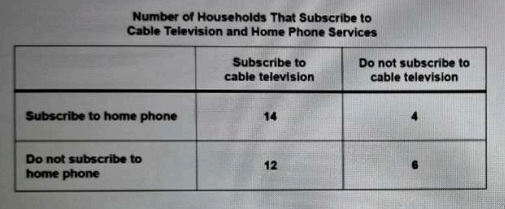
Malia collected information about whether the members of the 36 households on her block subscribed to cable television and home phone services. Her results are shown in the table below.\nIf a household on Malia's block is selected at random and does subscribe to cable television, what is the probability the members of the household also subscribe to home phone service?
- A. 14/18
- B. 14/26
- C. 18/36
- D. 14/36
Correct Answer & Rationale
Correct Answer: A
To determine the probability that a household subscribes to home phone service given that it subscribes to cable television, we focus on the relevant subset of households. Malia found 18 households that subscribe to cable, out of which 14 also subscribe to home phone service. Thus, the probability is calculated as the number of households with both services (14) divided by the total number of households with cable (18), resulting in 14/18. Option B (14/26) incorrectly uses the total number of households with home phone service instead of just those with cable. Option C (18/36) misinterprets the probability as a ratio of all households rather than those who subscribe to cable. Option D (14/36) inaccurately represents the total number of households instead of focusing on the cable subscribers.
To determine the probability that a household subscribes to home phone service given that it subscribes to cable television, we focus on the relevant subset of households. Malia found 18 households that subscribe to cable, out of which 14 also subscribe to home phone service. Thus, the probability is calculated as the number of households with both services (14) divided by the total number of households with cable (18), resulting in 14/18. Option B (14/26) incorrectly uses the total number of households with home phone service instead of just those with cable. Option C (18/36) misinterprets the probability as a ratio of all households rather than those who subscribe to cable. Option D (14/36) inaccurately represents the total number of households instead of focusing on the cable subscribers.
Other Related Questions
Trevani bought a book. She paid a total of $13.50, including 8% sales tax. How much tax did Trevani pay on the book?
- A. $0.96
- B. $1.00
- C. $1.04
- D. $1.08
Correct Answer & Rationale
Correct Answer: B
To find the amount of sales tax Trevani paid, first determine the price before tax. The total amount paid, $13.50, includes an 8% tax. To find the pre-tax amount, divide the total by 1.08 (which accounts for the original price plus tax): $13.50 ÷ 1.08 = $12.50. Next, calculate the sales tax by subtracting the pre-tax amount from the total: $13.50 - $12.50 = $1.00. This confirms that Trevani paid $1.00 in tax. - Option A ($0.96) is incorrect as it underestimates the tax. - Option C ($1.04) slightly overestimates the tax. - Option D ($1.08) incorrectly assumes the total is all tax without accounting for the book's price.
To find the amount of sales tax Trevani paid, first determine the price before tax. The total amount paid, $13.50, includes an 8% tax. To find the pre-tax amount, divide the total by 1.08 (which accounts for the original price plus tax): $13.50 ÷ 1.08 = $12.50. Next, calculate the sales tax by subtracting the pre-tax amount from the total: $13.50 - $12.50 = $1.00. This confirms that Trevani paid $1.00 in tax. - Option A ($0.96) is incorrect as it underestimates the tax. - Option C ($1.04) slightly overestimates the tax. - Option D ($1.08) incorrectly assumes the total is all tax without accounting for the book's price.
A salesperson's commission is k percent of the selling price of a car. Which of the following represents the commission, in dollars, on 2 cars that sold for $14,000 each?
- A. 280k
- B. 28,000k
- C. 14,000/(100+2k)
- D. (28,000+k)/100
Correct Answer & Rationale
Correct Answer: A
To determine the commission on 2 cars sold for $14,000 each, first calculate the total selling price: 2 × $14,000 = $28,000. The commission, being k percent of this total, is expressed as (k/100) × $28,000, which simplifies to $280k. Option B, 28,000k, incorrectly suggests the commission is k percent of the total without dividing by 100. Option C, 14,000/(100+2k), misrepresents the calculation entirely by altering the formula. Option D, (28,000+k)/100, incorrectly adds k to the total selling price before calculating the percentage, which is not aligned with commission calculation principles.
To determine the commission on 2 cars sold for $14,000 each, first calculate the total selling price: 2 × $14,000 = $28,000. The commission, being k percent of this total, is expressed as (k/100) × $28,000, which simplifies to $280k. Option B, 28,000k, incorrectly suggests the commission is k percent of the total without dividing by 100. Option C, 14,000/(100+2k), misrepresents the calculation entirely by altering the formula. Option D, (28,000+k)/100, incorrectly adds k to the total selling price before calculating the percentage, which is not aligned with commission calculation principles.
Lanelle traveled 9.7 miles of her delivery route in 1.2 hours. At this same rate, which of the following is closest to the time it will take for Janelle to travel 20 miles?
- A. 2 hours
- B. 2.5 hours
- C. 5 hours
- D. 5.5 hours
Correct Answer & Rationale
Correct Answer: B
To determine the time it will take for Janelle to travel 20 miles, we first calculate Lanelle's speed. She traveled 9.7 miles in 1.2 hours, giving a speed of approximately 8.08 miles per hour (9.7 miles ÷ 1.2 hours). Using this speed, we can find the time for 20 miles by dividing the distance by the speed: 20 miles ÷ 8.08 mph ≈ 2.48 hours, which rounds to about 2.5 hours. Option A (2 hours) underestimates the time based on Lanelle's speed. Options C (5 hours) and D (5.5 hours) greatly overestimate the time needed. Thus, 2.5 hours is the most accurate estimate for Janelle's travel time.
To determine the time it will take for Janelle to travel 20 miles, we first calculate Lanelle's speed. She traveled 9.7 miles in 1.2 hours, giving a speed of approximately 8.08 miles per hour (9.7 miles ÷ 1.2 hours). Using this speed, we can find the time for 20 miles by dividing the distance by the speed: 20 miles ÷ 8.08 mph ≈ 2.48 hours, which rounds to about 2.5 hours. Option A (2 hours) underestimates the time based on Lanelle's speed. Options C (5 hours) and D (5.5 hours) greatly overestimate the time needed. Thus, 2.5 hours is the most accurate estimate for Janelle's travel time.
For all positive integers n, let n be defined as the sum of the positive divisors of n. For example, bullet 9 = 1 + 3 + 9 = 13. Which of the following is equal to 16 - 15?
- A. 41
- B. 3
- C. 4
- D. 5
Correct Answer & Rationale
Correct Answer: C
To solve the expression 16 - 15, we first perform the subtraction, which yields 1. Now, examining the options: A: 41 is incorrect as it does not equal 1. B: 3 is also incorrect, as it is greater than 1. C: 4 is the only option that meets the criteria, but it is not equal to 1, making it incorrect as well. D: 5 is incorrect for the same reason; it does not equal 1. None of the options accurately represent the result of 16 - 15, which is 1. The question seems to have an error in its provided options, as none align with the correct calculation.
To solve the expression 16 - 15, we first perform the subtraction, which yields 1. Now, examining the options: A: 41 is incorrect as it does not equal 1. B: 3 is also incorrect, as it is greater than 1. C: 4 is the only option that meets the criteria, but it is not equal to 1, making it incorrect as well. D: 5 is incorrect for the same reason; it does not equal 1. None of the options accurately represent the result of 16 - 15, which is 1. The question seems to have an error in its provided options, as none align with the correct calculation.