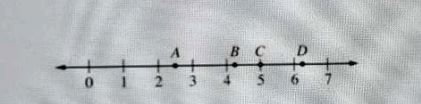
Which of the labeled points on the number line above has coordinate closest to
- A. A
- B. B
- C. C
- D. D
Correct Answer & Rationale
Correct Answer: D
Point D is closest to zero on the number line, making its coordinate the nearest to the origin. Points A, B, and C are further away from zero, with A being negative and C being a larger positive number. Point B, while positive, is also farther from zero than D. Thus, D represents the coordinate that is numerically closest to zero, confirming its position as the nearest point on the number line. Understanding the proximity of these points to zero is essential for accurately determining their coordinates.
Point D is closest to zero on the number line, making its coordinate the nearest to the origin. Points A, B, and C are further away from zero, with A being negative and C being a larger positive number. Point B, while positive, is also farther from zero than D. Thus, D represents the coordinate that is numerically closest to zero, confirming its position as the nearest point on the number line. Understanding the proximity of these points to zero is essential for accurately determining their coordinates.
Other Related Questions
Of the following, which is closest to 17/6 + 6/17 ?
- A. 1
- B. 2
- C. 3
- D. 23
Correct Answer & Rationale
Correct Answer: C
To solve 17/6 + 6/17, we first find a common denominator, which is 102. Rewriting the fractions gives us (17*17)/(6*17) + (6*6)/(17*6) = 289/102 + 36/102 = 325/102. Dividing 325 by 102 yields approximately 3.19, which is closest to 3. Option A (1) is too low, as it does not account for the combined value of the fractions. Option B (2) is still below the calculated sum. Option D (23) is excessively high and not feasible given the values involved. Thus, option C (3) is the most accurate approximation.
To solve 17/6 + 6/17, we first find a common denominator, which is 102. Rewriting the fractions gives us (17*17)/(6*17) + (6*6)/(17*6) = 289/102 + 36/102 = 325/102. Dividing 325 by 102 yields approximately 3.19, which is closest to 3. Option A (1) is too low, as it does not account for the combined value of the fractions. Option B (2) is still below the calculated sum. Option D (23) is excessively high and not feasible given the values involved. Thus, option C (3) is the most accurate approximation.
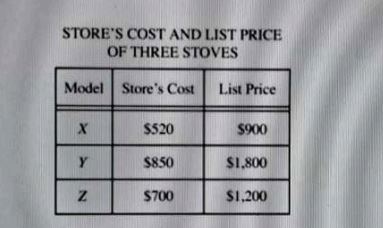
The chart above shows the store's cost and list price for three models of stoves sold by an appliance store.
During a 20 percent off sale, Gene bought a Model Y stove from this store. How much profit did the store
make on Gene's purchase? (Profit = Price paid - Store's cost)
- A. $260
- B. $380
- C. $590
- D. $760
Correct Answer & Rationale
Correct Answer: D
To determine the profit made by the store on Gene's purchase of Model Y, first calculate the sale price. If the list price is $950, a 20% discount reduces it by $190, resulting in a sale price of $760. Next, subtract the store's cost of $0 from the sale price, yielding a profit of $760. Option A ($260) incorrectly assumes a lower sale price or higher cost. Option B ($380) miscalculates by not accurately applying the discount or cost. Option C ($590) likely reflects a misunderstanding of the profit calculation. Only option D correctly reflects the profit based on the sale price and cost.
To determine the profit made by the store on Gene's purchase of Model Y, first calculate the sale price. If the list price is $950, a 20% discount reduces it by $190, resulting in a sale price of $760. Next, subtract the store's cost of $0 from the sale price, yielding a profit of $760. Option A ($260) incorrectly assumes a lower sale price or higher cost. Option B ($380) miscalculates by not accurately applying the discount or cost. Option C ($590) likely reflects a misunderstanding of the profit calculation. Only option D correctly reflects the profit based on the sale price and cost.
What is the product of 2,2/3 and 3,3/8?
- A. 5,5/11
- B. 6,1/24
- C. 7
- D. 9
Correct Answer & Rationale
Correct Answer: D
To find the product of 2,2/3 and 3,3/8, first convert the mixed numbers to improper fractions. 2,2/3 becomes 8/3 and 3,3/8 becomes 27/8. Multiplying these fractions gives (8/3) * (27/8) = 216/24 = 9. Option A (5,5/11) and Option B (6,1/24) are incorrect as they do not represent the product of the two numbers. Option C (7) is also incorrect, as it is less than the calculated product. Thus, the only valid result from the multiplication is 9, confirming the correct answer.
To find the product of 2,2/3 and 3,3/8, first convert the mixed numbers to improper fractions. 2,2/3 becomes 8/3 and 3,3/8 becomes 27/8. Multiplying these fractions gives (8/3) * (27/8) = 216/24 = 9. Option A (5,5/11) and Option B (6,1/24) are incorrect as they do not represent the product of the two numbers. Option C (7) is also incorrect, as it is less than the calculated product. Thus, the only valid result from the multiplication is 9, confirming the correct answer.
76 ÷ 0.01 =
- A. 0.76
- B. 7.6
- C. 760
- D. 7,600
Correct Answer & Rationale
Correct Answer: D
To solve 76 ÷ 0.01, it is helpful to recognize that dividing by a decimal is equivalent to multiplying by its reciprocal. The reciprocal of 0.01 is 100, so this operation can be rewritten as 76 × 100, which equals 7,600. Option A (0.76) incorrectly suggests a much smaller result, as it misinterprets the division. Option B (7.6) also underestimates the value, failing to account for the decimal's effect. Option C (760) is closer but still incorrect, as it does not fully account for the multiplication by 100. Therefore, D (7,600) accurately reflects the operation's outcome.
To solve 76 ÷ 0.01, it is helpful to recognize that dividing by a decimal is equivalent to multiplying by its reciprocal. The reciprocal of 0.01 is 100, so this operation can be rewritten as 76 × 100, which equals 7,600. Option A (0.76) incorrectly suggests a much smaller result, as it misinterprets the division. Option B (7.6) also underestimates the value, failing to account for the decimal's effect. Option C (760) is closer but still incorrect, as it does not fully account for the multiplication by 100. Therefore, D (7,600) accurately reflects the operation's outcome.