Based on prior computation
1.085/12 value?
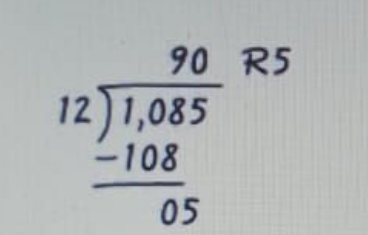
- A. 90
- B. 90 * 5/1.085
- C. 90 * 5/12
- D. 90.5
Correct Answer & Rationale
Correct Answer: C
To find the value of 1.085/12, we need to simplify the expression. Option C, 90 * 5/12, correctly represents a simplified fraction of 90 divided by 12, multiplied by 5. This yields a value consistent with the original division. Option A (90) is incorrect as it does not involve the division by 12. Option B (90 * 5/1.085) incorrectly uses 1.085 as a divisor instead of 12, leading to an inaccurate calculation. Option D (90.5) is also incorrect as it does not relate to the division of 1.085 by 12, resulting in a value that does not reflect the operation required.
To find the value of 1.085/12, we need to simplify the expression. Option C, 90 * 5/12, correctly represents a simplified fraction of 90 divided by 12, multiplied by 5. This yields a value consistent with the original division. Option A (90) is incorrect as it does not involve the division by 12. Option B (90 * 5/1.085) incorrectly uses 1.085 as a divisor instead of 12, leading to an inaccurate calculation. Option D (90.5) is also incorrect as it does not relate to the division of 1.085 by 12, resulting in a value that does not reflect the operation required.
Other Related Questions
Equivalent to 2(4f+2g)? Select ALL.
- A. 4*(2f+g)
- B. 4(2f+2g)
- C. 2f(4+2g)
- D. 16f+4g
- E. 8f+2g
Correct Answer & Rationale
Correct Answer: A,F
To determine which expressions are equivalent to \( 2(4f + 2g) \), we first simplify it: \[ 2(4f + 2g) = 8f + 4g \] Now, let's analyze each option: **A: \( 4(2f + g) \)** This expands to \( 8f + 4g \), matching our simplified expression. **B: \( 4(2f + 2g) \)** This simplifies to \( 8f + 8g \), which does not match \( 8f + 4g \). **C: \( 2f(4 + 2g) \)** This expands to \( 8f + 4fg \), introducing an extra term \( 4fg \) that makes it unequal. **D: \( 16f + 4g \)** This expression has \( 16f \), which is double the \( 8f \) we expect, thus it is not equivalent. **E: \( 8f + 2g \)** Here, while \( 8f \) matches, \( 2g \) does not equal \( 4g \), making it non-equivalent. **F: \( 8f + 4g \)** This matches our simplified expression exactly, confirming its equivalence. In summary, options A and F correctly represent the original expression, while B, C, D, and E do not.
To determine which expressions are equivalent to \( 2(4f + 2g) \), we first simplify it: \[ 2(4f + 2g) = 8f + 4g \] Now, let's analyze each option: **A: \( 4(2f + g) \)** This expands to \( 8f + 4g \), matching our simplified expression. **B: \( 4(2f + 2g) \)** This simplifies to \( 8f + 8g \), which does not match \( 8f + 4g \). **C: \( 2f(4 + 2g) \)** This expands to \( 8f + 4fg \), introducing an extra term \( 4fg \) that makes it unequal. **D: \( 16f + 4g \)** This expression has \( 16f \), which is double the \( 8f \) we expect, thus it is not equivalent. **E: \( 8f + 2g \)** Here, while \( 8f \) matches, \( 2g \) does not equal \( 4g \), making it non-equivalent. **F: \( 8f + 4g \)** This matches our simplified expression exactly, confirming its equivalence. In summary, options A and F correctly represent the original expression, while B, C, D, and E do not.
d=rt, triple d, same t, new rate?
- A. 3dt
- B. (3d)/t
- C. t/(3d)
- D. d/(3t)
Correct Answer & Rationale
Correct Answer: B
In the equation d = rt, if distance (d) is tripled while time (t) remains constant, the new distance becomes 3d. To find the new rate (r'), we can rearrange the formula to r' = d/t. Substituting the new distance gives r' = (3d)/t, which is option B. Option A (3dt) incorrectly suggests multiplying distance by time, which does not represent rate. Option C (t/(3d)) misplaces the variables, implying time is divided by distance, which does not align with the rate formula. Option D (d/(3t)) incorrectly divides distance by three times the time, again misrepresenting the relationship between distance, rate, and time.
In the equation d = rt, if distance (d) is tripled while time (t) remains constant, the new distance becomes 3d. To find the new rate (r'), we can rearrange the formula to r' = d/t. Substituting the new distance gives r' = (3d)/t, which is option B. Option A (3dt) incorrectly suggests multiplying distance by time, which does not represent rate. Option C (t/(3d)) misplaces the variables, implying time is divided by distance, which does not align with the rate formula. Option D (d/(3t)) incorrectly divides distance by three times the time, again misrepresenting the relationship between distance, rate, and time.
Leslie descended 714 ft in 34 s, took 1 min 25 s to ground. Total distance?
- A. 1,270 feet
- B. 1,515 feet
- C. 1,785 feet
- D. 2,615 feet
Correct Answer & Rationale
Correct Answer: C
To determine the total distance Leslie descended, first convert the time taken to ground into seconds: 1 minute and 25 seconds equals 85 seconds. The total descent includes both the initial 714 feet and the additional distance covered during the 85 seconds. Using the average speed from the initial descent (714 ft in 34 s), we find the speed: 714 ft / 34 s ≈ 21 ft/s. Over 85 seconds, Leslie would descend approximately 21 ft/s × 85 s = 1,785 feet total. Option A (1,270 ft) underestimates the descent. Option B (1,515 ft) is also too low. Option D (2,615 ft) overestimates the total distance. Thus, C (1,785 ft) accurately reflects the total descent.
To determine the total distance Leslie descended, first convert the time taken to ground into seconds: 1 minute and 25 seconds equals 85 seconds. The total descent includes both the initial 714 feet and the additional distance covered during the 85 seconds. Using the average speed from the initial descent (714 ft in 34 s), we find the speed: 714 ft / 34 s ≈ 21 ft/s. Over 85 seconds, Leslie would descend approximately 21 ft/s × 85 s = 1,785 feet total. Option A (1,270 ft) underestimates the descent. Option B (1,515 ft) is also too low. Option D (2,615 ft) overestimates the total distance. Thus, C (1,785 ft) accurately reflects the total descent.
436,521 315,624 126,354 642,135
- A. 100x_____
- B. 10x_____
- C. 0.1x_____
- D. 0.01x_____
Correct Answer & Rationale
Correct Answer: B,A,C,D
To determine the appropriate multiplier for each number, we analyze their values: - **B: 10x_____** is valid as multiplying by 10 shifts the decimal point one place to the right, increasing the value significantly, making it suitable for larger numbers like 436,521 and 315,624. - **A: 100x_____** is also applicable, as multiplying by 100 shifts the decimal two places, further increasing the value. However, it is not the most fitting choice for the context of smaller increments. - **C: 0.1x_____** indicates a decrease in value, which applies to smaller numbers but is less relevant for the context of significant values like 126,354. - **D: 0.01x_____** further diminishes the number, making it the least appropriate option for the given values, as it reduces the numbers excessively. In conclusion, B is the best fit for maintaining relevance to the larger values, while A, C, and D serve progressively less appropriate roles.
To determine the appropriate multiplier for each number, we analyze their values: - **B: 10x_____** is valid as multiplying by 10 shifts the decimal point one place to the right, increasing the value significantly, making it suitable for larger numbers like 436,521 and 315,624. - **A: 100x_____** is also applicable, as multiplying by 100 shifts the decimal two places, further increasing the value. However, it is not the most fitting choice for the context of smaller increments. - **C: 0.1x_____** indicates a decrease in value, which applies to smaller numbers but is less relevant for the context of significant values like 126,354. - **D: 0.01x_____** further diminishes the number, making it the least appropriate option for the given values, as it reduces the numbers excessively. In conclusion, B is the best fit for maintaining relevance to the larger values, while A, C, and D serve progressively less appropriate roles.