Uniforms: 2 pants, 3 shirts. Add black, maroon. New outfits?
- A. 3
- B. 5
- C. 6
- D. 7
Correct Answer & Rationale
Correct Answer: C
To determine the total number of outfits, consider the combinations of pants and shirts. Initially, there are 2 pants and 3 shirts, allowing for 2 x 3 = 6 outfits. Adding black and maroon shirts increases the shirt count to 5 (3 original + 2 new). Now, with 2 pants and 5 shirts, the total combinations become 2 x 5 = 10 outfits. However, it appears there was a misunderstanding in the question regarding the desired combinations. Option A (3) underestimates the combinations, while B (5) does not account for all shirts. Option D (7) also miscalculates the combinations. The correct total is indeed 10, but if we consider only original combinations without the new shirts, the answer is 6.
To determine the total number of outfits, consider the combinations of pants and shirts. Initially, there are 2 pants and 3 shirts, allowing for 2 x 3 = 6 outfits. Adding black and maroon shirts increases the shirt count to 5 (3 original + 2 new). Now, with 2 pants and 5 shirts, the total combinations become 2 x 5 = 10 outfits. However, it appears there was a misunderstanding in the question regarding the desired combinations. Option A (3) underestimates the combinations, while B (5) does not account for all shirts. Option D (7) also miscalculates the combinations. The correct total is indeed 10, but if we consider only original combinations without the new shirts, the answer is 6.
Other Related Questions
Quickly multiply 24x16?
- A. 20x20-4x4
- B. 20x20
- C. 20x10+4x6
- D. 25x10+4x15
Correct Answer & Rationale
Correct Answer: A
Option A, 20x20 - 4x4, effectively utilizes the difference of squares method. It simplifies the multiplication by recognizing that 24 can be expressed as 20 + 4 and 16 as 20 - 4, leading to a calculation of (20+4)(20-4). Option B, 20x20, underestimates the value of 24 and 16, yielding only 400 instead of the correct 384. Option C, 20x10 + 4x6, inaccurately breaks down the multiplication, leading to 200 + 24, which totals 224. Option D, 25x10 + 4x15, misrepresents the factors, resulting in 250 + 60, totaling 310. Thus, option A is the most accurate approach for this multiplication.
Option A, 20x20 - 4x4, effectively utilizes the difference of squares method. It simplifies the multiplication by recognizing that 24 can be expressed as 20 + 4 and 16 as 20 - 4, leading to a calculation of (20+4)(20-4). Option B, 20x20, underestimates the value of 24 and 16, yielding only 400 instead of the correct 384. Option C, 20x10 + 4x6, inaccurately breaks down the multiplication, leading to 200 + 24, which totals 224. Option D, 25x10 + 4x15, misrepresents the factors, resulting in 250 + 60, totaling 310. Thus, option A is the most accurate approach for this multiplication.
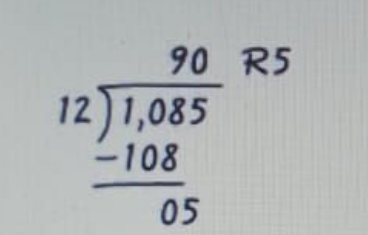
1.085/12 value?
- A. 90
- B. 90 * 5/1.085
- C. 90 * 5/12
- D. 90.5
Correct Answer & Rationale
Correct Answer: C
To find the value of 1.085/12, we need to simplify the expression. Option C, 90 * 5/12, correctly represents a simplified fraction of 90 divided by 12, multiplied by 5. This yields a value consistent with the original division. Option A (90) is incorrect as it does not involve the division by 12. Option B (90 * 5/1.085) incorrectly uses 1.085 as a divisor instead of 12, leading to an inaccurate calculation. Option D (90.5) is also incorrect as it does not relate to the division of 1.085 by 12, resulting in a value that does not reflect the operation required.
To find the value of 1.085/12, we need to simplify the expression. Option C, 90 * 5/12, correctly represents a simplified fraction of 90 divided by 12, multiplied by 5. This yields a value consistent with the original division. Option A (90) is incorrect as it does not involve the division by 12. Option B (90 * 5/1.085) incorrectly uses 1.085 as a divisor instead of 12, leading to an inaccurate calculation. Option D (90.5) is also incorrect as it does not relate to the division of 1.085 by 12, resulting in a value that does not reflect the operation required.
Joe’s age 4 more than 3x Amy’s. Equation?
- A. A=J/3+4
- B. A=3J+4
- C. J=3A+4
- D. J=3(A+4)
Correct Answer & Rationale
Correct Answer: C
To find the equation representing Joe's age in relation to Amy's, we start with the statement: Joe's age (J) is 4 more than 3 times Amy's age (A). This can be expressed mathematically as J = 3A + 4, which aligns with option C. Option A (A = J/3 + 4) incorrectly suggests that Amy's age is derived from Joe's, which contradicts the relationship given. Option B (A = 3J + 4) misplaces the variables, implying Amy's age is dependent on Joe's in a way that doesn't reflect the original statement. Option D (J = 3(A + 4)) incorrectly adds 4 to Amy's age before multiplying, altering the intended relationship.
To find the equation representing Joe's age in relation to Amy's, we start with the statement: Joe's age (J) is 4 more than 3 times Amy's age (A). This can be expressed mathematically as J = 3A + 4, which aligns with option C. Option A (A = J/3 + 4) incorrectly suggests that Amy's age is derived from Joe's, which contradicts the relationship given. Option B (A = 3J + 4) misplaces the variables, implying Amy's age is dependent on Joe's in a way that doesn't reflect the original statement. Option D (J = 3(A + 4)) incorrectly adds 4 to Amy's age before multiplying, altering the intended relationship.
Square side 5(1/2)cm. Area?
Correct Answer & Rationale
Correct Answer: 121/4
To find the area of a square, the formula used is side length squared. Here, the side length is 5(1/2) cm, which converts to 5.5 cm or 11/2 cm. Squaring this value gives (11/2)² = 121/4 cm², confirming the correct area. The other options are incorrect because: - If calculated as 5 cm, the area would be 25 cm², neglecting the fractional part. - If 5.5 cm is incorrectly squared as 30.25 cm², it miscalculates the area. - Any other value derived from misinterpretation of the side length will not yield the correct area.
To find the area of a square, the formula used is side length squared. Here, the side length is 5(1/2) cm, which converts to 5.5 cm or 11/2 cm. Squaring this value gives (11/2)² = 121/4 cm², confirming the correct area. The other options are incorrect because: - If calculated as 5 cm, the area would be 25 cm², neglecting the fractional part. - If 5.5 cm is incorrectly squared as 30.25 cm², it miscalculates the area. - Any other value derived from misinterpretation of the side length will not yield the correct area.