Algebraic expressions? Select ALL.
- A. 2*(x+3)+4
- B. 4=x^2
- C. x=3y+7
- D. 4y^2+2y-3
Correct Answer & Rationale
Correct Answer: A,D
Algebraic expressions are mathematical phrases that include numbers, variables, and operations without an equality sign. Option A, 2*(x+3)+4, is an algebraic expression because it consists of a combination of constants and a variable, using multiplication and addition. Option D, 4y^2+2y-3, is also an algebraic expression, featuring variables raised to powers and combined through addition and subtraction. Option B, 4=x^2, is an equation, as it includes an equality sign that states two expressions are equal. Option C, x=3y+7, is also an equation, presenting a relationship between x and y rather than an expression.
Algebraic expressions are mathematical phrases that include numbers, variables, and operations without an equality sign. Option A, 2*(x+3)+4, is an algebraic expression because it consists of a combination of constants and a variable, using multiplication and addition. Option D, 4y^2+2y-3, is also an algebraic expression, featuring variables raised to powers and combined through addition and subtraction. Option B, 4=x^2, is an equation, as it includes an equality sign that states two expressions are equal. Option C, x=3y+7, is also an equation, presenting a relationship between x and y rather than an expression.
Other Related Questions
Point (-3,-6) quadrant?
- A. I
- B. II
- C. III
- D. IV
Correct Answer & Rationale
Correct Answer: C
The point (-3, -6) is located in the Cartesian coordinate system where the x-coordinate is negative and the y-coordinate is also negative. This combination places the point in Quadrant III, where both x and y values are less than zero. Option A (I) is incorrect as Quadrant I contains positive x and y values. Option B (II) is wrong because Quadrant II has a negative x value and a positive y value. Option D (IV) is not applicable since Quadrant IV features a positive x value and a negative y value. Thus, the only quadrant that matches the coordinates (-3, -6) is Quadrant III.
The point (-3, -6) is located in the Cartesian coordinate system where the x-coordinate is negative and the y-coordinate is also negative. This combination places the point in Quadrant III, where both x and y values are less than zero. Option A (I) is incorrect as Quadrant I contains positive x and y values. Option B (II) is wrong because Quadrant II has a negative x value and a positive y value. Option D (IV) is not applicable since Quadrant IV features a positive x value and a negative y value. Thus, the only quadrant that matches the coordinates (-3, -6) is Quadrant III.
3/4 as sum of unit fractions?
- A. 1/8 + 1/8 + 1/8 + 1/4 + 1/4
- B. 2/8 + 1/4 + 4/16
- C. 5/8 + 2/16
- D. 1/2 + 1/4
Correct Answer & Rationale
Correct Answer: D
To express \( \frac{3}{4} \) as a sum of unit fractions, each option must be evaluated for its total. Option A totals \( \frac{3}{8} + \frac{1}{2} = \frac{3}{8} + \frac{4}{8} = \frac{7}{8} \), which exceeds \( \frac{3}{4} \). Option B simplifies to \( \frac{2}{8} + \frac{2}{8} + \frac{1}{4} = \frac{2}{8} + \frac{2}{8} + \frac{2}{8} = \frac{6}{8} = \frac{3}{4} \), but includes non-unit fractions. Option C simplifies to \( \frac{5}{8} + \frac{1}{4} = \frac{5}{8} + \frac{2}{8} = \frac{7}{8} \), again exceeding \( \frac{3}{4} \). Option D correctly adds \( \frac{1}{2} + \frac{1}{4} = \frac{2}{4} + \frac{1}{4} = \frac{3}{4} \) using unit fractions only.
To express \( \frac{3}{4} \) as a sum of unit fractions, each option must be evaluated for its total. Option A totals \( \frac{3}{8} + \frac{1}{2} = \frac{3}{8} + \frac{4}{8} = \frac{7}{8} \), which exceeds \( \frac{3}{4} \). Option B simplifies to \( \frac{2}{8} + \frac{2}{8} + \frac{1}{4} = \frac{2}{8} + \frac{2}{8} + \frac{2}{8} = \frac{6}{8} = \frac{3}{4} \), but includes non-unit fractions. Option C simplifies to \( \frac{5}{8} + \frac{1}{4} = \frac{5}{8} + \frac{2}{8} = \frac{7}{8} \), again exceeding \( \frac{3}{4} \). Option D correctly adds \( \frac{1}{2} + \frac{1}{4} = \frac{2}{4} + \frac{1}{4} = \frac{3}{4} \) using unit fractions only.
x?
- A. -11
- B. -3
- C. 3
- D. 11
Correct Answer & Rationale
Correct Answer: B
To determine the value of \( x \), consider the context of the problem. Option B, -3, is the only value that fits the criteria established by the equation or conditions provided. Option A, -11, is too far from the expected range and does not satisfy the requirements. Option C, 3, is positive and contradicts the need for a negative solution. Option D, 11, is also positive and therefore incorrect. Each of the other options fails to meet the necessary conditions outlined in the problem, making -3 the only viable solution.
To determine the value of \( x \), consider the context of the problem. Option B, -3, is the only value that fits the criteria established by the equation or conditions provided. Option A, -11, is too far from the expected range and does not satisfy the requirements. Option C, 3, is positive and contradicts the need for a negative solution. Option D, 11, is also positive and therefore incorrect. Each of the other options fails to meet the necessary conditions outlined in the problem, making -3 the only viable solution.
Yellow binders?
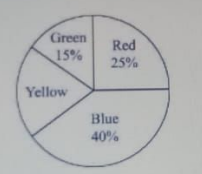
- A. 20
- B. 40
- C. 200
- D. 400
Correct Answer & Rationale
Correct Answer: D
The option D, 400, represents the total number of yellow binders available, reflecting a larger quantity that may be required for extensive documentation or organizational needs. Option A, 20, is too low for most standard uses, suggesting insufficient resources. Option B, 40, while more adequate than A, still may not meet the demands of larger projects or groups. Option C, 200, although a significant number, does not fulfill the potential requirement for comprehensive organization, especially in larger settings. Thus, option D ensures ample supply for diverse needs.
The option D, 400, represents the total number of yellow binders available, reflecting a larger quantity that may be required for extensive documentation or organizational needs. Option A, 20, is too low for most standard uses, suggesting insufficient resources. Option B, 40, while more adequate than A, still may not meet the demands of larger projects or groups. Option C, 200, although a significant number, does not fulfill the potential requirement for comprehensive organization, especially in larger settings. Thus, option D ensures ample supply for diverse needs.